deer
English
Etymology
From Middle English deere, dere, der, dier, deor (“small animal, deer”), from Old English dēor, dīor (“an animal, beast, any sort of wild animal, wild beast; deer, reindeer”), from Proto-Germanic *deuzą (“animal”), from Proto-Indo-European *dʰewsóm (“living thing”), from *dʰéws (“breath”), full-grade derivative of *dʰwés-. Cognate with Scots dere, deir (“deer”), North Frisian dier (“animal, beast”), West Frisian dier (“animal, beast”), Dutch dier (“animal, beast”), German Low German Deer, Deert (“animal”), German Tier (“animal, beast”), Swedish djur (“animal, beast”), Icelandic dýr (“animal, beast”). Related also to Albanian dash (“ram”), Lithuanian daũsos (“upper air; heaven”), Lithuanian dùsti (“to sigh”), Russian душа́ (dušá, “breath, spirit”), Lithuanian dvėsti (“to breath, exhale”), Sanskrit ध्वंसति (dhvaṃsati, “he falls to dust”). For semantic development compare Latin animālis (“animal”), from anima (“breath, spirit”).
Pronunciation
- (Received Pronunciation) IPA(key): /dɪə/
- (General American) IPA(key): /dɪɹ/
- (Scotland, some US) IPA(key): /diːɹ/
Audio (US) (file) - Rhymes: -ɪə(ɹ)
- Homophones: dear, dir
Noun
deer (plural deer or (nonstandard) deers)
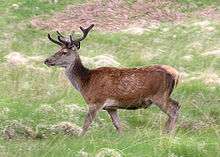
- A ruminant mammal with antlers and hooves of the family Cervidae, or one of several similar animals from related families of the order Artiodactyla.
- (in particular) One of the smaller animals of this family, distinguished from a moose or elk.
- I wrecked my car after a deer ran across the road.
- The meat of such an animal; venison.
- Oh, I've never had deer before.
- (obsolete, except in the phrase "small deer") An animal, especially a quadrupedal mammal, as opposed to a bird, fish, etc.
- 1606 : William Shakespeare, King Lear, Act III. IV
- But mice and rats and such small deer, have been Tom's food for seven long year.
- 1606 : William Shakespeare, King Lear, Act III. IV
Hyponyms
Derived terms
Translations
|
|
Anagrams
Dutch
Pronunciation
Audio (file) - Rhymes: -eːr
Verb
deer
Hunsrik
Alternative forms
- tëyer (Portuguese based orthography)
Pronunciation
- IPA(key): /ˈteːɐ/
Etymology 1
From Old High German ir. Compare Luxembourgish dir.
Pronoun
deer
- you (plural)
Inflection
| nominative | accusative | dative | ||||
|---|---|---|---|---|---|---|
| Proclitic | Enclitic | str. | unstr. | str. | unstr. | |
| 1st person singular | ich | -ich | mich | meer | mer | |
| 2nd person singular (informal) |
du | -du, -de | dich | deer | der | |
| 3rd person singular (m) | er, där | -er | ihn | en | ihm | em |
| 3rd person singular (f) | sie, die | -se | sie / ihns | se | eer | re |
| 3rd person singular (n) | es, das | 's | es | ihm | em | |
| 1st person plural | meer | mer | uns | uns | ||
| 2nd person plural | deer | der | eich | eich | ||
| 3rd person plural | sie, die | -se | sie | se | denne | |
Pronoun
deer
- stressed dative of du.
Inflection
| nominative | accusative | dative | ||||
|---|---|---|---|---|---|---|
| Proclitic | Enclitic | str. | unstr. | str. | unstr. | |
| 1st person singular | ich | -ich | mich | meer | mer | |
| 2nd person singular (informal) |
du | -du, -de | dich | deer | der | |
| 3rd person singular (m) | er, där | -er | ihn | en | ihm | em |
| 3rd person singular (f) | sie, die | -se | sie / ihns | se | eer | re |
| 3rd person singular (n) | es, das | 's | es | ihm | em | |
| 1st person plural | meer | mer | uns | uns | ||
| 2nd person plural | deer | der | eich | eich | ||
| 3rd person plural | sie, die | -se | sie | se | denne | |
Further reading
Limburgish
Etymology
From Middle Dutch dier, from Old Dutch *dior, from Proto-Germanic *deuzą.
Noun
deer n
Inflection
| Root singular | Root plural | Diminutive singular | Diminutive plural | |
|---|---|---|---|---|
| Nominative | deer | deer | deerke | deerkes |
| Genitive | deers | deer | deerkes | deerkes |
| Locative | daer | daer | daerke | daerkes |
| Dative* | daerem | daerer | ? | ? |
| Accusative* | deer | ? | deerke | deerkes |
- The dative and accusative are obsolete nowadays; use the nominative instead.
Saterland Frisian
Etymology
From Old Frisian dēr, thēr, from Proto-Germanic *þar. More at there.
Adverb
deer