個
See also: 个
| ||||||||
Translingual
| Stroke order | |||
|---|---|---|---|
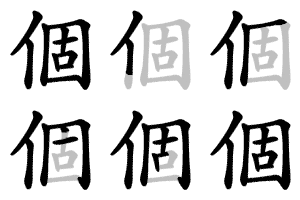 | |||
Han character
個 (radical 9, 人+8, 10 strokes, cangjie input 人田十口 (OWJR), four-corner 26200, composition ⿰亻固)
Derived characters
References
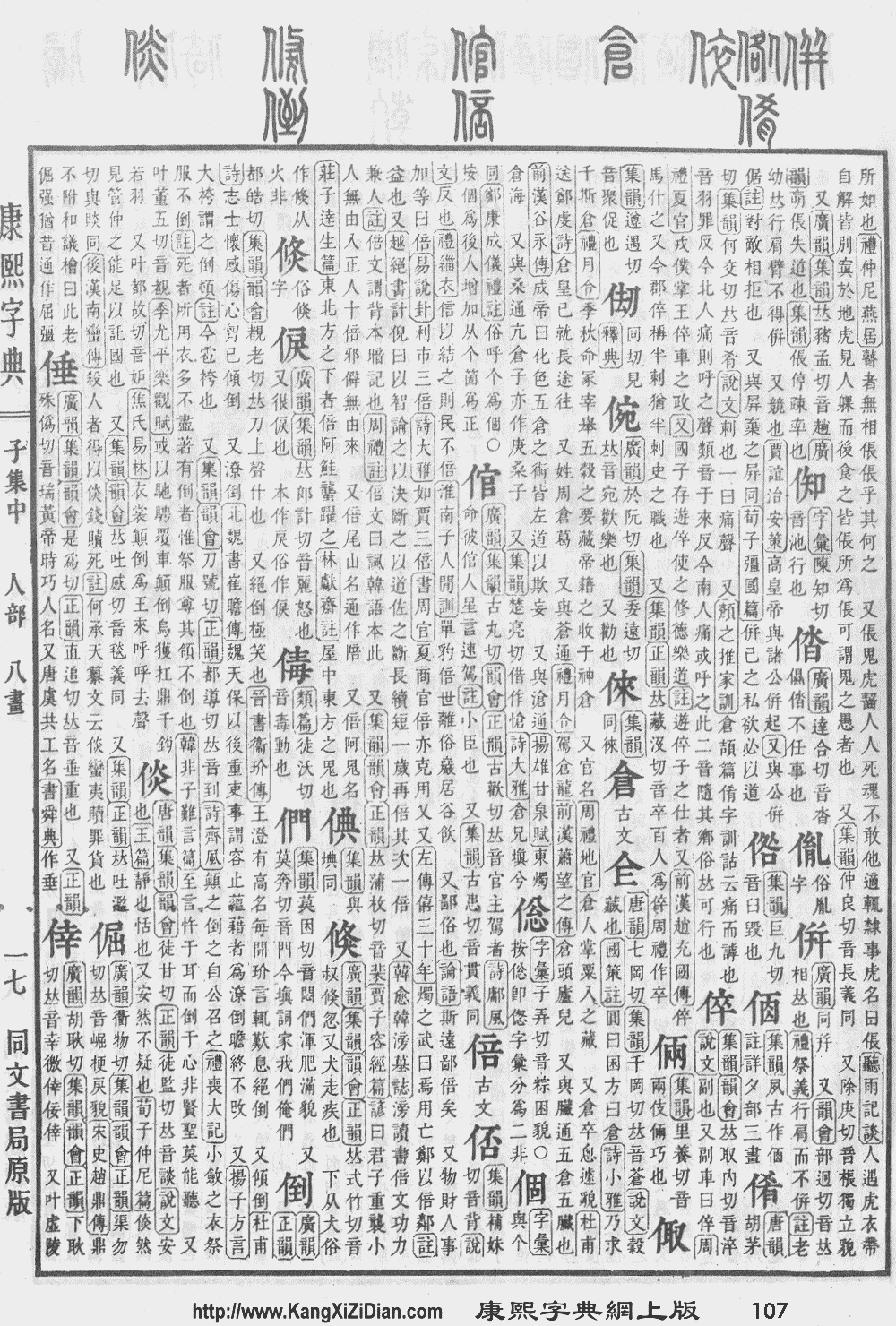
- KangXi: page 107, character 17
- Dai Kanwa Jiten: character 758
- Dae Jaweon: page 228, character 2
- Hanyu Da Zidian: volume 1, page 178, character 3
- Unihan data for U+500B
Chinese
| trad. | 個/箇 | |
|---|---|---|
| simp. | 个 | |
Glyph origin
| Characters in the same phonetic series (古) (Zhengzhang, 2003) | |
|---|---|
| Old Chinese | |
| 箇 | *kaːls |
| 個 | *kaːls |
| 居 | *kɯ, *kas |
| 橭 | *kaː, *kʰaː |
| 嫴 | *kaː |
| 姑 | *kaː |
| 辜 | *kaː |
| 酤 | *kaː, *kaːs, *ɡaːʔ |
| 蛄 | *kaː |
| 鴣 | *kaː |
| 沽 | *kaː, *kaːʔ, *kaːs |
| 盬 | *kaː, *kaːʔ |
| 古 | *kaːʔ |
| 罟 | *kaːʔ |
| 估 | *kaːʔ |
| 鈷 | *kaːʔ |
| 詁 | *kaːʔ |
| 牯 | *kaːʔ |
| 故 | *kaːs |
| 固 | *kaːs |
| 稒 | *kaːɡs |
| 痼 | *kaːɡs |
| 錮 | *kaːɡs |
| 鯝 | *kaːɡs |
| 棝 | *kaːɡs |
| 凅 | *kaːɡs |
| 枯 | *kʰaː |
| 軲 | *kʰaː |
| 跍 | *kʰaː |
| 骷 | *kʰaː |
| 苦 | *kʰaːʔ, *kʰaːs |
| 葫 | *qʰaː, *ɡaː |
| 餬 | *ɡaː |
| 瑚 | *ɡaː |
| 湖 | *ɡaː |
| 鶘 | *ɡaː |
| 猢 | *ɡaː |
| 醐 | *ɡaː |
| 糊 | *ɡaː |
| 箶 | *ɡaː |
| 蝴 | *ɡaː |
| 胡 | *ɡaː |
| 瓳 | *ɡaː |
| 怙 | *ɡaːʔ |
| 祜 | *ɡaːʔ |
| 岵 | *ɡaːʔ |
| 婟 | *ɡaːʔ, *ɡaːɡs |
| 楛 | *ɡaːʔ |
| 据 | *ka |
| 裾 | *ka |
| 琚 | *ka |
| 椐 | *ka, *kas, *kʰa |
| 鶋 | *ka |
| 蜛 | *ka |
| 崌 | *ka |
| 涺 | *ka |
| 腒 | *ka, *ɡa |
| 鋸 | *kas |
| 倨 | *kas |
| 踞 | *kas |
| 涸 | *ɡaːɡ |
Phono-semantic compound (形聲, OC *kaːls) : semantic 亻 (“person”) + phonetic 固 (OC *kaːs).
Etymology
The semantics may have developed along the grammaticalisation process "bamboo stalk" (箇) > "piece, item" > "classifier for every category of noun" > "possessive particle, generic particle". If so, it would then possibly be cognate with 竿 (OC *kaːn, “bamboo, rod”). Compare Tibetan མཁར་བ (mkhar ba), འཁར་བ ('khar ba, “walking stick, staff”) and Thai ก้าน (gâan, “stem, stalk”).
Pronunciation
Definitions
個
- piece; item; individual
- size; height
- separate; respective; separately; individually
- single; alone
- (dialectal) one
- The generic classifier for people or for things lacking specific classifiers.
- Classifier for hours and months.
- Alternative classifier, for nouns having specific classifiers. Often colloquial and regional. Usage varies greatly between different topolects.
- (Cantonese) Classifier for yuan, dollars, etc., used when followed by cents.
- (Mandarin, colloquial) Particle, placed between a verb and numbers, showing that the following numbers are approximate, not accurate.
- (Mandarin, Cantonese, colloquial) Particle, placed between a verb and its object or complement, adding a sense of ease, swiftness and one-offness to the action.
- (Mandarin, colloquial) Particle used after 些 (xiē).
- (dialectal Mandarin) Particle used in some time-related words.
- (obsolete, Wu, Xiang, Gan, dialectal Cantonese, dialectal Min) (= 搿) this; that
- (Cantonese, Wu) Word-initial particle, serving as the definite article.
- (Cantonese, Wu, Teochew) Possessive particle. Equivalent to Mandarin 的 (de).
- (dialectal) Sentence-final declarative, affirmative, or prohibitive particle. Equivalent to Mandarin 的 (de), 了 (le).
- (often dialectal) Emphatic particle between a pronoun and a noun, usually to highlight some negative quality of the person.
Synonyms
| Dialectal synonyms of 個 (“classifier for people”) [map] | ||
|---|---|---|
| Variety | Location | Words |
| Formal (Written Standard Chinese) | 個 | |
| Mandarin | Beijing | 個 |
| Taiwan | 個 | |
| Jinan | 個 | |
| Xi'an | 個 | |
| Wuhan | 個 | |
| Chengdu | 個 | |
| Yangzhou | 個 | |
| Hefei | 個 | |
| Cantonese | Guangzhou | 個 |
| Hong Kong | 個 | |
| Taishan | 個 | |
| Yangjiang | 個 | |
| Gan | Nanchang | 個、隻 |
| Hakka | Meixian | 隻 |
| Jin | Taiyuan | 個 |
| Min Bei | Jian'ou | 隻 |
| Min Dong | Fuzhou | 個、隻 |
| Min Nan | Xiamen | 個 |
| Chaozhou | 個 | |
| Haikou | 個、枚 | |
| Wu | Shanghai | 個 |
| Suzhou | 個 | |
| Wenzhou | 個 | |
| Xiang | Changsha | 個、隻 |
| Shuangfeng | 個 | |
Compounds
Derived terms from 個
|
|
|
Descendants
Others:
- Vietnamese: cái
Japanese
Kanji
個
Readings
Counter
- item, article, thing
- あの枝に桜ん坊が十二個だけあります。
- Ano eda ni sakuranbo ga jūni-ko dake arimasu.
- There are only twelve cherries on that branch.
- あの枝に桜ん坊が十二個だけあります。
Usage notes
This is the most generic counter in Japanese. It can be used to count just about anything.
Korean
Hanja
個 • (gae) (hangeul 개, McCune–Reischauer kae)
- a piece
- a unit
- an item.
Vietnamese
Han character
- generic classifier
References
This article is issued from
Wiktionary.
The text is licensed under Creative Commons - Attribution - Sharealike.
Additional terms may apply for the media files.