好
| ||||||||
Translingual
| Stroke order | |||
|---|---|---|---|
 | |||
| Stroke order | |||
|---|---|---|---|
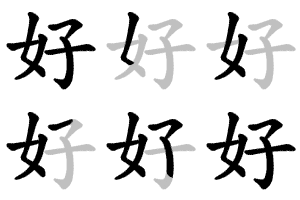 | |||
Han character
好 (radical 38, 女+3, 6 strokes, cangjie input 女弓木 (VND), four-corner 47447, composition ⿰女子)
Derived characters
References
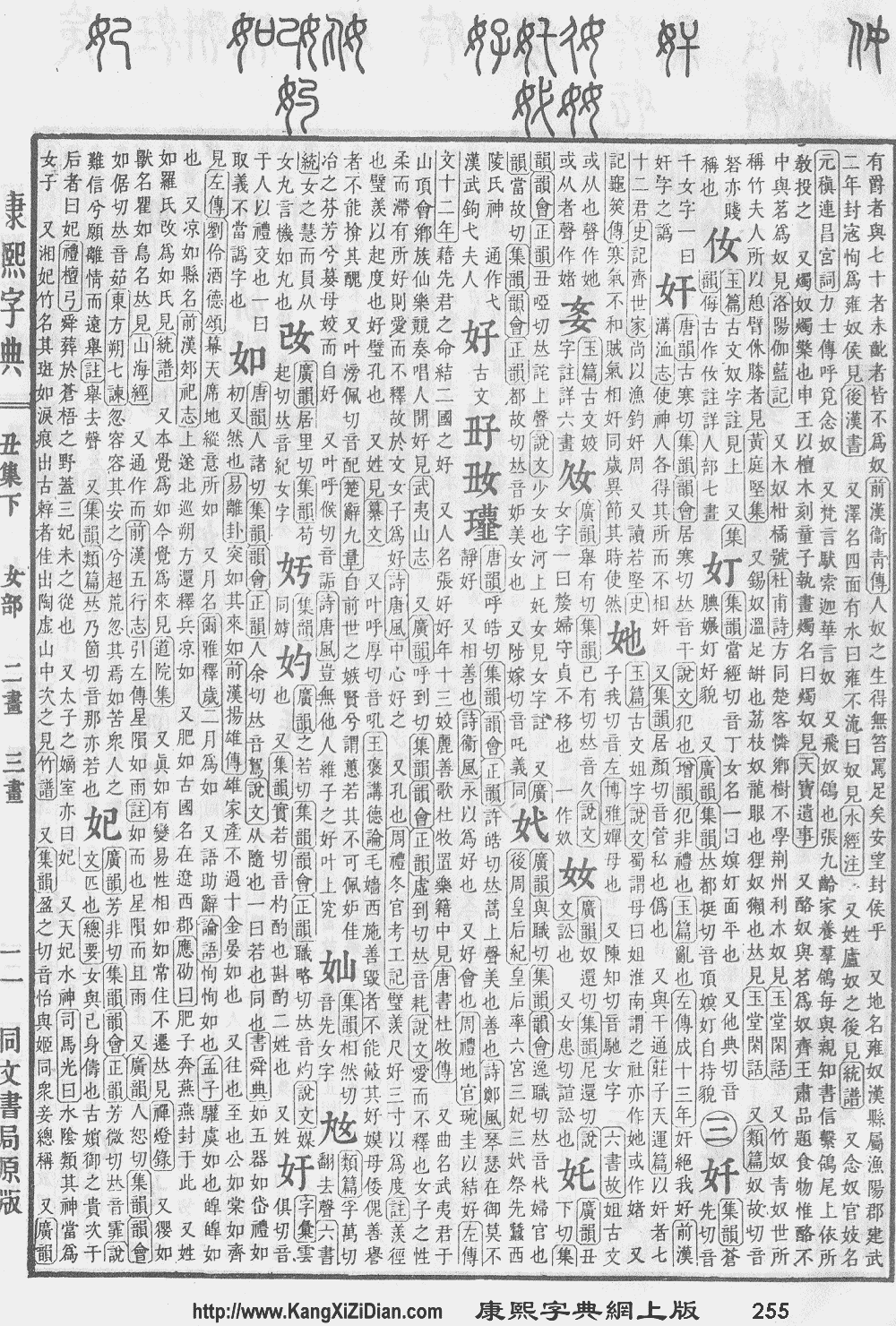
- KangXi: page 255, character 11
- Dai Kanwa Jiten: character 6053
- Dae Jaweon: page 518, character 12
- Hanyu Da Zidian: volume 2, page 1028, character 1
- Unihan data for U+597D
Chinese
| simp. and trad. |
好 | |
|---|---|---|
| alt. forms | 𡥃 | |
Glyph origin
| Historical forms of the character 好 | |||
|---|---|---|---|
| Shang | Western Zhou | Shuowen Jiezi (compiled in Han) | Liushutong (compiled in Ming) |
| Oracle bone script | Bronze inscriptions | Small seal script | Transcribed ancient scripts |
 |
 |
 |
 |
| Characters in the same phonetic series (好) (Zhengzhang, 2003) | |
|---|---|
| Old Chinese | |
| 薅 | *qʰuː |
| 好 | *qʰuːʔ, *qʰuːs |
Ideogrammic compound (會意) : 女 (“woman”) + 子 (“child”).
The widely accepted meaning of this character is that the characters for "female" (女) and "child" (子) were put together to form a compound because it was good for a woman to have a child. Similarly, it has been proposed that the compound originally refers to the mutual affection between the mother and child, which then extended to mean "good". These theories are supported by the smaller 子 found in some oracle bones and bronze inscriptions.
However, broader interpretations of the second character 子 could lead to other theories. 子 could also mean "son", so it may have meant two children, a boy and a girl next to each other, which is a good fortune to have a boy and a girl. 子 could also mean "man", so it may have referred to the love between a man and a woman, which is good. Duan Yucai, in his annotated version of Shuowen, interpreted it as originally referring to the beauty of 女子 (nǚzǐ, “woman”). Lastly, it could mean that the "attitude" of a girl was considered good.
Etymology
The two pronunciations are cognate – pronunciation 2 is the *-s suffixed form, or exoactive/putative of pronunciation 1, literally "to consider good". Compare 惡 (OC *qaːɡ, “bad; evil”) > 惡 (OC *qaːɡs, “to consider bad; to hate”).
This word has been compared with Proto-Sino-Tibetan *hu (“to raise; to rear; to nourish”): Proto-Lolo-Burmese *hu3, Abor-Miri u, Qiang (Mawo) χu, which is only attested in a limited number of languages. If this is correct, it may be related to 畜 (OC *l̥ʰuɡs, *l̥ʰuɡ, *hluɡ, “to raise; to rear; domesticated animal”). Alternatively, compare Tibetan མཁོ (mkho, “necessary, important”).
Cognate with Central Bai hux (“good”), which may be a loanword from Chinese.
Pronunciation 1
Definitions
好
- good; well
- Used as an interjection
- nice; kind
- friendly; close; acquainted
- done; ready
- to be good to, easy to
- (making it) convenient, easy for
- so that
- to recover from an illness
- (somewhat dialectal) very; quite; rather; so
- a pleasure to VERB
- properly; carefully
- Particle used after verbs to denote the completion or near-completion of an action.
- Particle denoting agreement, support or wish to terminate a conversation.
- Particle denoting dissatisfaction in ironical sentences.
Synonyms
- (very):
| Dialectal synonyms of 很 (“very; quite”) [map] | ||
|---|---|---|
| Variety | Location | Words |
| Classical Chinese | 甚 | |
| Formal (Written Standard Chinese) | 非常、很、十分、太 | |
| Mandarin | Beijing | 挺、很、倍兒 |
| Taiwan | 很、挺 | |
| Tianjin | 挺、很 | |
| Jinan | 挺、楞 | |
| Xi'an | 很 | |
| Wuhan | 蠻、很 | |
| Chengdu | 很、好 | |
| Yangzhou | 蠻、稀、很 | |
| Hefei | 很 | |
| Cantonese | Guangzhou | 好 |
| Hong Kong | 好 | |
| Taishan | 好 | |
| Yangjiang | 好 | |
| Gan | Nanchang | 蠻 |
| Hakka | Meixian | 好 |
| Miaoli (N. Sixian) | 當、已、還 | |
| Liudui (S. Sixian) | 蓋、盡、還 | |
| Hsinchu (Hailu) | 當、已、還 | |
| Dongshi (Dabu) | 當、已、還 | |
| Zhuolan (Raoping) | 當、已、還 | |
| Yunlin (Zhao'an) | 足、真、實在 | |
| Jin | Taiyuan | 很、挺 |
| Min Bei | Jian'ou | 真 |
| Min Dong | Fuzhou | 野、真 |
| Min Nan | Xiamen | 真、野、誠、有夠 |
| Quanzhou | 真、野、誠、有夠 | |
| Zhangzhou | 盡、蓋、足、足範、有夠 | |
| Taipei | 真、誠 | |
| Kaohsiung | 有夠、足、真、誠、蓋 | |
| Tainan | 有夠、足、真、誠、蓋 | |
| Taichung | 誠、蓋、足 | |
| Hsinchu | 真、誠 | |
| Lukang | 真、誠 | |
| Sanxia | 真、誠 | |
| Yilan | 有夠、足、誠、盡 | |
| Kinmen | 足、誠 | |
| Magong | 真、誠 | |
| Penang | 真、誠、真正 | |
| Chaozhou | 過 | |
| Wu | Shanghai | 蠻、老 |
| Suzhou | 蠻 | |
| Wenzhou | 蠻、蒙、顯 | |
| Xiang | Changsha | 很、蠻 |
| Shuangfeng | 蠻 | |
Compounds
|
|
|
Descendants
Others:
- Vietnamese: hẩu (“kind, good, delicious”)
Pronunciation 2
Definitions
好
- to be fond of; to like
- to have a tendency to; to be prone to; good to; easy to
- (dialectal Mandarin, Wu) can; to be able to
Synonyms
| Dialectal synonyms of 喜歡 (“to like”) [map] | ||
|---|---|---|
| Variety | Location | Words |
| Classical Chinese | 喜好、愛好 | |
| Formal (Written Standard Chinese) | 喜愛、喜好、愛好 | |
| Mandarin | Beijing | 喜歡、好希、愛 |
| Taiwan | 喜歡、愛 | |
| Jinan | 喜歡 | |
| Xi'an | 喜歡、愛 | |
| Wuhan | 喜歡、愛 | |
| Chengdu | 喜歡、歡喜、愛 | |
| Yangzhou | 歡喜 | |
| Hefei | 喜歡 | |
| Cantonese | Guangzhou | 中意、歡喜 |
| Hong Kong | 中意 | |
| Taishan | 中意 | |
| Yangjiang | 中意、歡喜 | |
| Gan | Nanchang | 歡喜 |
| Hakka | Meixian | 中意、好 |
| Miaoli (N. Sixian) | 中意、好 | |
| Liudui (S. Sixian) | 中意、好 | |
| Hsinchu (Hailu) | 中意、好 | |
| Dongshi (Dabu) | 中意、合意、好 | |
| Zhuolan (Raoping) | 中意、好 | |
| Yunlin (Zhao'an) | 佮意、愛 | |
| Jin | Taiyuan | 喜歡、待見 |
| Min Bei | Jian'ou | 愛、喜歡 |
| Min Dong | Fuzhou | 歡喜、愛 |
| Min Nan | Xiamen | 歡喜、意愛、愛、佮意、舒合 |
| Quanzhou | 歡喜、意愛、愛、佮意 | |
| Zhangzhou | 歡喜、愛、佮意 | |
| Taipei | 歡喜、意愛、愛、佮意 | |
| Penang | 舒合、愛 | |
| Philippines (Manila) | 愛、佮意 | |
| Chaozhou | 歡喜、愛 | |
| Wu | Shanghai | 歡喜 |
| Suzhou | 歡喜 | |
| Wenzhou | 喜歡 | |
| Xiang | Changsha | 喜歡 |
| Shuangfeng | 喜歡 | |
Compounds
|
|
|
Descendants
References
Japanese
Kanji
- fondness; what one likes
Readings
Compounds
Proper noun
好 (hiragana よしみ, rōmaji Yoshimi)
- A male given name
Korean
Hanja
好 • (ho) (hangeul 호, revised ho, McCune–Reischauer ho)
- to like
Vietnamese
Han character
好 (háo, háu, hảo, hão, hếu, hiếu, hấu, hẩu)
- This term needs a translation to English. Please help out and add a translation, then remove the text
{{rfdef}}.