你
| ||||||||
| ||||||||
Translingual
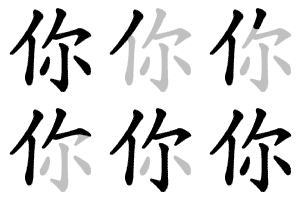
| Stroke order | |||
|---|---|---|---|
 | |||
| Stroke order | |||
|---|---|---|---|
 | |||
Han character
你 (radical 9, 人+5, 7 strokes, cangjie input 人弓火 (ONF), four-corner 27290 or 27292, composition ⿰亻尔)
Derived characters
- 𪡇, 您
References
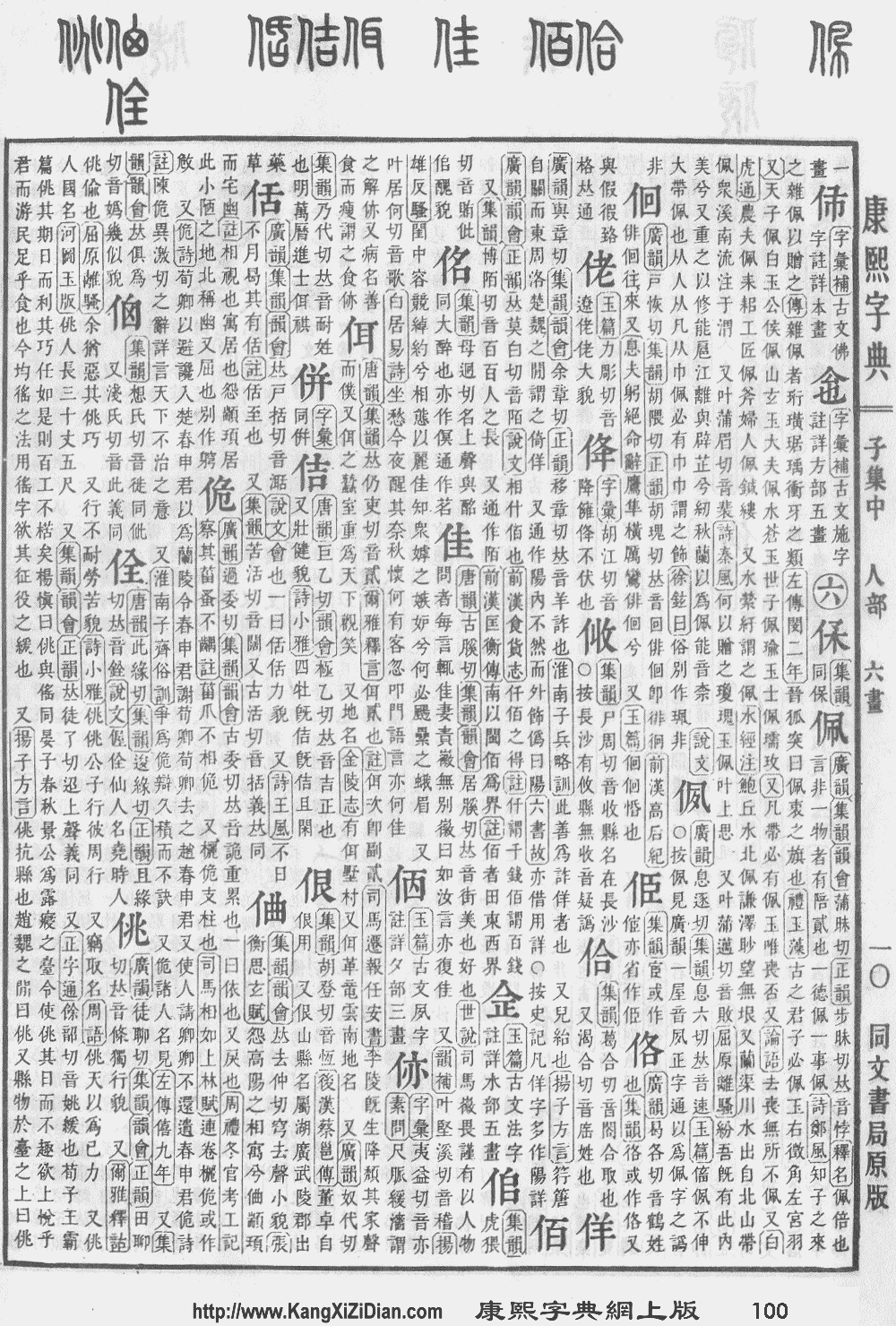
- KangXi: not present, would follow page 100, character 2
- Dai Kanwa Jiten: character 471
- Dae Jaweon: page 205, character 4
- Hanyu Da Zidian: volume 1, page 137, character 5
- Unihan data for U+4F60
Chinese
| simp. and trad. |
你 | |
|---|---|---|
| alt. forms | ||
Glyph origin
| Historical forms of the character 你 | ||||
|---|---|---|---|---|
| ||||
|
References: Mostly from Richard Sears' Chinese Etymology site (authorisation),
|


| Characters in the same phonetic series (尔) (Zhengzhang, 2003) | |
|---|---|
| Old Chinese | |
| 妳 | *rneːlʔ |
| 弥 | *mnel |
| 尒 | *njelʔ |
| 尔 | *njelʔ |
| 迩 | *njelʔ |
| 你 | *nɯʔ |
| 苶 | *neːb, *njed, *neːd |
Phono-semantic compound (形聲, OC *nɯʔ) : semantic 亻 (“person”) + phonetic 尔 (OC *njelʔ).
Etymology
Ultimately from Proto-Sino-Tibetan *na-ŋ (“you”).
Pronunciation
Definitions
你
- (informal) you (the person spoken to or written to)
Synonyms
| Dialectal synonyms of 你 (“you (singular)”) [map] | ||
|---|---|---|
| Variety | Location | Words |
| Classical Chinese | 汝、爾 | |
| Formal (Written Standard Chinese) | 你 | |
| Mandarin | Beijing | 你、您 |
| Jinan | 你 | |
| Xi'an | 你 | |
| Wuhan | 你、你家 | |
| Chengdu | 你 | |
| Yangzhou | 你 | |
| Hefei | 你 | |
| Cantonese | Guangzhou | 你 |
| Hong Kong | 你 | |
| Taishan | 你 | |
| Yangjiang | 你 | |
| Gan | Nanchang | 你 |
| Hakka | Meixian | 你 |
| Miaoli (N. Sixian) | 你 | |
| Liudui (S. Sixian) | 你 | |
| Hsinchu (Hailu) | 你 | |
| Dongshi (Dabu) | 你 | |
| Zhuolan (Raoping) | 你 | |
| Yunlin (Zhao'an) | 你 | |
| Jin | Taiyuan | 你 |
| Min Bei | Jian'ou | 你 |
| Min Dong | Fuzhou | 汝 |
| Matsu | 汝 | |
| Min Nan | Xiamen | 汝 |
| Quanzhou | 汝 | |
| Zhangzhou | 汝 | |
| Taipei | 汝 | |
| Kaohsiung | 汝 | |
| Tainan | 汝 | |
| Taichung | 汝 | |
| Hsinchu | 汝 | |
| Lukang | 汝 | |
| Sanxia | 汝 | |
| Yilan | 汝 | |
| Kinmen | 汝 | |
| Magong | 汝 | |
| Penang | 汝 | |
| Singapore | 汝 | |
| Philippines (Manila) | 汝 | |
| Chaozhou | 汝 | |
| Shantou | 汝 | |
| Wu | Shanghai | 儂 |
| Suzhou | 倷 | |
| Wenzhou | 你 | |
| Ningbo | 儂、爾、爾儂、像儂、像爾 | |
| Xiang | Changsha | 你 |
| Shuangfeng | 你 | |
Compounds
See also
| Standard Chinese personal pronouns | |||
|---|---|---|---|
| Person | Singular | Plural | |
| 1st | — | 我 (wǒ) | 我們/我们 (wǒmen) |
| inclusive | 咱們/咱们 (zánmen) | ||
| 2nd | male/indefinite | 你 | 你們/你们 (nǐmen) |
| female | 妳/你 (nǐ) | 妳們/你们 (nǐmen) | |
| deity | 祢 (nǐ) | 祢們/祢们 (nǐmen) | |
| polite | 您 (nín) | 你們/你们 (nǐmen) 您們/您们 (nínmen) | |
| 3rd | male/indefinite | 他 (tā) | 他們/他们 (tāmen) |
| female | 她 (tā) | 她們/她们 (tāmen) | |
| deity | 祂 (tā) | 祂們/祂们 (tāmen) | |
| animal | 牠/它 (tā) | 牠們/它们 (tāmen) | |
| inanimate | 它 (tā) | 它們/它们 (tāmen) | |
Japanese
Kanji
你
Readings
Usage notes
This character is not used in modern Japanese. It may appear as a 略字 (ryakuji, “abbreviated character”) for 爾, itself only used in historical texts and not used in modern Japanese.
Korean
Hanja
你 • (ni) (hangeul 니, revised ni, McCune–Reischauer ni)
- This term needs a translation to English. Please help out and add a translation, then remove the text
{{rfdef}}.
Vietnamese
Han character
- This term needs a translation to English. Please help out and add a translation, then remove the text
{{rfdef}}.
References
This article is issued from
Wiktionary.
The text is licensed under Creative Commons - Attribution - Sharealike.
Additional terms may apply for the media files.