月
| ||||||||
 | ||||||||
Translingual
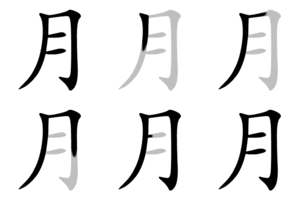
| Stroke order | |||
|---|---|---|---|
 | |||
Han character
月 (radical 74, 月+0, 4 strokes, cangjie input 月 (B), four-corner 77220, composition ⿵冂二)
- Kangxi radical #74, ⽉.
Usage notes
Do not confuse 月 with ⺼, a form of 肉 (“flesh, meat”) when used as the left-hand radical of a character. ⺼ is used for parts of the body such as 背 (“back”) or 肝 (“liver”). These may be written identically as 月, but in careful use they are distinguished, with the inside of ⺼ being written with unattached diagonal strokes. This is particularly an issue in looking up characters by radical; compare the 月 index and 肉 index.
Derived characters
- Index:Chinese radical/月
References
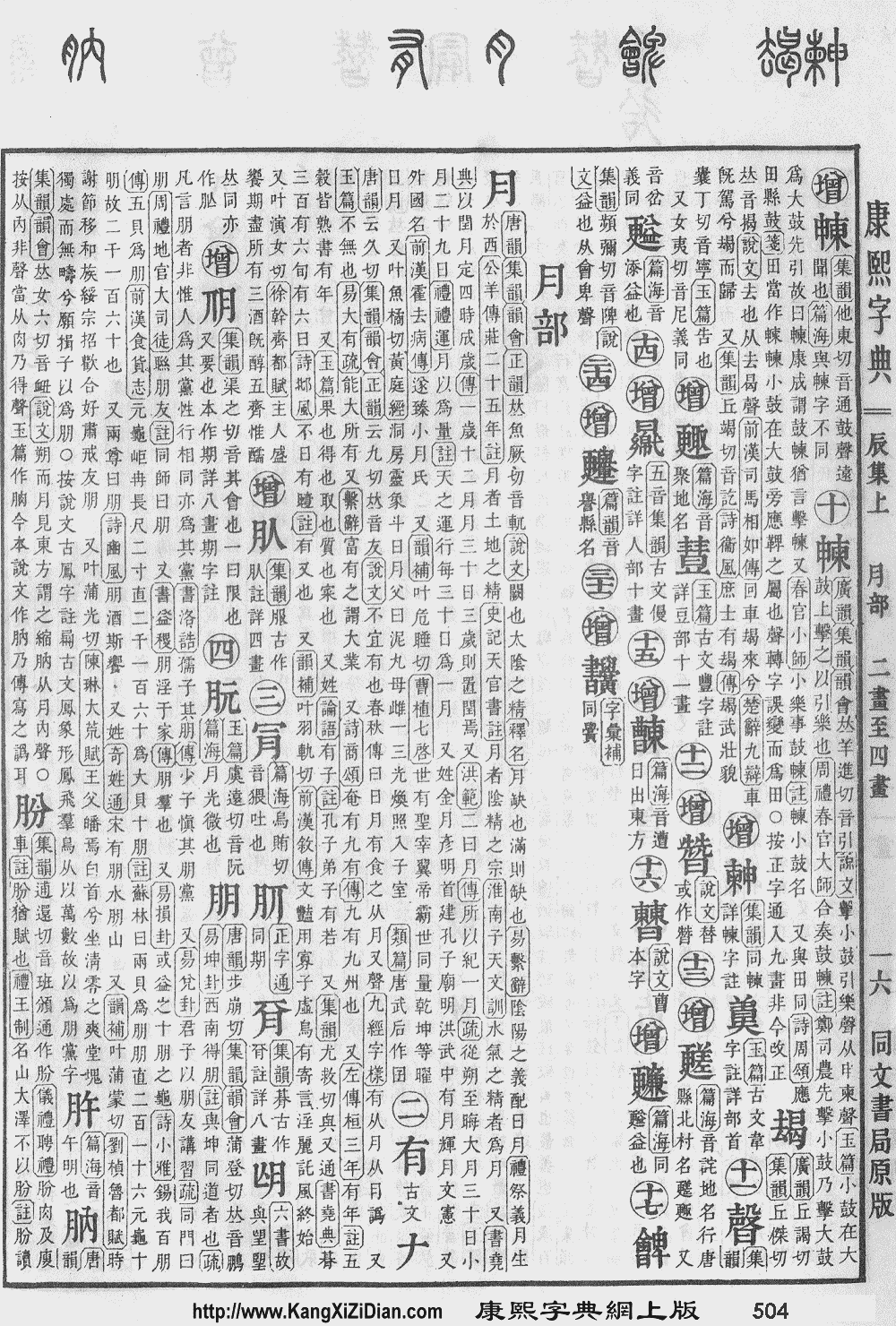
- KangXi: page 504, character 19
- Dai Kanwa Jiten: character 14330
- Dae Jaweon: page 879, character 20
- Hanyu Da Zidian: volume 3, page 2041, character 1
- Unihan data for U+6708
Chinese
| simp. and trad. |
月 | |
|---|---|---|
Glyph origin
| Historical forms of the character 月 | ||||
|---|---|---|---|---|
| Shang | Western Zhou | Warring States | Shuowen Jiezi (compiled in Han) | Liushutong (compiled in Ming) |
| Oracle bone script | Bronze inscriptions | Chu Slip and silk script | Small seal script | Transcribed ancient scripts |
 |
 |
 |
 |
 |
| Characters in the same phonetic series (月) (Zhengzhang, 2003) | |
|---|---|
| Old Chinese | |
| 刖 | *ŋroːd, *ŋod, *ŋuːd |
| 枂 | *ŋoːd, *ŋod |
| 月 | *ŋod |
| 跀 | *ŋod |
| 抈 | *ŋod |
| 鈅 | *ŋod |
| 玥 | *ŋod |
| 蚏 | *ɢod |
Pictogram (象形) – pictographic representation of a crescent moon.
Etymology 1
Unknown. Unger (1992) proposes as cognates Tibetan ངོ (ngo, “waxing and waning moon; half moon”) (e.g. མར་ངོ (mar ngo, “waning moon”) and ཡར་ངོ (yar ngo, “waxing moon”)). Also compare Proto-Sino-Tibetan *s-ŋow (“white; light colour”).
Matisoff sets up Proto-Sino-Tibetan *s-ŋʷ(j)a-t (“moon; star”) for this, whence also Magar [script needed] (gya hot, “moon”).
Thai งวด (ngûuat, “occasion; time; period”) may be a Chinese loan (Manomaivibool, 1975).
Pronunciation
Definitions
月
Synonyms
- (moon):
- (month): 月份 (yuèfèn)
Compounds
|
|
|
See also
Etymology 2
| For pronunciation and definitions of 月 – see 肉 (“meat; flesh; body; etc.”). (This character, 月, is a variant form of 肉.) |
Japanese
Kanji
- moon
- a month (on the lunar calendar)
- menstruation
- abbreviation for 月曜日 (Monday)
Readings
Compounds
- 月下氷人 (gekkahyōjin): matchmaker
- 月影 (tsukikage): moonlight
- 月額 (getsugaku): monthly amount
- 月刊 (gekkan): monthly publication
- 月極 (tsukigime): monthly
- 月経 (gekkei): menstruation
- 月桂樹 (gekkeiju): laurel tree
- 月光 (gekkō): moonlight
- 月食 (gesshoku), 月蝕 (gesshoku): lunar eclipse
- 月次 (getsuji): monthly
- 月桃 (gettō): shell ginger
- 月賦 (geppu): monthly payment, monthly installment
- 月曜日 (getsuyōbi): Monday
- 月例 (getsurei): monthly
- 月齢 (getsurei): the number of days of the moon
- 月代 (tsukishiro): lunar era
- 月並み (tsukinami): mediocrity
- 月餅 (geppei): a moon cake, a type of Chinese confectionery
- 月末 (getsumatsu): the end of the month
- 月日 (gappi): the date
- 月旦 (gettan): the first day of the month
- 有明の月 (ariake no tsuki): the moon when it is still visible after the sun has risen
- 日進月歩 (nisshingeppo): rapid advance
- 日月 (jitsugetsu): sun and moon
- 毎月 (maitsuki): every month
- 雨月 (ugetsu): the fifth lunar month
- 新月 (shingetsu): new moon
- 月形 (tsukigata): a crescent moon
- 三日月 (mikazuki): crescent moon
- 半月 (hantsuki), 半月 (hangetsu): half moon
- 半月 (haniwari): a hermaphrodite
- 満月 (mangetsu): full moon
- 無月 (mugetsu): moonless sky
- 月夜 (getsuya), 月夜 (tsukiyo), 月夜 (tsukuyo): a moonlit night; moonlight
- 月読 (Tsukuyomi), 月読 (Tsukiyomi), 月夜見 (Tsukuyomi), 月夜見 (Tsukiyomi): the Japanese god of the moon
See also
Etymology 1
| Kanji in this term |
|---|
| 月 |
| つく Grade: 1 |
| kun’yomi |
From Old Japanese. Only found in older compounds. Appears to be the older form.
Pronunciation
Noun
- the moon
Usage notes
Not productive in modern Japanese. Not found in isolation.
Derived terms
Etymology 2
| Kanji in this term |
|---|
| 月 |
| つき Grade: 1 |
| kun’yomi |
/tuki2/ invalid IPA characters (2) → */tukwi/ → */t͡sukwi/ → /t͡suki/
From Old Japanese. Likely a shift from tsuku above, derived through a fusion with ancient Japanese emphatic nominal particle い (i). Compare the development of 神 (kami) from older combining form kamu.
Pronunciation
Noun
- the moon
- the lunar cycle, a month
- 月に一度、旅行に出かけます。
- Tsuki ni ichido, ryokō ni dekakemasu.
- I go for a trip once a month.
- 月に一度、旅行に出かけます。
- (tarot): the Moon, the eighteenth trump or major arcana card in most traditional Tarot decks
Synonyms
Derived terms
Etymology 3
| Kanji in this term |
|---|
| 月 |
| がつ Grade: 1 |
| on’yomi |
/ɡwatu/ → /ɡat͡su/
From Middle Chinese 月 (MC ŋʉɐt̚).
Pronunciation
Suffix
月 (hiragana がつ, rōmaji -gatsu, historical hiragana ぐわつ)
Usage notes
When used in most compounds or when counting a number of months with ヶ (ka), 月 is pronounced げつ (getsu). When used in compounds for modern months of the year, it is pronounced がつ (gatsu). When used for poetic or lunar months, it is pronounced つき (tsuki).
Etymology 4
| Kanji in this term |
|---|
| 月 |
| げつ Grade: 1 |
| on’yomi |
/ɡwetu/ → /ɡet͡su/
From Middle Chinese 月 (MC ŋʉɐt̚). The kan'on, so likely a later borrowing. Compare modern Hakka reading ngie̍t, Min Nan ge̍h.
Pronunciation
Counter
月 (hiragana げつ, rōmaji -getsu)
Noun
月 (hiragana げつ, rōmaji getsu, historical hiragana ぐゑつ)
- a month
Usage notes
When used in most compounds or when counting a number of months with ヶ (ka), 月 is pronounced げつ (getsu). When used in compounds for modern months of the year, it is pronounced がつ (gatsu). When used for poetic or lunar months, it is pronounced つき (tsuki).
References
|
- Source: EDICT and KANJIDIC files licensed by the Electronic Dictionaries Research Group.
Korean
Hanja
Vietnamese
Han character
月 (nguyệt)
- This term needs a translation to English. Please help out and add a translation, then remove the text
{{rfdef}}.