是
| ||||||||
Translingual
| Stroke order | |||
|---|---|---|---|
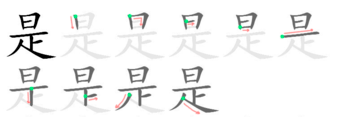 | |||
| Stroke order | |||
|---|---|---|---|
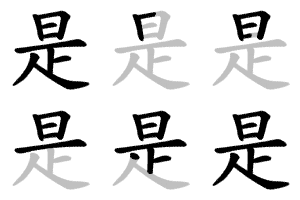 | |||
Han character
是 (radical 72, 日+5, 9 strokes, cangjie input 日一卜人 (AMYO), four-corner 60801, composition ⿱日𤴓)
Derived characters
References
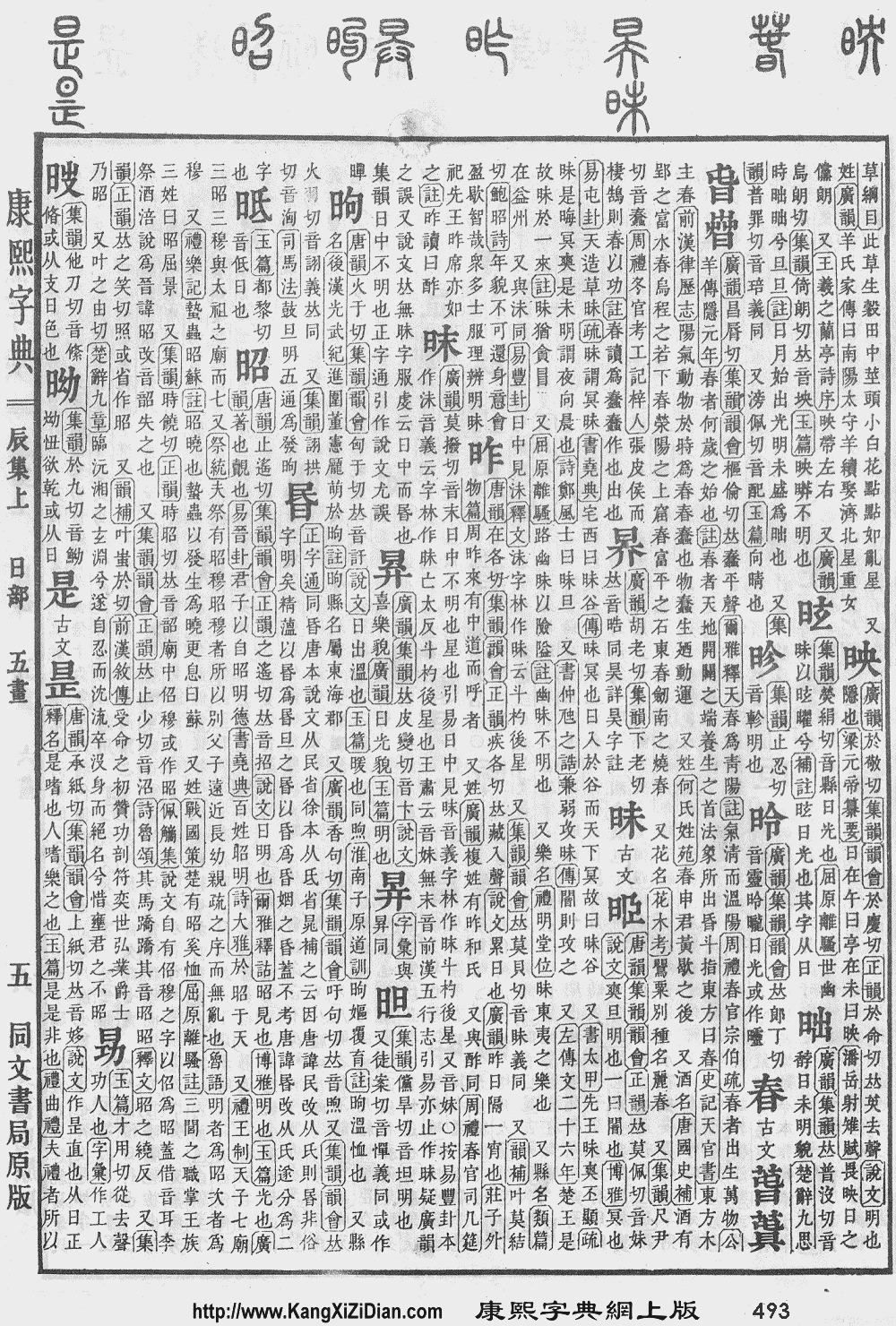
- KangXi: page 493, character 26
- Dai Kanwa Jiten: character 13859
- Dae Jaweon: page 858, character 6
- Hanyu Da Zidian: volume 2, page 1497, character 5
- Unihan data for U+662F
Chinese
| simp. and trad. |
是 | |
|---|---|---|
| alt. forms | 昰 | |
Glyph origin
| Historical forms of the character 是 | |||||||
|---|---|---|---|---|---|---|---|
| Western Zhou | Spring and Autumn | Warring States | Shuowen Jiezi (compiled in Han) | Liushutong (compiled in Ming) | |||
| Bronze inscriptions | Bronze inscriptions | Bronze inscriptions | Chu Slip and silk script | Qin slip script | Shizhoupian script | Small seal script | Transcribed ancient scripts |
 |
 |
 |
 |
 |
 |
 |
 |
| Characters in the same phonetic series (是) (Zhengzhang, 2003) | |
|---|---|
| Old Chinese | |
| 鞮 | *teː |
| 隄 | *teː, *deː |
| 堤 | *teː, *teːʔ, *dje |
| 鍉 | *teː |
| 蝭 | *teːs, *deː |
| 醍 | *tʰeːʔ, *deː |
| 緹 | *tʰeːʔ, *deː |
| 提 | *deː, *dje |
| 瑅 | *deː |
| 題 | *deː, *deːs |
| 媞 | *deː, *deːʔ, *djeʔ |
| 褆 | *deː, *deʔ, *djeʔ |
| 禔 | *deː, *tje, *dje |
| 騠 | *deː |
| 趧 | *deː |
| 鯷 | *deː, *deːs, *djes |
| 踶 | *deːs, *deʔ |
| 徥 | *deʔ, *djeʔ |
| 匙 | *dje |
| 是 | *djeʔ |
| 諟 | *djeʔ |
| 翨 | *hljes, *kles |
| 睼 | *tʰeːns |
| 寔 | *djɯɡ |
| 湜 | *dɯɡ |
| 遈 | *djɯɡ |
Originally a phono-semantic compound (形聲, OC *djeʔ) : semantic 早 + phonetic 止 (OC *kjɯʔ), but the original meaning is unclear. It has been suggested that 早 looks like a spoon, so 是 may have been the original character for 匙 (OC *dje, “spoon”). As early as in late bronze inscriptions, the lower part of 早 split off and combined with 止 to give 昰, which carried over to the small seal script, and Shuowen considers this a compound of 日 (“sun”) + 正 (“upright; right”) (i.e. as the upright sun).
Etymology
“This [an independent pronoun] > be right, correct, to be, so”. From Proto-Sino-Tibetan *m-daj ~ m-di (“that; this”). Cognate with Tibetan དེ (de, “that”), Jingpho dai, ndai (“this”).
Cognate with 寔 (OC *djɯɡ, “this”), 實 (OC *ɦliɡ, “this”) and 諟 (OC *djeʔ, “to examine, to consider”).
Pronunciation
Definitions
是
- † this; this thing
- (copulative) to be
- indicating that the subject and object are the same.
- indicating that the subject has the qualities described by a noun or noun phrase.
- indicating a place being occupied by the object, where the place forms the subject.
- indicating that the subject and object are the same.
- a particle emphasizing the word following it.
- a particle showing agreement. In this meaning, 是 is stressed. truly; indeed.
- (only in compounds) true, correct
- (This is a fossil word from Ancient Chinese where 是 (OC *djeʔ) originally means "what is right (for the country)", i.e., "laws and policies")
- A surname.
Usage notes
When translated as "to be", 是 is used only to link two nouns or nominal expressions.
是 is not used to link a noun and an adjective. The following sentence would be incorrect:
The correct sentence is
Here, 很 (hěn) is used as a filler to link a noun and an adjective and is not interpreted as "very". Not using it would sound unnatural. A way to use 是 with an adjective is to use 的 (de) after the adjective to turn it into a noun.
Synonyms
| Dialectal synonyms of 是 (“to be (+ noun)”) [map] | ||
|---|---|---|
| Variety | Location | Words |
| Formal (Written Standard Chinese) | 是 | |
| Mandarin | Beijing | 是 |
| Taiwan | 是 | |
| Tianjin | 是 | |
| Jinan | 是 | |
| Xi'an | 是 | |
| Wuhan | 是 | |
| Chengdu | 是 | |
| Yangzhou | 是 | |
| Hefei | 是 | |
| Cantonese | Guangzhou | 係 |
| Hong Kong | 係 | |
| Taishan | 係 | |
| Yangjiang | 係 | |
| Gan | Nanchang | 是 |
| Hakka | Meixian | 係 |
| Miaoli (N. Sixian) | 係 | |
| Liudui (S. Sixian) | 係 | |
| Hsinchu (Hailu) | 係 | |
| Dongshi (Dabu) | 係 | |
| Zhuolan (Raoping) | 係 | |
| Yunlin (Zhao'an) | 係 | |
| Jin | Taiyuan | 是 |
| Min Bei | Jian'ou | 是 |
| Min Dong | Fuzhou | 是 |
| Min Nan | Xiamen | 是 |
| Quanzhou | 是 | |
| Zhangzhou | 是 | |
| Taipei | 是 | |
| Kaohsiung | 是 | |
| Tainan | 是 | |
| Taichung | 是 | |
| Hsinchu | 是 | |
| Lukang | 是 | |
| Sanxia | 是 | |
| Yilan | 是 | |
| Kinmen | 是 | |
| Magong | 是 | |
| Penang | 是 | |
| Chaozhou | 是 | |
| Shantou | 是 | |
| Wu | Shanghai | 是 |
| Suzhou | 是 | |
| Wenzhou | 是 | |
| Xiang | Changsha | 是 |
| Shuangfeng | 是 | |
Compounds
|
|
|
References
Japanese
Kanji
- justice, right
Readings
- Goon: ぜ (ze, Jōyō)
- Kan’on: し (shi)
- Kun: これ (kore, 是); この (kono, 是); ここ (koko, 是)
- Nanori: これ (kore); すなお (sunao); ただし (tadashi); つな (tsuna); ゆき (yuki); よし (yoshi)
Korean
Hanja
是 • (si)
- This term needs a translation to English. Please help out and add a translation, then remove the text
{{rfdef}}.
Vietnamese
Han character
是 (thị)
- This term needs a translation to English. Please help out and add a translation, then remove the text
{{rfdef}}.