bay
English
Pronunciation
- enPR: bā, IPA(key): /beɪ/
Audio (US) (file) - Rhymes: -eɪ
Etymology 1
From Middle English baye, baie, from Old English beġ (“berry”), as in beġbēam (“berry-tree”), conflated with Old French baie, from Latin bāca (“berry”).
Noun
bay (plural bays)
- (obsolete) A berry.
- Laurus nobilis, a tree or shrub of the family Lauraceae, having dark green leaves and berries.
- Bay leaf, the leaf of this or certain other species of tree or shrub, used as a herb.
- (in the plural, now rare) The leaves of this shrub, woven into a garland used to reward a champion or victor; hence, fame, victory.
- 1596, Edmund Spenser, The Faerie Queene, IV.i:
- both you here with many a cursed oth, / Sweare she is yours, and stirre vp bloudie frayes, / To win a willow bough, whilest other weares the bayes.
- (Can we date this quote?) Trumbull
- The patriot's honours and the poet's bays.
- 1596, Edmund Spenser, The Faerie Queene, IV.i:
- (US, dialect) A tract covered with bay trees.
- A kind of mahogany obtained from Campeche in Mexico.
Synonyms
- (Laurus nobilis): bay laurel, Grecian laurel, laurel, sweet bay, true laurel, bay tree
- (Garland symbolic of fame, victor): laurels
Derived terms
Translations
|
Etymology 2
From French baie, from Late Latin baia, probably ultimately from Iberian.
Noun
bay (plural bays)
- (geography) A body of water (especially the sea) more or less three-quarters surrounded by land.
- 1913, Joseph C. Lincoln, chapter 1, in Mr. Pratt's Patients:
- 'Twas early June, the new grass was flourishing everywheres, the posies in the yard—peonies and such—in full bloom, the sun was shining, and the water of the bay was blue, with light green streaks where the shoal showed.
-
- A bank or dam to keep back water.
Synonyms
- (body of water): gulf
Derived terms
|
Translations
|
|
Etymology 3
From French baie, from Old French baé, masculine singular past participle of the verb baer, from Vulgar Latin *badō (“I am open”).
Noun
bay (plural bays)
- An opening in a wall, especially between two columns.
- An internal recess; a compartment or area surrounded on three sides.
- 2013 June 1, “Ideas coming down the track”, in The Economist, volume 407, number 8838, page 13 (Technology Quarterly):
- A “moving platform” scheme […] is more technologically ambitious than maglev trains even though it relies on conventional rails. Local trains would use side-by-side rails to roll alongside intercity trains and allow passengers to switch trains by stepping through docking bays.
-
- The distance between two supports in a vault or building with a pitched roof.
- (nautical) Each of the spaces, port and starboard, between decks, forward of the bitts, in sailing warships.
- (rail transport) A bay platform.
- A bay window.
Derived terms
- bay platform
- bay window
- bomb bay
- buggy bay
- engine bay
- loading bay
Translations
|
Etymology 4
From Old French bay, combined with aphesized form of abay; verbal form Old French baier, abaier.
Noun
bay (plural bays)
- The excited howling of dogs when hunting or being attacked.
- c. 1588–1593, Shakespeare, William, Titus Andronicus, act 2, scene 2, lines 1–6:
- The hunt is up, the morn is bright and grey, / The fields are fragrant, and the woods are green. / Uncouple here, and let us make a bay / And wake the Emperor and his lovely bride, / And rouse the Prince, and ring a hunter's peal, / That all the court may echo with the noise.
-
- (by extension) The climactic confrontation between hunting-dogs and their prey.
- (figuratively) A state of being obliged to face an antagonist or a difficulty, when escape has become impossible.
- (Can we date this quote?) Dryden
- Embolden'd by despair, he stood at bay.
- (Can we date this quote?) I. Taylor
- The most terrible evils are just kept at bay by incessant efforts.
- (Can we date this quote?) Dryden
Derived terms
Translations
Verb
bay (third-person singular simple present bays, present participle baying, simple past and past participle bayed)
- (intransitive) To howl.
- (Can we date this quote?) Dryden
- The hounds at nearer distance hoarsely bayed.
- (Can we date this quote?) Dryden
- (transitive) To bark at; hence, to follow with barking; to bring or drive to bay.
- to bay the bear
- a. 1611, Shakespeare, William, Cymbeline, act 5, scene 5, lines 222–223:
- Spit, and throw stones, cast mire upon me, set / The dogs o'th' street to bay me:
- (transitive) To pursue noisily, like a pack of hounds.
Derived terms
- bay at the moon
Translations
Etymology 5
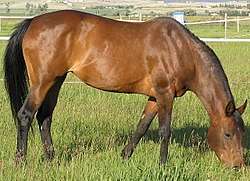
From French baie, from Latin badius (“reddish brown, chestnut”).
Adjective
bay (comparative more bay, superlative most bay)
- Of a reddish-brown colour (especially of horses).
Derived terms
- bay cat
- bay lynx
Translations
Noun
bay (uncountable)
Quotations
- For quotations of use of this term, see Citations:bay.
Translations
- The translations below need to be checked and inserted above into the appropriate translation tables, removing any numbers. Numbers do not necessarily match those in definitions. See instructions at Wiktionary:Entry layout#Translations.
See also
Anagrams
Cebuano
Etymology 1
Initial clipping of abay.
Noun
bay
- an address to a male friend
Etymology 2
Compare balay.
Noun
bay
- a house
Cornish
Pronunciation
- IPA(key): [bæi]
Noun
bay m (plural bayow)
Mutation
Synonyms
Related terms
Crimean Tatar
Adjective
bay
Declension
| nominative | bay |
|---|---|
| genitive | baynıñ |
| dative | bayğa |
| accusative | baynı |
| locative | bayda |
| ablative | baydan |
Haitian Creole
Verb
bay
- to give
Synonyms
Hone
Noun
bay
Further reading
- Anne Storch, Hone, in Coding Participant Marking: Construction Types in Twelve African Languages, edited by Gerrit Jan Dimmendaal
Turkish
Etymology
From Old Turkic 𐰉𐰖 (b¹j¹, bay, “rich person, noble”), from Proto-Turkic *bāj (“rich, noble; many, numerous”), possibly from Proto-Altaic *bēǯu (“numerous, great”),[1] Related to common Turkic бай, not related to bey.
The meaning “sir, gentleman” was coined during the language reforms in parallel to bey.[2]
Noun
bay (definite accusative bayı, plural baylar)
Declension
| Inflection | ||||||||||||||||||||||||||
|---|---|---|---|---|---|---|---|---|---|---|---|---|---|---|---|---|---|---|---|---|---|---|---|---|---|---|
| Nominative | bay | |||||||||||||||||||||||||
| Definite accusative | bayı | |||||||||||||||||||||||||
| Singular | Plural | |||||||||||||||||||||||||
| Nominative | bay | baylar | ||||||||||||||||||||||||
| Definite accusative | bayı | bayları | ||||||||||||||||||||||||
| Dative | baya | baylara | ||||||||||||||||||||||||
| Locative | bayda | baylarda | ||||||||||||||||||||||||
| Ablative | baydan | baylardan | ||||||||||||||||||||||||
| Genitive | bayın | bayların | ||||||||||||||||||||||||
| ||||||||||||||||||||||||||
Usage notes
Used as a title, the word is usually capitalized and followed by a person's name, often his surname or full name (as in “Bay Ahmet Şık”). This is unlike the more traditional title bey, which is used after a person's name, most commonly just his given name (as in “Ahmet Bey”).
Synonyms
- bey
- beyefendi
Derived terms
- albay
- yarbay
- bayan
Adjective
bay (comparative daha bay, superlative en bay)
Declension
| Inflection | ||||||||||||||||||||||||||
|---|---|---|---|---|---|---|---|---|---|---|---|---|---|---|---|---|---|---|---|---|---|---|---|---|---|---|
| Nominative | bay | |||||||||||||||||||||||||
| Definite accusative | bayı | |||||||||||||||||||||||||
| Singular | Plural | |||||||||||||||||||||||||
| Nominative | bay | baylar | ||||||||||||||||||||||||
| Definite accusative | bayı | bayları | ||||||||||||||||||||||||
| Dative | baya | baylara | ||||||||||||||||||||||||
| Locative | bayda | baylarda | ||||||||||||||||||||||||
| Ablative | baydan | baylardan | ||||||||||||||||||||||||
| Genitive | bayın | bayların | ||||||||||||||||||||||||
| ||||||||||||||||||||||||||
Synonyms
Antonyms
References
- ↑ Starostin, Sergei; Dybo, Anna; Mudrak, Oleg (2003) Etymological dictionary of the Altaic languages (Handbuch der Orientalistik; VIII.8), Leiden, New York, Köln: E.J. Brill: “*bēǯu”
- ↑ Nişanyan, Sevan (2002–), “bay”, in Nişanyan Sözlük
Vietnamese
Pronunciation
- (Hà Nội) IPA(key): [ɓaj˧˧]
- (Huế) IPA(key): [ɓaj˧˧]
- (Hồ Chí Minh City) IPA(key): [ɓaj˧˧]
Etymology 1
From Proto-Mon-Khmer *par; cognates include Bahnar păr, Pacoh pár and Mon ပဝ် (pɔ).
Verb
bay (𠖤, 𩙻)
- to fly (travel through the air)
- to flutter (flap or wave quickly but irregularly)
- to fly (travel very fast)
- to fade away
Derived terms
Adverb
bay
- with ease; in a fast-paced manner
- cãi bay
- to snap at each other
- cãi bay
Etymology 2
Noun
(classifier cái) bay (𨭍)
Etymology 3
See bây.
Pronoun
bay
- (informal) you (second-person plural)
Alternative forms
Related terms
References
- "bay" in Hồ Ngọc Đức, Free Vietnamese Dictionary Project (details)