non
English
Pronunciation
Audio (US) (file)
Adverb
non (not comparable)
- Obsolete form of none.
Asturian
Etymology
Adverb
non
Basque
Pronoun
non
Chiricahua
Noun
non
- Alternative spelling of nun
Chuukese
Preposition
non
Dutch
Pronunciation
- Rhymes: -ɔn
audio (file)
Noun
non f (plural nonnen, diminutive nonnetje n)
Synonyms
Fala
Alternative forms
Etymology
From Old Portuguese non, from Latin nōn (“not”).
Adverb
non
- not (negates the meaning of the modified verb)
- 2000, Domingo Frades Gaspar, Vamus a falal: Notas pâ coñocel y platical en nosa fala, Editora regional da Extremadura, Theme II, Chapter 2: Recunquista:
- Non poemos analizar con pormenoris estis siglos, pero tampoco se debi toleral que, sin fundamentus, se poña en duda algo que a Historia documentá nos lega sobre nossa terra.
- We can’t thoroughly analyse these centuries, but one mustn’t tolerate that, unfoundedly, something documented history tells us about our land be questioned.
- Non poemos analizar con pormenoris estis siglos, pero tampoco se debi toleral que, sin fundamentus, se poña en duda algo que a Historia documentá nos lega sobre nossa terra.
-
French
Etymology
From Old French non, from Latin nōn.
Pronunciation
- IPA(key): /nɔ̃/
audio (file)
Adverb
non
Conjunction
non
- not
- 1869, Sully Prudhomme, “La Voie lactée”, in Les Solitudes:
- Êtes-vous toujours en prière ? / Êtes-vous des astres blessés ? / Car ce sont des pleurs de lumière, / Non des rayons, que vous versez.
- Are you still in prayer? / Are you hurt stars? / Because it is cries of light, / Not rays, that you pour.
- Êtes-vous toujours en prière ? / Êtes-vous des astres blessés ? / Car ce sont des pleurs de lumière, / Non des rayons, que vous versez.
-
Interjection
non
- no!
Derived terms
Further reading
- “non” in le Trésor de la langue française informatisé (The Digitized Treasury of the French Language).
Friulian
Etymology
From Latin nōmen, from Proto-Indo-European *h₁nómn̥.
Noun
non m (plural nons)
Galician
Etymology
From Old Portuguese non, from Latin nōn.
Pronunciation
IPA(key): /no̝ŋ/, /ˈnoŋ/
Adverb
non
- no, not, not at all.
- no (used to show disagreement or negation)
- no (used to reinforce an affirmation as negation of the alternative - but it can be omitted without changing the meaning)
- Ás veces é mellor berrar que non calar
- Sometimes it is better to shout than to - keep quiet
- no (reinforces a mandate in interrogative sentences)
Usage notes
Non usually contracts, in speech, with a following personal pronoun a, as, o, os, although this contraction is rarely shown in written Galician (either as nono, n'o, etc):
- Non o queres? ("You don't want it?"): /nono'kɛs/ = /noː'kɛs/
References
- “non” in Dicionario de Dicionarios do galego medieval, SLI - ILGA 2006-2012.
Haitian Creole
Etymology
Noun
non
Related terms
Ido
| < 8 | 9 | 10 > |
|---|---|---|
| Cardinal : non Ordinal : nonesma Adverbial : nonfoye Multiplier : nonopla Fractional : nonima | ||
| Ido Wikipedia article on non | ||
Etymology
From English nine, German neun, ultimately from Proto-Indo-European *h₁néwn̥. In length from English nona-, French nona-, Italian nono, Spanish nono.
Numeral
non
- nine (9)
Interlingua
Adverb
non
Istriot
Alternative forms
Etymology
Noun
non
Italian
Etymology
Pronunciation
audio (file) - IPA(key): [non]
Adverb
non
Latin
Etymology
From Old Latin noenum, from Proto-Indo-European *ne (“not”) + *óynos (“one”) (= ne + ūnus)[1]. See also nē and nī.
Pronunciation
- (Classical) IPA(key): /noːn/
- (Ecclesiastical) IPA(key): /non/
Audio (Classical) (file)
Particle
nōn (negative particle)
- not
- Graecum est; non legitur.
- It's Greek; it cannot be read.
Usage notes
The particle nōn may be used to negate verbs, adjectives, nouns, or phrases.
Derived terms
Descendants
References
- non in Charlton T. Lewis and Charles Short (1879) A Latin Dictionary, Oxford: Clarendon Press
- non in Charlton T. Lewis (1891) An Elementary Latin Dictionary, New York: Harper & Brothers
- non in Gaffiot, Félix (1934) Dictionnaire Illustré Latin-Français, Hachette
- Carl Meissner; Henry William Auden (1894) Latin Phrase-Book, London: Macmillan and Co.
- not to stir from one's place: loco or vestigio se non movere
- to lose no time: tempus non amittere, perdere
- to take no thought for the future: futura non cogitare, curare
- I have not seen you for five years: quinque anni sunt or sextus annus est, cum te non vidi
- on the day after, which was September 5th: postridie qui fuit dies Non. Sept. (Nonarum Septembrium) (Att. 4. 1. 5)
- to-day the 5th of September; tomorrow September the 5th: hodie qui est dies Non. Sept.; cras qui dies futurus est Non. Sept.
- to be always at a person's side: ab alicuius latere non discedere
- to make not the slightest effort; not to stir a finger: manum non vertere alicuius rei causa
- to have disappeared: non apparere
- to fail to see what lies before one: quod ante pedes est or positum est, non videre
- to keep one's countenance, remain impassive: vultum non mutare
- to be hardly able to restrain one's tears: lacrimas tenere non posse
- to be hardly able to restrain one's tears: fletum cohibere non posse
- to be unable to speak for emotion: prae lacrimis loqui non posse
- to be unable to sleep: somnum capere non posse
- I cannot sleep for anxiety: curae somnum mihi adimunt, dormire me non sinunt
- I haven't had a wink of sleep: somnum oculis meis non vidi (Fam. 7. 30)
- the matter progresses favourably, succeeds: aliquid (bene, prospere) succedit or procedit (opp. parum procedere, non succedere)
- on good grounds; reasonably: non sine causa
- to draw from the fountain-head: e fontibus haurire (opp. rivulos consectari or fontes non videre)
- it is incompatible with the nature of a wise man; the wise are superior to such things: hoc in sapientem non cadit
- it is no longer in my power: mihi non est integrum, ut...
- to accede to a man's petitions: alicui petenti satisfacere, non deesse
- to chafe under an indignity, repudiate it: ignominiam non ferre
- to spare no pains: labori, operae non parcere
- to work without intermission: laborem non intermittere
- ideally, not really: cogitatione, non re
- to be probable: a vero non abhorrere
- I know very well: probe scio, non ignoro
- I know very well: non sum ignarus, nescius (not non sum inscius)
- I am not unaware: me non fugit, praeterit
- I cannot make myself believe that..: non possum adduci, ut (credam)
- I have not made up my mind: mihi non constat (with indirect question)
- I cannot bring myself to..: a me impetrare non possum, ut
- to differ qualitatively not quantitatively: genere, non numero or magnitudine differre
- I have nothing to say against it: non repugno
- to contradict oneself, be inconsistent: a se dissidere or sibi non constare (of persons)
- to be absolutely ignorant of arithmetic: bis bina quot sint non didicisse
- to represent a thing dramatically: sic exponere aliquid, quasi agatur res (non quasi narretur)
- to be unable to say all one wants: verbis non omnia exsequi posse
- I have nothing to write about: non habeo argumentum scribendi
- I have nothing to write about: non habeo, non est quod scribam
- to answer every question: percontanti non deesse (De Or. 1. 21. 97)
- not to trouble oneself about a thing: non laborare de aliqua re
- I am not dissatisfied with my progress: non me paenitet, quantum profecerim
- to lose one's head, be beside oneself: sui (mentis) compotem non esse
- to lose one's head, be beside oneself: non esse apud se (Plaut. Mil. 4. 8. 26)
- the house is not large enough for all: domus non omnes capit (χωρειν)
- to never set foot out of doors: domo pedem non efferre
- I have no means, no livelihood: non habeo, qui (unde) vivam
- to be bankrupt: non solvendo esse (Phil. 2. 2. 4)
- the corn is not yet ripe: frumenta in agris matura non sunt (B. G. 1. 16. 2)
- to further the common weal: saluti rei publicae non deesse
- there are whispers of the appointment of a dictator: non nullus odor est dictaturae (Att. 4. 18)
- to take care not to..: non committere, ut...
- men exempt from service owing to age: qui per aetatem arma ferre non possunt or aetate ad bellum inutiles
- to fail to answer one's name: ad nomen non respondere (Liv. 7. 4)
- not to interrupt the march: iter non intermittere
- to not let the enemy escape: hostem e manibus non dimittere
- not to mention..: ut non (nihil) dicam de...
- to say nothing further on..: ut plura non dicam
- I do not deny: non nego, non infitior
- I cannot find words for..: dici vix (non) potest or vix potest dici (vix like non always before potest)
- which I can say without offence, arrogance: quod non arroganter dixerim
- this is not the place to..: non est huius loci c. Inf.
- this is not the place to..: non est hic locus, ut...
- I do not take that too strictly: non id ad vivum reseco (Lael. 5. 8)
- not to stir from one's place: loco or vestigio se non movere
Middle French
Etymology
From Old French non.
Interjection
non
Descendants
- French: non
Novial
Adverb
non
Old English
Etymology 1
From Latin nōna (“ninth; ninth hour”)
Pronunciation
- IPA(key): /noːn/
Noun
nōn ?
- (historical) Nones, the ninth hour after sunrise
- (Christianity) Nones, the religious service appointed to this hour
Synonyms
- (time): nōntīd, nōntīma
- (religious service): nōnsang
Derived terms
- nōngereord, nōnmete, nōnsang, nōntīd, nōntīma
Etymology 2
Pronunciation
- IPA(key): /non/
Noun
non m
References
- "nōn" and "non" in Bosworth & Toller's Anglo-Saxon Dictionary (1882), Oxford: Clarendon Press.
Old French
Etymology
Pronunciation
- Rhymes: -õn
Interjection
non
Adverb
non
- not
- circa 1190, Chrétien de Troyes, Le Roman de Percival
- Les uns barbez, les autres non
- Some bearded, the others not
- Les uns barbez, les autres non
- circa 1190, Chrétien de Troyes, Le Roman de Percival
Noun
non m (oblique plural nons, nominative singular nons, nominative plural non)
- Alternative form of nom
Old Portuguese
Etymology
From Latin nōn (“no”), from Old Latin noenum, from Proto-Indo-European *ne (“not”) + *óynos (“one”).
Pronunciation
- IPA(key): /ˈnõ/
Adverb
non
- no, not
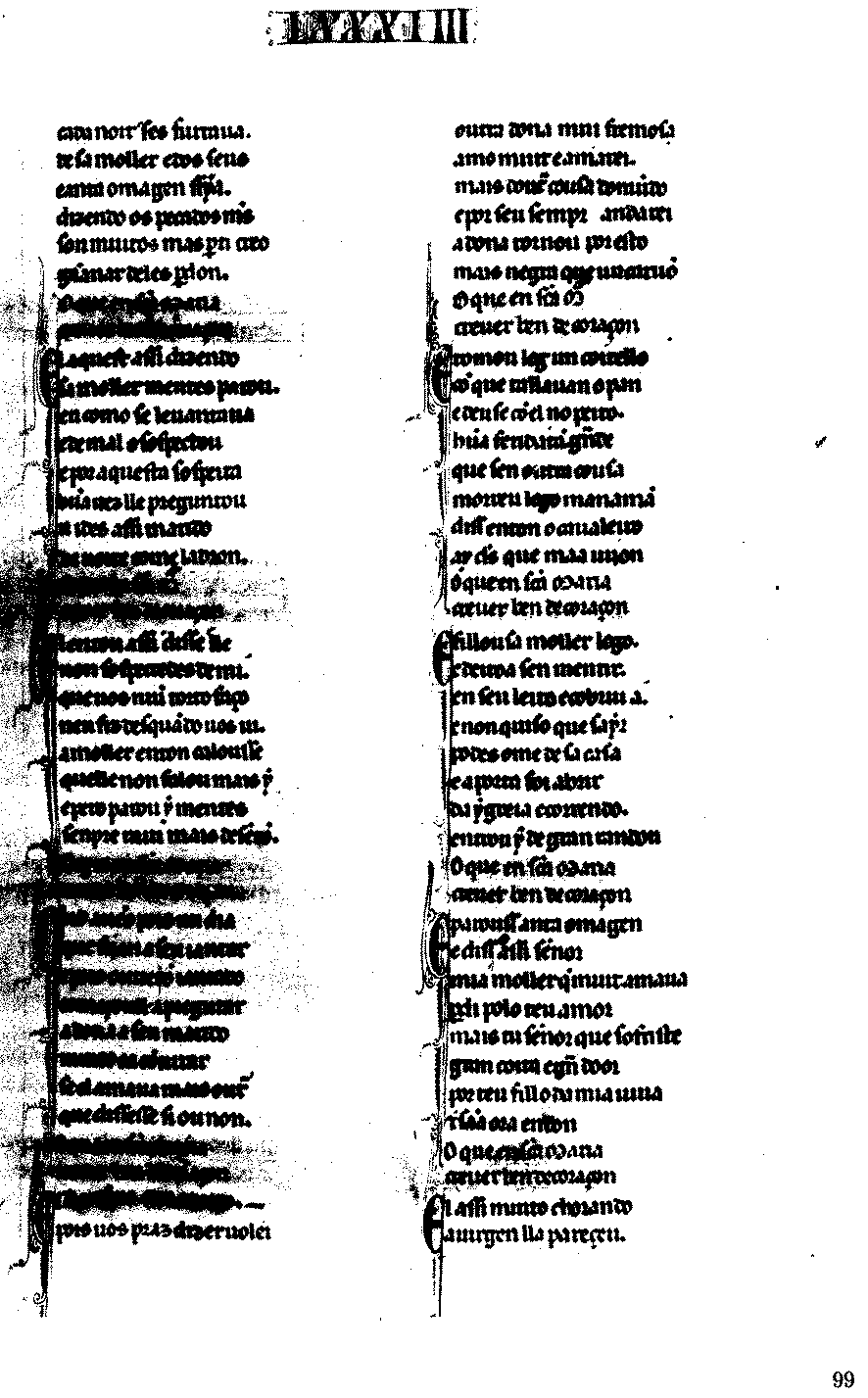
- 13th century, attributed to Alfonso X of Castile, Cantigas de Santa Maria, E codex, cantiga 84 (facsimile):
- ſi ou non
- yes or no
- ſi ou non
- 13th century, attributed to Alfonso X of Castile, Cantigas de Santa Maria, E codex, cantiga 84 (facsimile):
Descendants
Romansch
Etymology
From Late Latin nonnus (compare Italian nonno).
Noun
non m (plural nons)
Synonyms
- (Rumantsch Grischun, Sursilvan, Sutsilvan, Surmiran) tat
- (Vallader) bazegner, bapsegner
Related terms
Vietnamese
Pronunciation
- (Hà Nội) IPA(key): [nɔn˧˧]
- (Huế) IPA(key): [nɔŋ˧˧]
- (Hồ Chí Minh City) IPA(key): [nɔŋ˧˧]
Etymology 1
From Proto-Vietic *k-nɔːn.
Adjective
non (嫩)
Derived terms
- bắp non (baby corn)
Etymology 2
Noun
non (𡽫)
Western Apache
Alternative forms
Etymology
Cognates: Navajo nooʼ, Chiricahua nun, Mescalero nun, Plains Apache nǫǫ.
Pronunciation
Audio (US) (file) - IPA(key): [nòn]
Noun
non
- something stored away, cache
Zazaki
Etymology
Noun
non