儂
| ||||||||
Translingual
Han character
儂 (radical 9 人+13, 15 strokes, cangjie input 人廿田女 (OTWV), four-corner 25232, composition ⿰亻農)
References
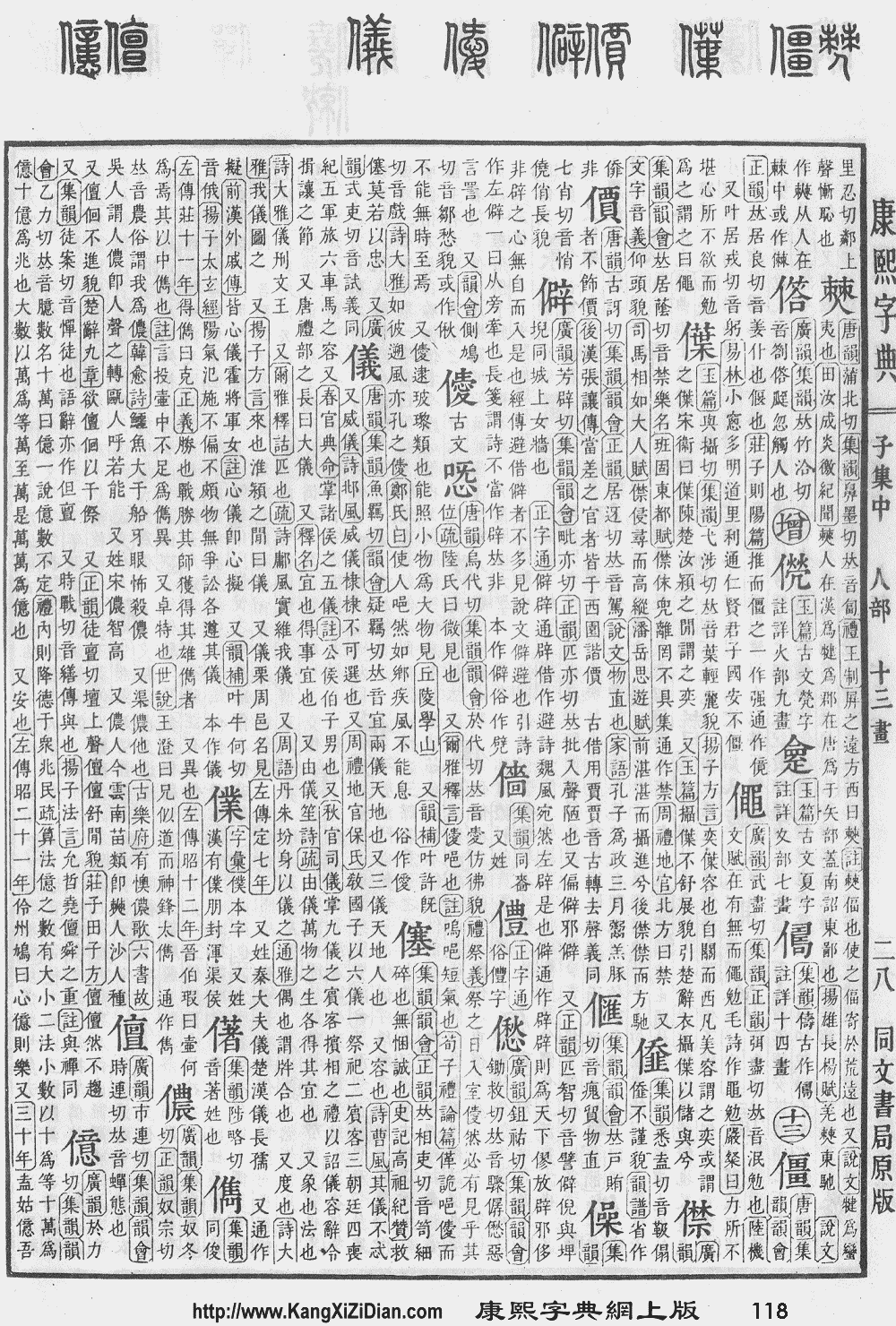
- KangXi: page 118, character 25
- Dai Kanwa Jiten: character 1176
- Dae Jaweon: page 251, character 9
- Hanyu Da Zidian: volume 1, page 225, character 4
- Unihan data for U+5102
Chinese
| trad. | 儂 | |
|---|---|---|
| simp. | 侬 | |
Glyph origin
| Characters in the same phonetic series (農) (Zhengzhang, 2003) | |
|---|---|
| Old Chinese | |
| 嶩 | *nuː |
| 噥 | *rnuːŋ, *nuːŋ |
| 鬞 | *rnuːŋ, *noŋ |
| 擃 | *rnuːŋʔ |
| 齈 | *noːŋs |
| 癑 | *noːŋs |
| 農 | *nuːŋ |
| 辳 | *nuːŋ |
| 憹 | *nuːŋ |
| 膿 | *nuːŋ |
| 儂 | *nuːŋ |
| 濃 | *noŋ |
| 醲 | *noŋ |
| 襛 | *noŋ, *njoŋ |
| 穠 | *noŋ, *njoŋ |
| 檂 | *noŋ |
Phono-semantic compound (形聲, OC *nuːŋ) : semantic 亻 + phonetic 農 (OC *nuːŋ).
Etymology
“Person; I; me > suffix for pronouns” in southeastern dialects.
Its senses of “person; human being” and “pronoun suffix” are well-attested in the classical literature, dating back to the Six Dynasties. At the present time, traces of this word are found in regions of Jiangsu (Northern Wu), Anhui (Hui), Shanghai (Northern Wu), Zhejiang (Southern Wu), Jiangxi (Gan), Fujian (Min), Guangdong (Southern Min, Cantonese), Guangxi (Cantonese) and Hainan (Min).
- “Person; human”
- In coastal Min (Min Dong, Min Nan and Puxian Min), it serves as the vernacular reading of 人 (OC *njin, “person”), by itself or in compounds. It is also used in Jinqu Wu dialects (formerly classified as Wuzhou Wu and Chuqu Wu), usually written as 農.
- “I”
- 儂 was used to mean “I” in medieval poetry from the Wu region, before it was displaced by the common Chinese 我 (MC ŋɑX, “I”). Also attested was ancient Wu 阿儂 (MC ʔɑ nuoŋ, “I”), which was abbreviated to 阿 (“I”) in certain dialects, such as Jinhua.
- “Pronoun suffix”
- This is widely found in Wu and Min dialects. The structure ‹ singular pronoun (“I, you, he/she/it”) + 儂 › is common, with 儂 functioning either as a meaningless particle or a pluraliser. The resulting forms were thus used to mean singular or plural pronouns, and were rather prone to elision to become a single syllable. Compare the following plural pronouns in Min:
-
Original word Meaning Fuding
(Eastern Min)Longyan
(Southern Min)Xiamen
(Southern Min)Xianyou
(Puxian Min)我儂 we ua neiŋ gua laŋ gun (阮) kuoŋ ~ kŋ (滾) 儂儂 we (inclusive) - laŋ laŋ lan (咱) - 汝儂 you (plural) ni neiŋ li laŋ lin (恁) tyøŋ (長) 伊儂 they i neiŋ i laŋ in (𪜶) yøŋ (𪜶)
- A similar chain of changes happened in the Wu dialects to arrive at the modern divergent dialectal forms for “you (singular)”. In Shanghai and some other Wu dialects, the first syllable had become elided, leaving 儂 to mean “you (singular)”.
-
爾儂 (MC ȵiᴇX nuoŋ) Fenghua (Zhejiang) /n̩˧˨˦.noŋˑ/ Yuyao (Zhejiang) /noŋ˩˩˧/ Shanghai (Shanghai) /nʊŋ˨˧/ (儂) Ningbo (Zhejiang) /nəu˨˩˧/ Changshu (Jiangsu) /nɛ̃˧˩/ Suzhou (Jiangsu) /ne̞˧˩/ Shengze (Jiangsu) /nə˧˩/
With regard to the etymology of this word, Huang (2000), Norman (1983) and Zhou (1986) hypothesised that this is the same as 農 (OC *nuːŋ, “farmer; peasant”). The use of this word as a pronoun may have originated as a form of personal deprecation and then come to be used as a full-fledged pronoun. Pan and Chen (1995) considered this theory implausible, and proposed that this was originally a Baiyue substrate word, possibly of Tai-Kadai origin. The initial meaning of nong was possibly a clan name, later developing to mean “person; I”. Compare Zhuang Nungz (“a surname”) and name of the 11th century Zhuang leader Nong Zhigao, as well as the name of the Nùng people in Vietnam.
Pronunciation
Definitions
儂
- (coastal Min, dialectal Wu) person; human being
- Suffix for pronouns, functioning as a meaningless particle or a pluralising particle.
- Used as a variety of pronouns in different dialects: I; you (singular); he, she, it; we; you (plural); they
- A surname. Nong
Synonyms
| Dialectal synonyms of 你 (“you (singular)”) [map] | ||
|---|---|---|
| Variety | Location | Words |
| Classical Chinese | 汝、爾 | |
| Formal (Written Standard Chinese) | 你 | |
| Mandarin | Beijing | 你、您 |
| Jinan | 你 | |
| Xi'an | 你 | |
| Wuhan | 你、你家 | |
| Chengdu | 你 | |
| Yangzhou | 你 | |
| Hefei | 你 | |
| Cantonese | Guangzhou | 你 |
| Hong Kong | 你 | |
| Taishan | 你 | |
| Yangjiang | 你 | |
| Gan | Nanchang | 你 |
| Hakka | Meixian | 你 |
| Miaoli (N. Sixian) | 你 | |
| Liudui (S. Sixian) | 你 | |
| Hsinchu (Hailu) | 你 | |
| Dongshi (Dabu) | 你 | |
| Zhuolan (Raoping) | 你 | |
| Yunlin (Zhao'an) | 你 | |
| Jin | Taiyuan | 你 |
| Min Bei | Jian'ou | 你 |
| Min Dong | Fuzhou | 汝 |
| Matsu | 汝 | |
| Min Nan | Xiamen | 汝 |
| Quanzhou | 汝 | |
| Zhangzhou | 汝 | |
| Taipei | 汝 | |
| Kaohsiung | 汝 | |
| Tainan | 汝 | |
| Taichung | 汝 | |
| Hsinchu | 汝 | |
| Lukang | 汝 | |
| Sanxia | 汝 | |
| Yilan | 汝 | |
| Kinmen | 汝 | |
| Magong | 汝 | |
| Penang | 汝 | |
| Singapore | 汝 | |
| Philippines (Manila) | 汝 | |
| Chaozhou | 汝 | |
| Shantou | 汝 | |
| Wu | Shanghai | 儂 |
| Suzhou | 倷 | |
| Wenzhou | 你 | |
| Ningbo | 儂、爾、爾儂、像儂、像爾 | |
| Xiang | Changsha | 你 |
| Shuangfeng | 你 | |
Compounds
Japanese
| Kanji in this term |
|---|
| 儂 |
| わし Hyōgaiji |
| kun’yomi |
Kanji
Readings
Usage notes
This character is seldom used in modern Japanese.
Etymology 1
| Kanji in this term |
|---|
| 儂 |
| わし Hyōgaiji |
| kun’yomi |
Contraction of 私 (watashi, “I, me”).[1][2]
Pronunciation
Alternative forms
- 私 (more common)
Pronoun
Usage notes
The term is generally only used by the elderly, and its use is often considered stereotypical of them. As such, it is frequently used in TV shows and comics to emphasize the age of characters.
More commonly spelled 私, or in kana to make the reading explicit.
Etymology 2
| Kanji in this term |
|---|
| 儂 |
| かれ Hyōgaiji |
| kun’yomi |
From Old Japanese. Compound of 彼 (ka, “that, yon”) + れ (re, nominalizing suffix for demonstratives). Found in the Man'yōshū compiled around 759.
Pronunciation
Alternative forms
- 彼 (more common)
Pronoun
Usage notes
Very rare spelling. See the more common spelling 彼 for more details about the term.
References
Korean
Hanja
儂 • (nong) (hangeul 농, revised nong, McCune–Reischauer nong)
- This term needs a translation to English. Please help out and add a translation, then remove the text
{{rfdef}}.
Vietnamese
Han character
儂 (nông, nùng, noọng)
- This term needs a translation to English. Please help out and add a translation, then remove the text
{{rfdef}}.