愛
| ||||||||
Translingual
| Stroke order | |||
|---|---|---|---|
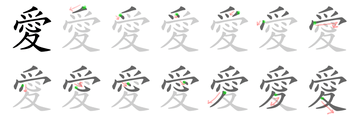 | |||
Han character
愛 (radical 61, 心+9, 13 strokes, cangjie input 月月心水 (BBPE), four-corner 20247, composition ⿳爫冖𢖻)
Derived characters
Descendants
References
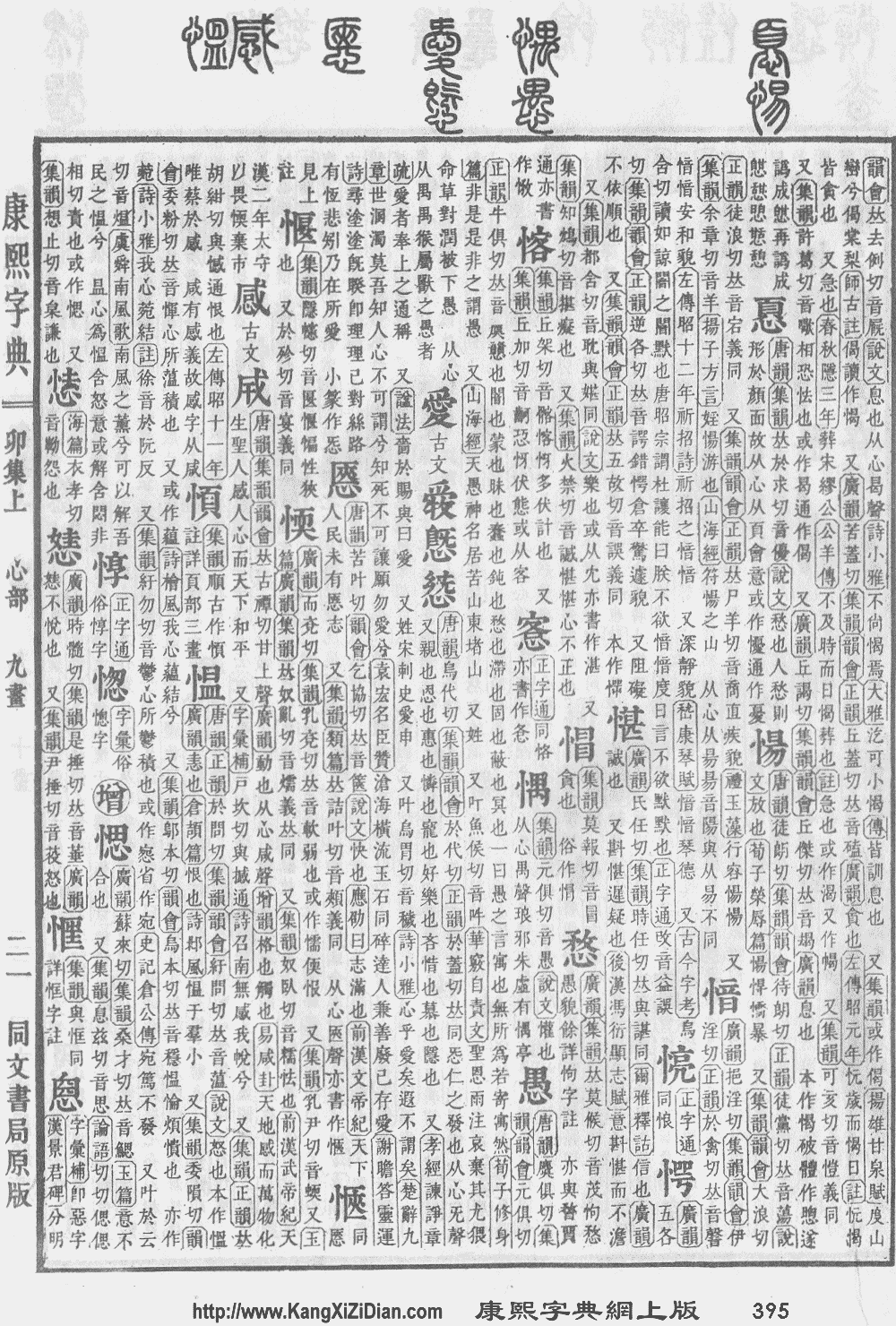
- KangXi: page 395, character 13
- Dai Kanwa Jiten: character 10947
- Dae Jaweon: page 732, character 2
- Hanyu Da Zidian: volume 4, page 2323, character 1
- Unihan data for U+611B
Chinese
| trad. | 愛 | |
|---|---|---|
| simp. | 爱 | |
| alt. forms | ||
Glyph origin
| Historical forms of the character 愛 | |
|---|---|
| Warring States | Shuowen Jiezi (compiled in Han) |
| Bronze inscriptions | Small seal script |
 |
 |
| Characters in the same phonetic series (愛) (Zhengzhang, 2003) | |
|---|---|
| Old Chinese | |
| 愛 | *qɯːds |
| 曖 | *qɯːds, *qaːds |
| 僾 | *qɯːds, *qɯlʔ |
| 靉 | *qɯːds, *qɯlʔ |
| 薆 | *qɯːds |
| 璦 | *qɯːds |
| 瞹 | *qaːds |
Originally 㤅, a phono-semantic compound (形聲, OC *qɯːds) : phonetic 旡 (OC *kɯds) + semantic 心 (“heart”).
As early as the Qin dynasty, a meaningless component 夊 (“foot”) was added to the bottom of the character, as with some other characters depicting people. Compare 憂 (from 㥑).
Further corruption turned the original phonetic 旡 into ⿱爫冖.
Pronunciation
Definitions
愛
- love; affection
- love; benevolence
- 遺愛人間 / 遗爱人间 ― yíàirénjiān ― to leave love behind
- to love
- affectionate
- beloved
- to like; to be fond of; to be keen on
- to be prone; to be easy to
- to treasure; to value
- (Hakka, Cantonese, Wu) to want (an object)
- (Min, Hakka) to want to do; to need to; must
- something one loves; someone whom one loves
- Honorific for someone else's daughter; variant of 嬡/嫒 (ài).
- A surname.
Synonyms
| Dialectal synonyms of 喜歡 (“to like”) [map] | ||
|---|---|---|
| Variety | Location | Words |
| Classical Chinese | 喜好、愛好 | |
| Formal (Written Standard Chinese) | 喜愛、喜好、愛好 | |
| Mandarin | Beijing | 喜歡、好希、愛 |
| Taiwan | 喜歡、愛 | |
| Jinan | 喜歡 | |
| Xi'an | 喜歡、愛 | |
| Wuhan | 喜歡、愛 | |
| Chengdu | 喜歡、歡喜、愛 | |
| Yangzhou | 歡喜 | |
| Hefei | 喜歡 | |
| Cantonese | Guangzhou | 中意、歡喜 |
| Hong Kong | 中意 | |
| Taishan | 中意 | |
| Yangjiang | 中意、歡喜 | |
| Gan | Nanchang | 歡喜 |
| Hakka | Meixian | 中意、好 |
| Miaoli (N. Sixian) | 中意、好 | |
| Liudui (S. Sixian) | 中意、好 | |
| Hsinchu (Hailu) | 中意、好 | |
| Dongshi (Dabu) | 中意、合意、好 | |
| Zhuolan (Raoping) | 中意、好 | |
| Yunlin (Zhao'an) | 佮意、愛 | |
| Jin | Taiyuan | 喜歡、待見 |
| Min Bei | Jian'ou | 愛、喜歡 |
| Min Dong | Fuzhou | 歡喜、愛 |
| Min Nan | Xiamen | 歡喜、意愛、愛、佮意、舒合 |
| Quanzhou | 歡喜、意愛、愛、佮意 | |
| Zhangzhou | 歡喜、愛、佮意 | |
| Taipei | 歡喜、意愛、愛、佮意 | |
| Penang | 舒合、愛 | |
| Philippines (Manila) | 愛、佮意 | |
| Chaozhou | 歡喜、愛 | |
| Wu | Shanghai | 歡喜 |
| Suzhou | 歡喜 | |
| Wenzhou | 喜歡 | |
| Xiang | Changsha | 喜歡 |
| Shuangfeng | 喜歡 | |
Usage notes
- When used for people, 愛/爱 usually refers to romantic love. When used like this, older Mandarin speakers often describe the use of this term as overly 肉麻 (ròumá, “cheesy”). For this reason, the word 喜歡/喜欢 (xǐhuan, “to like”) might be used instead. Using the word 喜歡/喜欢 (xǐhuan) literally means like, but when used in a romantic context (especially boyfriend/girlfriend), it actually means love. However, younger Mandarin speakers seem to have been influenced somewhat by Western culture, and are now using the verb 愛/爱 much more often than was socially acceptable in the past.
Compounds
|
|
|
Japanese
Kanji
Readings
- Goon: あい (ai, Jōyō); お (o)
- Kan’on: あい (ai, Jōyō)
- Kun: いつくしむ (itsukushimu, 愛しむ); いとしい (itoshii, 愛しい); いとおしむ (itooshimu, 愛おしむ); おしむ (oshimu, 愛しむ); まな (mana, 愛); めでる (mederu, 愛でる); めで (mede, 愛で); めで (mede, 愛)
- Nanori: あ (a); あい (ai); あし (ashi); え (e); かな (kana); なる (naru); めぐ (megu); めぐみ (megumi); よし (yoshi); ちか (chika)
Compounds
Etymology 1
| Kanji in this term |
|---|
| 愛 |
| あい Grade: 4 |
| on’yomi |
From Middle Chinese 愛 (ʔojH, “to love”)). Compare modern Mandarin 愛/爱 (ài).
Pronunciation
Noun
Synonyms
Derived terms
Idioms
- 愛して見れば鼻欠けも靨 (aishite mireba hanakake mo ekubo): “if you love someone, even a missing nose is only a dimple” ⇒ when you love someone, you minimize their flaws
Proper noun
- A female given name
- A surname.
Etymology 2
| Kanji in this term |
|---|
| 愛 |
| めで Grade: 4 |
| kun’yomi |
The 連用形 (ren'yōkei, “continuative or stem form”) of Old Japanese verb 愛づ (medzu, “to love; to appreciate or admire”), modern form 愛でる (mederu).[3][1]
Pronunciation
Alternative forms
- 愛で, 目出
Noun
- (archaic) love, appreciation, dearness
- c. 759, Man'yōshū (book 5, poem 894)
- 愛能盛尓 天下 奏多麻比志 家子等 撰多麻比天 [Man'yōgana]
- 愛の盛りに 天の下 申し給いし 家の子と 選び給いて [Modern spelling]
- mede no sakari ni ame no shita mōshitamai shi ie no ko to erabitamaite
- with the utmost of love, [Amaterasu] spoke under the heavens, and chose with her children...
- c. 759, Man'yōshū (book 5, poem 894)
Idioms
Related terms
Etymology 3
| Kanji in this term |
|---|
| 愛 |
| まな Grade: 4 |
| kun’yomi |
Originally a compound of 真 (ma, “true, genuine”) + な (na), an Old Japanese version of modern Japanese の (no, possessive particle).[3] The use of 愛 here is an example of ateji.
Pronunciation
Noun
- (archaic) (derived from prefix sense) something dear, something loved
- c. 759, Man'yōshū (book 14, poem 3462)
- 麻奈登伊布兒我 安夜尓可奈思佐 [Man'yōgana]
- 愛という児が あやに愛しさ [Modern spelling]
- mana to iu ko ga aya ni kanashisa
- the child called a dear, such indescribable tenderness
- c. 759, Man'yōshū (book 14, poem 3462)
Prefix
愛 (hiragana まな, rōmaji mana-)
- before a common noun, expresses a sense of admiration or value: good, genuine; compare English the real deal
- before a noun describing a person, expresses praise or fondness: dear, beloved
Derived terms
Proper noun
- A female given name
Etymology 4
Used as ateji in various names. 愛 is a very common element in many, many names.
Proper noun
愛 (hiragana あづみ, rōmaji Azumi, alternative reading ああい, rōmaji Āi, alternative reading あいか, rōmaji Aika, alternative reading あいす, rōmaji Aisu, alternative reading あき, rōmaji Aki, alternative reading あこ, rōmaji Ako, alternative reading あみか, rōmaji Amika, alternative reading あおい, rōmaji Aoi, alternative reading ありさ, rōmaji Arisa, alternative reading あや, rōmaji Aya, alternative reading あゆ, rōmaji Ayu, alternative reading ちぎり, rōmaji Chigiri, alternative reading ちか, rōmaji Chika, alternative reading ちかし, rōmaji Chikashi, alternative reading えりな, rōmaji Erina, alternative reading はあと, rōmaji Hāto, alternative reading ひかり, rōmaji Hikari, alternative reading いと, rōmaji Ito, alternative reading いとし, rōmaji Itoshi, alternative reading いつみ, rōmaji Itsumi, alternative reading いずみ, rōmaji Izumi, alternative reading かな, rōmaji Kana, alternative reading かなえ, rōmaji Kanae, alternative reading かなさ, rōmaji Kanasa, alternative reading きずな, rōmaji Kizuna, alternative reading こころ, rōmaji Kokoro, alternative reading このむ, rōmaji Konomu, alternative reading まどか, rōmaji Madoka, alternative reading まなぶ, rōmaji Manabu, alternative reading まなみ, rōmaji Manami, alternative reading めづる, rōmaji Mezuru, alternative reading めご, rōmaji Mego, alternative reading めぐ, rōmaji Megu, alternative reading めぐみ, rōmaji Megumi, alternative reading めぐむ, rōmaji Megumu, alternative reading めい, rōmaji Mei, alternative reading なる, rōmaji Naru, alternative reading なるこ, rōmaji Naruko, alternative reading のぞみ, rōmaji Nozomi, alternative reading らぶ, rōmaji Rabu, alternative reading るい, rōmaji Rui, alternative reading さら, rōmaji Sara, alternative reading さらん, rōmaji Saran, alternative reading つぐみ, rōmaji Tsugumi, alternative reading つくみ, rōmaji Tsukumi, alternative reading うい, rōmaji Ui, alternative reading よし, rōmaji Yoshi, alternative reading よしき, rōmaji Yoshiki, alternative reading よしみ, rōmaji Yoshimi)
- A female given name
References
Korean
Hanja
Vietnamese
Han character
愛 (ái, áy)
- This term needs a translation to English. Please help out and add a translation, then remove the text
{{rfdef}}.