美
| ||||||||
Translingual
| Japanese stroke order | |||
|---|---|---|---|
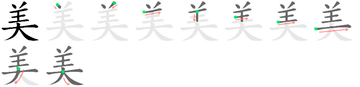 | |||
| Stroke order | |||
|---|---|---|---|
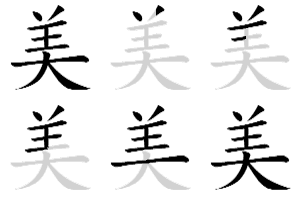 | |||
Han character
美 (radical 123, 羊+3, 9 strokes, cangjie input 廿土大 (TGK), four-corner 80431, composition ⿱𦍌大)
Descendants
References
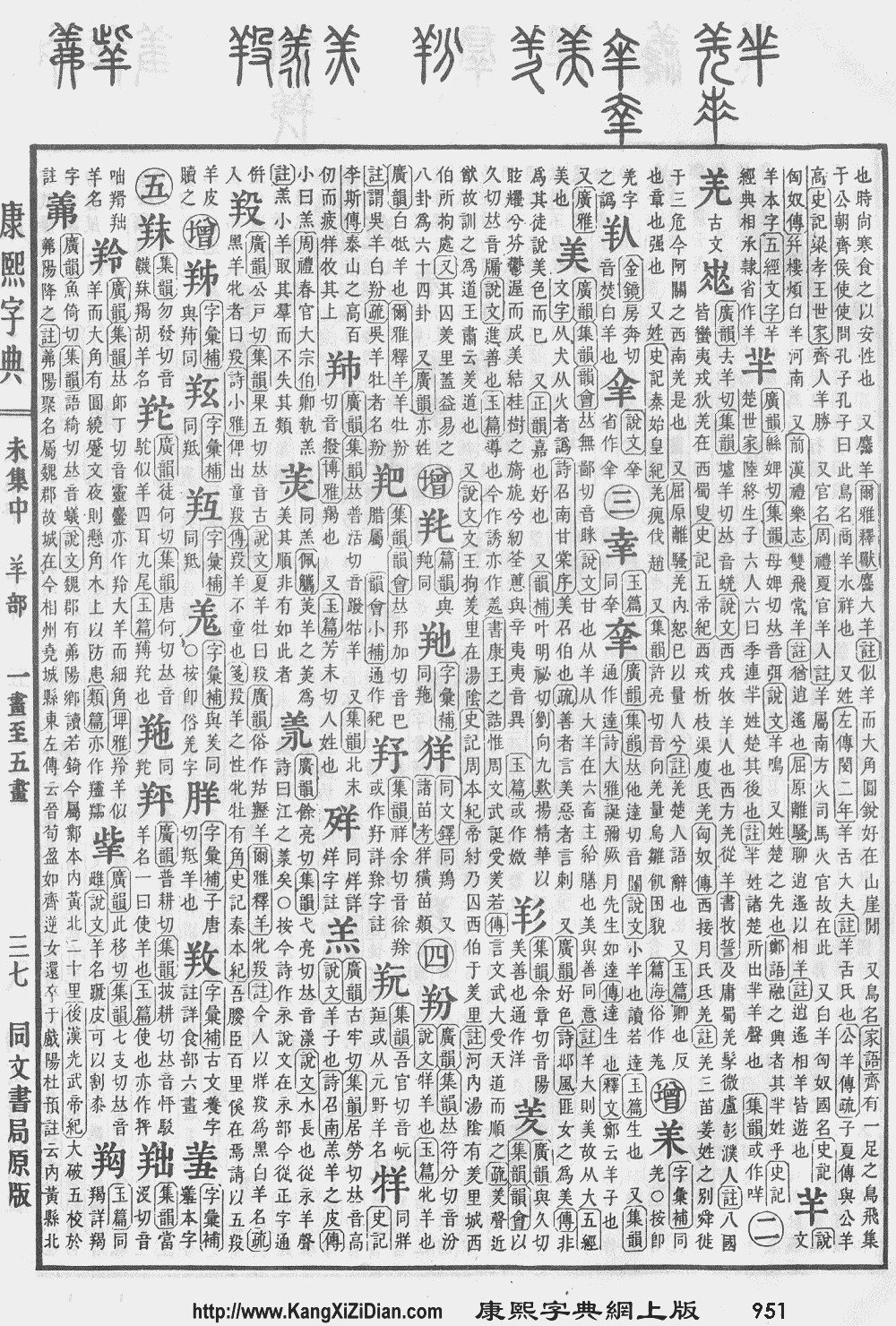
- KangXi: page 951, character 10
- Dai Kanwa Jiten: character 28435
- Dae Jaweon: page 1393, character 17
- Hanyu Da Zidian: volume 5, page 3126, character 5
- Unihan data for U+7F8E
Chinese
| simp. and trad. |
美 | |
|---|---|---|
| alt. forms | 媄 | |
Glyph origin
| Characters in the same phonetic series (美) (Zhengzhang, 2003) | |
|---|---|
| Old Chinese | |
| 美 | *mriʔ |
| 渼 | *mriʔ |
| 媄 | *mriʔ |
Ideogram (指事) : 羊 (“goat, sheep”) + 人 (“person”) – a person with a headdress of feathers or ram's horn.
Pronunciation
Definitions
美
- beautiful; pretty; attractive; good-looking
- delicious; tasty; flavoursome
- good; fine; satisfactory; happy
- to beautify; to prettify
- to praise; to commend
- (dialectal) to be pleased with oneself
- beautiful things; beauty
- Short for 美洲 (Měizhōu, “America (continent)”).
- Short for 美國/美国 (Měiguó, “United States of America”).
- A surname. Mei
Compounds
Derived terms from 美
|
|
|
Japanese
Kanji
美
Readings
Compounds
Suffix
- suffix used by female given names, such as 奈美(なみ, Nami), 恵美(えみ, Emi; めぐみ, Megumi), 宏美(ひろみ, Hiromi)
- (rare) suffix used by male given names
Korean
Hanja
美 • (mi) (hangeul 미, McCune–Reischauer mi, Yale mi)
- the USA, the Americas (in compounds, in news media)
- beautiful
Compounds
Derived terms
Vietnamese
Han character
- The United States of America, America
- Beautiful
This article is issued from
Wiktionary.
The text is licensed under Creative Commons - Attribution - Sharealike.
Additional terms may apply for the media files.