把
| ||||||||
Translingual
Han character
把 (radical 64 手+4, 7 strokes, cangjie input 手日山 (QAU), four-corner 57017, composition ⿰扌巴)
References
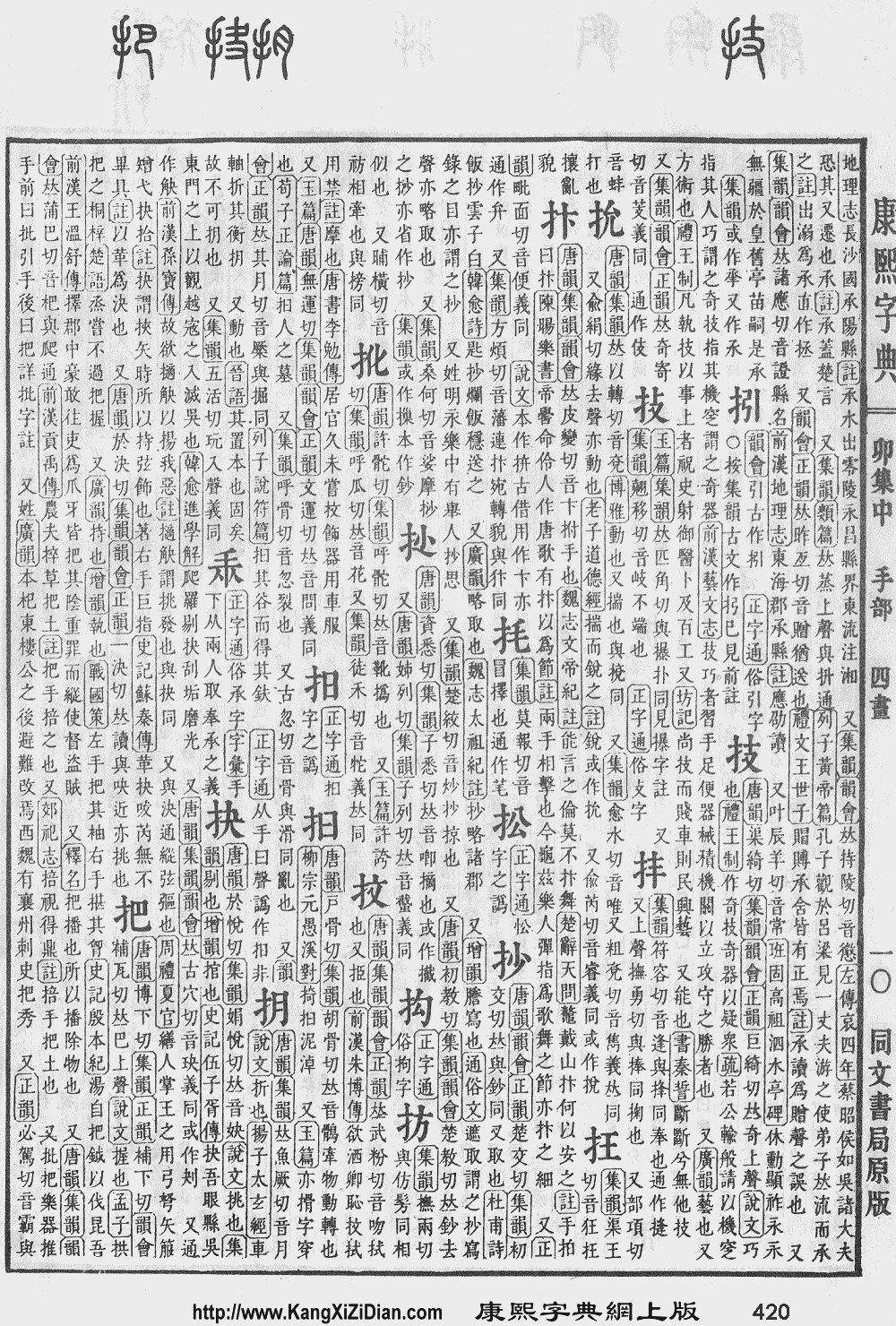
- KangXi: page 420, character 21
- Dai Kanwa Jiten: character 11874
- Dae Jaweon: page 768, character 1
- Hanyu Da Zidian: volume 3, page 1845, character 4
- Unihan data for U+628A
Chinese
| simp. and trad. |
把 | |
|---|---|---|
Glyph origin
| Characters in the same phonetic series (巴) (Zhengzhang, 2003) | |
|---|---|
| Old Chinese | |
| 巴 | *praː |
| 芭 | *praː |
| 笆 | *praː, *braːʔ |
| 豝 | *praː |
| 鈀 | *praː, *pʰraː |
| 吧 | *praː, *pʰraː |
| 蚆 | *praː, *pʰraː |
| 疤 | *praː |
| 把 | *praːʔ |
| 爸 | *praːs, *baʔ |
| 弝 | *praːs |
| 靶 | *praːs |
| 葩 | *pʰraː |
| 舥 | *pʰraː |
| 妑 | *pʰraː |
| 帊 | *pʰraːs |
| 琶 | *braː |
| 爬 | *braː |
| 杷 | *braː, *braːs, *braːs |
| 跁 | *braːʔ, *braːs |
| 耙 | *braːs |
Phono-semantic compound (形聲, OC *praːʔ) : semantic 手 (“hand”) + phonetic 巴 (OC *praː).
Pronunciation 1
Definitions
把
- to hold; to grasp; to take
- to guard; to have control over
- (traditional Chinese medicine) to feel (for the pulse)
- A light verb or preposition placed before the object of a sentence to allow it to be placed before the verb, giving greater flexibility in complex sentence construction.
- Used before a “subject + verb + complement” structure; to cause to; to make
- bundle; bunch
- handle; knob; grip (a part of an object which is held in the hand)
- stem (of a flower, leaf, fruit, etc.)
- 葉把兒 / 叶把儿 ― yèbàr ― stem of a leaf
- Classifier for objects that can be held using handles or knobs, such as guns, chairs, brooms, or umbrellas.
- Classifier for handfuls of something, such as grains, soil.
- Classifier for bundles or bunches.
- Classifier for some abstract ideas, such as force, effort or age.
- Classifier for something done with the hand.
- Placed after numerals or classifiers to express uncertainty; approximately
- A surname.
Synonyms
| Dialectal synonyms of 把 (“”) [map] | ||
|---|---|---|
| Variety | Location | Words |
| Formal (Written Standard Chinese) | 將 | |
| Mandarin | Beijing | 把 |
| Taiwan | 把 | |
| Jinan | 把 | |
| Xi'an | 把 | |
| Wuhan | 把 | |
| Chengdu | 把 | |
| Yangzhou | 把 | |
| Hefei | 把、幫 | |
| Cantonese | Guangzhou | 將 |
| Hong Kong | 將 | |
| Yangjiang | 將 | |
| Gan | Nanchang | 把 |
| Hakka | Meixian | 將、將把 |
| Xingning | 捉到 | |
| Huidong | 將 | |
| Qujiang | 將 | |
| Xiaosanjiang | 將 | |
| Changting | 將 | |
| Pingyu | 捉 | |
| Wuping | 拿 | |
| Ninghua | 把 | |
| Ruijin | 將 | |
| Shicheng | 拿 | |
| Shangyou | 拿 | |
| Miaoli (N. Sixian) | 將 | |
| Liudui (S. Sixian) | 將 | |
| Hsinchu (Hailu) | 將 | |
| Dongshi (Dabu) | 將 | |
| Zhuolan (Raoping) | 將 | |
| Yunlin (Zhao'an) | 將 | |
| Jin | Taiyuan | 把 |
| Min Bei | Jian'ou | 拿、邀 |
| Min Dong | Fuzhou | 將、共、揢 |
| Matsu | 揢 | |
| Min Nan | Xiamen | 將、共 |
| Quanzhou | 將、共 | |
| Zhangzhou | 將、共 | |
| Taipei | 將、共 | |
| Kaohsiung | 將、共 | |
| Chaozhou | 將、對、個 | |
| Wu | Suzhou | 拿 |
| Wenzhou | 逮 | |
| Xiang | Changsha | 把 |
| Shuangfeng | 把 | |
Compounds
Derived terms from 把
|
|
|
Pronunciation 2
Definitions
把
Japanese
Kanji
把
- This term needs a translation to English. Please help out and add a translation, then remove the text
{{rfdef}}.
Readings
Compounds
Etymology
| Kanji in this term |
|---|
| 把 |
| たば Grade: S |
| kun’yomi |
Pronunciation
Alternative forms
Counter
- counter for bundles
Noun
References
Korean
Hanja
把 • (pa) (hangeul 파, McCune–Reischauer p'a, Yale pha)
- This term needs a translation to English. Please help out and add a translation, then remove the text
{{rfdef}}.
Vietnamese
Han character
把 (bã, bả, bạ, bỡ, bữa, vả, vã, vỗ, bá, bẻ, bửa, lả, sấp, trả)
- This term needs a translation to English. Please help out and add a translation, then remove the text
{{rfdef}}.
This article is issued from
Wiktionary.
The text is licensed under Creative Commons - Attribution - Sharealike.
Additional terms may apply for the media files.