頭
| ||||||||
Translingual
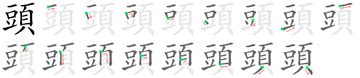
| Stroke order | |||
|---|---|---|---|
 | |||
Han character
頭 (radical 181, 頁+7, 16 strokes, cangjie input 一廿一月金 (MTMBC), four-corner 11186, composition ⿰豆頁)
Derived characters
- 𭀆, 𫷒, 𢸸, 𤃌, 𨯲, 𡾣, 䕱, 𨷩
Related characters
References
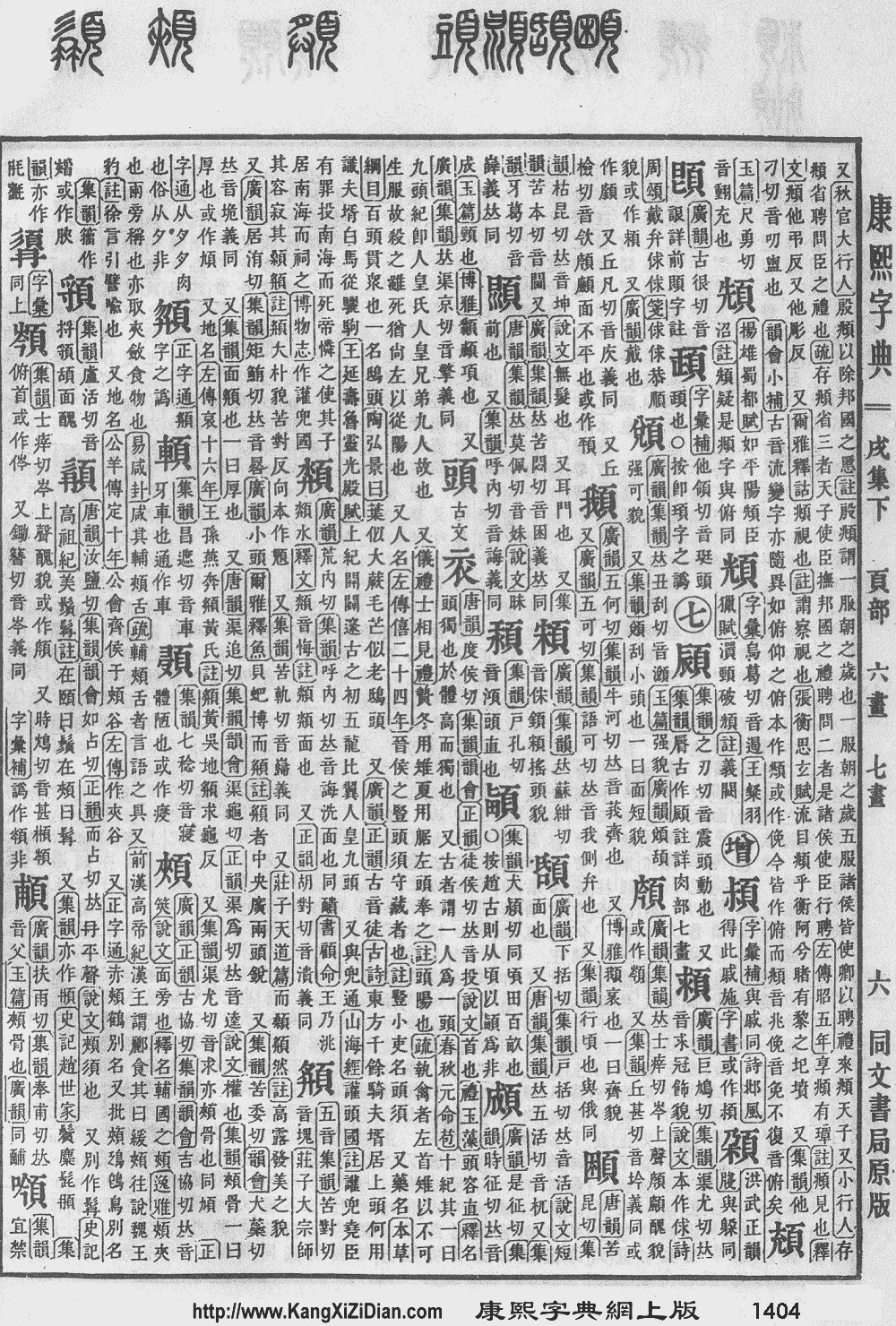
- KangXi: page 1404, character 20
- Dai Kanwa Jiten: character 43490
- Dae Jaweon: page 1921, character 13
- Hanyu Da Zidian: volume 7, page 4372, character 5
- Unihan data for U+982D
Chinese
| trad. | 頭 | |
|---|---|---|
| simp. | 头 | |
Glyph origin
| Characters in the same phonetic series (豆) (Zhengzhang, 2003) | |
|---|---|
| Old Chinese | |
| 侸 | *toː |
| 剅 | *toː, *roː |
| 郖 | *toː, *doːs |
| 鬪 | *toːs |
| 鋀 | *tʰoː |
| 頭 | *doː |
| 豆 | *doːs |
| 逗 | *doːs, *dos |
| 痘 | *doːs |
| 梪 | *doːs |
| 脰 | *doːs |
| 荳 | *doːs |
| 浢 | *doːs |
| 餖 | *doːs |
| 毭 | *doːs |
| 豎 | *djoʔ |
| 裋 | *djoʔ |
| 短 | *toːnʔ |
Phono-semantic compound (形聲, OC *doː) : phonetic 豆 (OC *doːs) + semantic 頁.
Etymology
Replaced earlier 首 (OC *hljuʔ, *hljus, “head”).
Pronunciation
Definitions
頭
- (anatomy) head (Classifier: 個/个 m c)
- 我又要叫你和女人彼此為仇;你的後裔和女人的後裔也彼此為仇。女人的後裔要傷你的頭;你要傷他的腳跟。 [MSC, trad.]
- From: 新標點和合本 (Chinese Union Version with New Punctuation), 創世記 (Genesis) 3:15
- Wǒ yòu yào jiào nǐ hé nǚrén bǐcǐ wéi chóu; nǐ de hòuyì hé nǚrén de hòuyì yě bǐcǐ wéi chóu. Nǚrén de hòuyì yào shāng nǐ de tóu; nǐ yào shāng tā de jiǎogēn. [Pinyin]
- And I will put enmity between thee and the woman, and between thy seed and her seed; it shall bruise thy head, and thou shalt bruise his heel.
我又要叫你和女人彼此为仇;你的后裔和女人的后裔也彼此为仇。女人的后裔要伤你的头;你要伤他的脚跟。 [MSC, simp.]
- hair
- top; tip; end
- chief; boss; leader
- remnant; end
- Classifier for livestock. ⇒ all nouns using this classifier
- first; leading
- Diminutive suffix.
Synonyms
Compounds
|
|
|
Japanese
Kanji
Readings
- Goon: ず (zu, Jōyō)←づ (du, historical)
- Kan’on: とう (tō, Jōyō)
- Tōon: じゅう (jū)←ぢゆう (dyū, historical)
- Kan’yōon: と (to, Jōyō, uncommon)
- Kun: あたま (atama, 頭, Jōyō); かしら (kashira, 頭); かぶり (kaburi, 頭); こうべ (kōbe, 頭)←かうべ (kaube, historical)
- Nanori: かぶ (kabu); かぶし (kabushi); かみ (kami); ちゃん (chan); つぶり (tsuburi); つむ (tsumu); つむり (tsumuri); づ (zu); どたま (dotama)
Compounds
Etymology 1
| Kanji in this term |
|---|
| 頭 |
| あたま Grade: 2 |
| kun’yomi |
From Old Japanese of unknown derivation. Theories include:
- Compound of 天玉 (a tama, literally “heaven, sky + ball”). This is problematic phonetically, as 天 appears historically as ama or ame, not as just a
- Compound of 当て間 (ate ma, literally “putting something in contact + space, gap”), referring to the head as a moxibustion point. This is also problematic phonetically, as the shift from ate to ata necessitates a change in meaning of the underlying verb. This is also problematic semantically, as the 間 (ma) term refers more specifically to a gap or space.
- Compound of 貴間 (ate ma, literally “noble + space”), referring to the most important part of the body. However, the use of 間 (ma) in this way is again problematic. Moreover, 貴 (ate, “noble”) appears in The Tale of the Bamboo Cutter dating to the 900s CE, while 頭 (atama) with a sense of fontanelle appears in the Wamyō Ruijushō dated 938 CE, leaving insufficient time for either the semantic or phonetic drift required.[1][2]
Historically, this term first appears with a sense of fontanelle, in reference to the soft place on the top of an infant's head where the bones of the skull have not yet fused. As such, a more likely derivation might be as a compound of 当た (ata, “not quite touching, not quite in contact”, possibly a fossilized 未然形 (mizenkei, “incomplete form”) of classical verb 当つ (atsu), root of modern 当たる (ataru, “to touch, to come into contact”)) + 間 (ma, “space, gap, opening”).
Pronunciation
Noun
頭 (hiragana あたま, rōmaji atama)
- head (body part)
- 頭が痛い。
- Atama ga itai.
- My head hurts.
- 頭が痛い。
- (anatomy, archaic, possibly obsolete) the fontanelle part of the skull
Idioms
- 頭が良い (atama ga ii): bright, intelligent
- 頭が悪い (atama ga warui): stupid, intellectually challenged
Etymology 2
| Kanji in this term |
|---|
| 頭 |
| かしら Grade: 2 |
| kun’yomi |
From Old Japanese.[1] Found as a standalone noun in the Man'yōshū, completed some time after 759 CE, and as a counter in the Kojiki, dating to 712 CE.
Alternative forms
- (head of a doll): 首
Pronunciation
Counter
頭 (hiragana かしら, rōmaji -kashira)
Noun
頭 (hiragana かしら, rōmaji kashira)
Derived terms
- 年頭 (toshigashira, “oldest person”)
- 膝頭 (hizagashira, “kneecap”)
- 前頭 (maegashira, rank-and-file sumo wrestler)
Radical names containing 頭:
- 網頭 (ami-gashira, “top 'net' radical”)
- 糸頭 (ito-gashira, “top 'thread' radical”)
- 老頭 (oi-gashira, “top 'old' radical”)
- 髪頭 (kami-gashira, “top 'hair' radical”)
- 彑頭 (kei-gashira, “top 'pig's head' radical”)
- 虎頭 (tora-gashira, “top 'tiger' radical”)
- 冬頭 (fuyu-gashira, “top 'winter' radical”)
- 八頭 (hachi-gashira, “top 'eight' radical”)
- 発頭 (hatsu-gashira, “top 'dotted tent' radical”)
- 人頭 (hito-gashira, “top 'person' radical”)
Etymology 3
| Kanji in this term |
|---|
| 頭 |
| かぶり Grade: 2 |
| kun’yomi |
Cognate with and shift in meaning from かぶり (kaburi, “covering; hat, crown”), spelled in kanji as 被り or 冠.
Pronunciation
Noun
頭 (hiragana かぶり, rōmaji kaburi)
Idioms
- 頭を振る (kaburi o furu, “shake one's head (in denial)”)
Etymology 4
| Kanji in this term |
|---|
| 頭 |
| かぶ Grade: 2 |
| Irregular |
Cognate with 株 (kabu, “stump; root”), from a general sense of lump.[1]
Pronunciation
- (Irregular reading)
- IPA(key): [ka̠bɯ̟ᵝ]
Noun
- (obsolete) head
Derived terms
Etymology 5
| Kanji in this term |
|---|
| 頭 |
| つぶり Grade: 2 |
| Irregular |
Cognate with 粒 (tsubu, “round thing”, such as a grain), 禿ぶ (tsubu, “to go bald”, from the idea of one's head becoming round), 円ら (tsubura, “round”, adjective), 潰れる (tsubureru, “to become rounded, as from wear and tear, or from crushing”).[1]
Some sources[2] derive this as a shift from 円ら (tsubura, “round”, adjective). However, the phonology and semantics for this do not fit (changing /a/ to /i/, and repurposing the adjectivizing suffix ら to instead form a noun). The modern verb tsubureru had the form tsuburu in older stages of the language. The tsuburi reading for 頭 may more likely represent a nominalization derived from this older verb, following normal patterns for creating nouns from verbs.
Pronunciation
- (Irregular reading)
- IPA(key): [t͡sɨᵝbɯ̟ᵝɾʲi]
Noun
Etymology 6
| Kanji in this term |
|---|
| 頭 |
| つむり Grade: 2 |
| Irregular |
From tsuburi above. Bilabial plosive /b/ becomes bilabial nasal /m/.
Pronunciation
Noun
Etymology 7
| Kanji in this term |
|---|
| 頭 |
| つむ Grade: 2 |
| Irregular |
Shortened from tsumuri above.[1]
Pronunciation
- (Irregular reading)
- IPA(key): [t͡sɨᵝmɯ̟ᵝ]
Noun
Derived terms
- 御頭 (otsumu, “head”, mainly used of an infant)
Etymology 8
| Kanji in this term |
|---|
| 頭 |
| こうべ Grade: 2 |
| kun’yomi |
/kamipe/ → /kampe/ → /kaube/ → /kɔːbe/ → /koːbe/
Compound of either 上 (kami, “upper”) or 髪 (kami, “hair”) (likely cognates) with the suffix 方 (pe, “location, direction”).[1][2][4]
Alternatively, may be an alteration from 頭 (kabu, “head”, see above) + 上 (ue, “up”).[1]
Pronunciation
Alternative forms
Noun
頭 (hiragana こうべ, rōmaji kōbe, historical hiragana かうべ)
Derived terms
Etymology 9
| Kanji in this term |
|---|
| 頭 |
| どたま Grade: 2 |
| Irregular |
Contraction of ど (do, “super-”, often used ironically as a derogatory prefix) + 頭 (atama, “head”).
Pronunciation
Noun
頭 (hiragana どたま, rōmaji dotama)
Usage notes
Often spelled in hiragana, as どたま.
Etymology 10
| Kanji in this term |
|---|
| 頭 |
| ず Grade: 2 |
| on’yomi |
/du/ → /d͡zu/ → /zu/
From Middle Chinese 頭 (MC dəu). The goon reading, so likely an earlier borrowing.
Pronunciation
Noun
頭 (hiragana ず, rōmaji zu, historical hiragana づ)
Usage notes
This reading is more often found in compounds, such as 頭痛 (zutsū, “a headache”).
Idioms
Etymology 11
| Kanji in this term |
|---|
| 頭 |
| とう Grade: 2 |
| on’yomi |
From Middle Chinese 頭 (MC dəu). The kan'on reading, so likely a later borrowing. The shift from initial /d/ to voiceless /t/ is due to influence or reborrowing from a later stage of the Chinese language. Compare modern Mandarin reading tóu, Cantonese tau4, Min Nan tao5.
Pronunciation
Counter
- heads of large animals (cows, horses)
- 合わせて1300頭余りが出荷され、全国各地に流通した。
- Awasete sen sanbyaku tō amari ga shukka sare, zenkoku kakuchi ni ryūtsū shita.
- Altogether over 1300 heads of cattle have been distributed throughout the country.
- 合わせて1300頭余りが出荷され、全国各地に流通した。
Noun
Derived terms
- 蔵人頭 (kuroudo no tō)
- 頭中将 (tō no chūjō)
- 頭弁 (tō no ben)
References
- 1 2 3 4 5 6 7 1988, 国語大辞典(新装版) (Kokugo Dai Jiten, Revised Edition) (in Japanese), Tōkyō: Shogakukan
- 1 2 3 4 5 6 7 8 9 10 11 12 13 14 2006, 大辞林 (Daijirin), Third Edition (in Japanese), Tōkyō: Sanseidō, →ISBN
- 1 2 3 4 5 6 7 8 9 10 11 1998, NHK日本語発音アクセント辞典 (NHK Japanese Pronunciation Accent Dictionary) (in Japanese), Tōkyō: NHK, →ISBN
- ↑ 1995, 大辞泉 (Daijisen) (in Japanese), Tōkyō: Shogakukan, →ISBN
Further reading
- Etymology entry for 頭 (atama) at Gogen-Yurai Jiten (Etymology and Origin Dictionary; in Japanese): http://gogen-allguide.com/a/atama.html
- Etymology entry for 頭 (atama) at Key: Zatsugaku Jiten (Key: Dictionary of Miscellaneous Knowledge; in Japanese}: http://www.7key.jp/data/language/etymology/a/atama.html#etymology
Korean
Hanja
頭 • (du) (hangeul 두)
- This term needs a translation to English. Please help out and add a translation, then remove the text
{{rfdef}}.
Northern Amami-Oshima
Etymology
Cognate with mainland Japanese 頭 (tsuburi), dialectal 頭 (tsuburo), itself probably a compound of 粒 (tsubu, “round thing, such as a grain”) + ろ (ro, suffix indicating a state or condition).
Kanji
頭 (hiragana つぃぶる, romaji tsiburu)
Noun
頭 (hiragana つぃぶる, romaji tsiburu)
Oki-No-Erabu
Etymology
Cognate with mainland Japanese 頭 (tsuburi), dialectal 頭 (tsuburo), itself probably a compound of 粒 (tsubu, “round thing, such as a grain”) + ろ (ro, suffix indicating a state or condition).
Kanji
頭 (hiragana ちぶる, romaji chiburu)
Noun
頭 (hiragana ちぶる, romaji chiburu)
- head
- an intelligent person
Okinawan
Kanji
頭 (hiragana ちぶる, romaji chiburu)
Etymology
Cognate with mainland Japanese 頭 (tsuburi), dialectal 頭 (tsuburo), itself probably a compound of 粒 (tsubu, “round thing, such as a grain”) + ろ (ro, suffix indicating a state or condition).
Noun
頭 (hiragana ちぶる, romaji chiburu)
- head
- an intelligent person
Compounds
Southern Amami-Oshima
Etymology
Cognate with mainland Japanese 頭 (tsuburi), dialectal 頭 (tsuburo), itself probably a compound of 粒 (tsubu, “round thing, such as a grain”) + ろ (ro, suffix indicating a state or condition).
Kanji
頭 (hiragana つぃぶる, romaji tsiburu)
Noun
頭 (hiragana つぃぶる, romaji tsiburu)
Vietnamese
Han character
頭 (đầu)
- This term needs a translation to English. Please help out and add a translation, then remove the text
{{rfdef}}.
Yaeyama
Etymology
Cognate with mainland Japanese 頭 (tsuburi), dialectal 頭 (tsuburo), itself probably a compound of 粒 (tsubu, “round thing, such as a grain”) + ろ (ro, suffix indicating a state or condition).
Kanji
頭 (hiragana つぶり, romaji tsuburi, hiragana つぃぶる, romaji tsiburu, hiragana つぃぶるぃ, romaji tsiburi)
Noun
頭 (hiragana つぶり, romaji tsuburi, hiragana つぃぶる, romaji tsiburu, hiragana つぃぶるぃ, romaji tsiburi)
Yoron
Etymology
Cognate with mainland Japanese 頭 (tsuburi), dialectal 頭 (tsuburo), itself probably a compound of 粒 (tsubu, “round thing, such as a grain”) + ろ (ro, suffix indicating a state or condition).
Kanji
頭 (hiragana ちぶる, romaji chiburu)
Noun
頭 (hiragana ちぶる, romaji chiburu)
- head
- an intelligent person