為
| ||||||||
Translingual
| Stroke order | |||
|---|---|---|---|
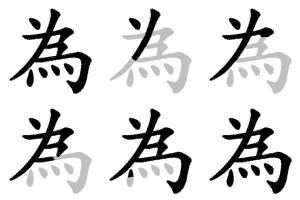 | |||
Han character
為 (radical 86, 火+5, 9 strokes, cangjie input 戈大弓火 (IKNF), four-corner 20227)
Descendants
References
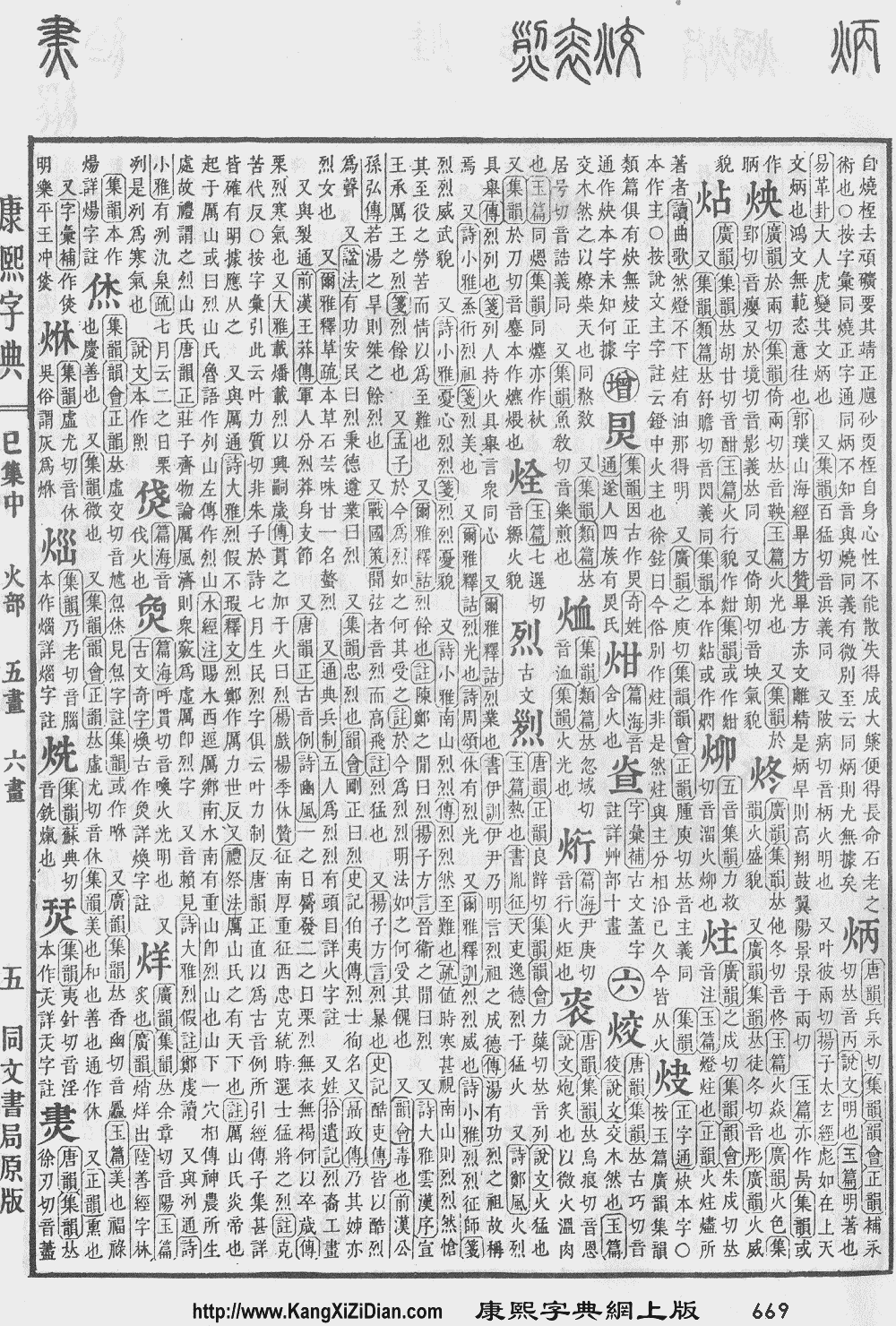
- KangXi: not present, would follow page 669, character 10
- Dai Kanwa Jiten: character 18981
- Hanyu Da Zidian: volume 3, page 2198, character 11
- Unihan data for U+70BA
Chinese
| trad. | 為/爲 | |
|---|---|---|
| simp. | 为 | |
Glyph origin
| Historical forms of the character 為 | ||||
|---|---|---|---|---|
| Shang | Western Zhou | Warring States | Shuowen Jiezi (compiled in Han) | Liushutong (compiled in Ming) |
| Oracle bone script | Bronze inscriptions | Chu Slip and silk script | Small seal script | Transcribed ancient scripts |
 |
 |
 |
 |
 |
Simplified from 爲.
In the oracle bone script, it is an ideogrammic compound (會意) : 又 (“hand”) + 象 (“elephant”) — a hand holding an elephant. The 又 later became 爪 (“hand; claw”).
Shuowen Jiezi explained the character to be a representation of the female macaque.
Etymology
The two pronunciations below (“to make; to do; to be”, “for; to; because”) are cognate; the latter is the *–s derivative of the former. Words meaning “to make, to do” often have secondary meanings of “for, as” – compare 作.
Etymology not certain. Starostin compared this word with Tibetan བགྱིད (bgyid, “to make, to manufacture”), བགྱི་བ (bgyi ba, “action, deed”), ཡིན (yin, “is, be”) and Burmese ဝေ (we, “to distribute, to share”). Schuessler (2007) listed *ʔaajh (“to give”) (> Khmer ឲ្យ (ʾaoy, “to give, to donate”)) and Khmer ធ្វើ (thvəə, “to do, to make”), although the vowels do not match.
The graphic representation using monkey or elephant probably stems a homophonic or near-homophonic etymon which was rarely attested; compare Proto-Sino-Tibetan *b/g-woj-n > Jingpho woi (“monkey”) and possibly 猿 (OC *ɢʷan, “ape”). Outside Sino-Tibetan, compare Proto-Vietic *-vɔːj (“elephant”) > Vietnamese voi (“elephant”).
Pronunciation 1
Definitions
為
- to do; to make
- (to turn, to transform) into; to
- to be (equivalent to, equal to)
- to take something as
- to act as; to serve as; to behave as
- 其竹節度三尺,柔細可為索,亦以皮為麻。 [Classical Chinese, trad.]
- From: Tang Dynasty, Fan Chuo, Manshu, chapter 7, part 7
- Qí zhújié duó sān chǐ, róuxì kě wéi suǒ, yì yǐ pí wéi má. [Pinyin]
- Each joint measures three chi; thin and supple, it may be used as a rope, and its skin may also be used as linen.
其竹节度三尺,柔细可为索,亦以皮为麻。 [Classical Chinese, simp.]
- as (in the capacity of)
Compounds
|
|
|
Pronunciation 2
Definitions
為
Compounds
|
Japanese
| 為 | |
| 爲 |
Kanji
(common “Jōyō” kanji, shinjitai kanji, kyūjitai form 爲)
- This term needs a translation to English. Please help out and add a translation, then remove the text
{{rfdef}}.
Readings
Noun
Verb
為 (irregular conjugation, hiragana す, rōmaji su)
- to do
Derived terms
- 為る (suru)
Compounds
Korean
Hanja
為 • (wi) (hangeul 위) 為 (wi; hangul: 위)
- This term needs a translation to English. Please help out and add a translation, then remove the text
{{rfdef}}.
Vietnamese
Han character
- This term needs a translation to English. Please help out and add a translation, then remove the text
{{rfdef}}.