skull
English
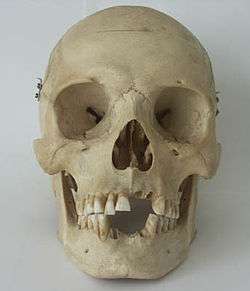
Front view of a human (Homo sapiens's) skull
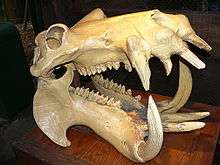
The skull of a hippopotamus
Etymology 1
From Middle English scolle, probably from Old Norse skalli (“bald head, skull”), itself probably related to Old English scealu (“husk”). Compare Swedish skulle, Norwegian skalle. [1]
Alternative forms
- scull (obsolete)
Pronunciation
- enPR: skŭl, sko͝ol, IPA(key): /skʌl/, /skʊl/
Audio (US) (file) - Homophone: scull
- Rhymes: -ʌl, -ʊl
Noun
skull (plural skulls)
- (anatomy) The main bones of the head considered as a unit; the cranium.
- 1922, Virginia Woolf, Jacob's Room Chapter 1
- He was about to roar when, lying among the black sticks and straw under the cliff, he saw a whole skull—perhaps a cow's skull, a skull, perhaps, with the teeth in it. Sobbing, but absent-mindedly, he ran farther and farther away until he held the skull in his arms.
- 1922, Virginia Woolf, Jacob's Room Chapter 1
- A symbol for death; death's-head
- A crust formed on the ladle, etc. by the partial cooling of molten metal.
- The crown of the headpiece in armour.
- (Scotland) A shallow bow-handled basket.
Synonyms
Meronyms
- Thesaurus:skull
Derived terms
Translations
cranium
|
|


death's-head, skull
See also
Verb
skull (third-person singular simple present skulls, present participle skulling, simple past and past participle skulled)
- To hit in the head with a fist, a weapon, or a thrown object.
References
Etymology 2
See school (“a multitude”).
Noun
skull (plural skulls)
- Obsolete form of school.
- 1586, William Warner, Albion’s England:
- A knavish skull of boys and girls did pelt at him.
- 1601, Philemon Holland (translator), Pliny the Elder (author), The Historie of the World. Commonly called, The Natvrall Historie of C. Plinivs Secvndvs., book IX, chapter xv: “Of the names and natures of many fishes.”:
- These fishs, togither with the old Tunies and the young, called Pelamides, enter in great flotes and skulls, into the sea Pontus, for the sweet food that they there find: and every companie of them hath their fever all leaders and captaines; and before them all, the Maquerels lead the way; which, while they be in the water, have a colour of brimstone; but without, like they be to the rest.
- 1586, William Warner, Albion’s England:
Part or all of this entry has been imported from the 1913 edition of Webster’s Dictionary, which is now free of copyright and hence in the public domain. The imported definitions may be significantly out of date, and any more recent senses may be completely missing.
(See the entry for skull in Webster’s Revised Unabridged Dictionary, G. & C. Merriam, 1913.)
Anagrams
Swedish
Pronunciation
- IPA(key): /skɵlː/
Noun
skull c
- (on someone's) behalf; an archaic form of skuld (debt), used to indicate for whom or why something is done
- för min skull
- for me, because of me, on my behalf
- För edra hjärtans hårdhets skull tillstadde Moses eder att skiljas från edra hustrur
- Moses because of the hardness of your hearts suffered you to put away your wives (Matthew 19:8)
- för min skull
Related terms
This article is issued from
Wiktionary.
The text is licensed under Creative Commons - Attribution - Sharealike.
Additional terms may apply for the media files.