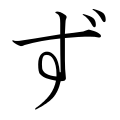
ず
See also: す
 | ||||||||||
Japanese
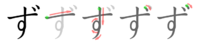
| Stroke order | |||
|---|---|---|---|
 | |||
Pronunciation
Etymology 1
The hiragana character す (su) with a dakuten (゛).
Syllable
ず (romaji zu)
- The hiragana syllable ず (zu). Its equivalent in katakana is ズ (zu).
See also
Etymology 2
From Old Japanese. Generally considered to be a combination of negation suffix ぬ (nu) in its 連用形 (ren'yōkei, “continuative or stem form”) of に (ni) + honorific suffix す (su).[1][2][3]
/nisu/ → */nzu/ → /zu/
Appears both as zu and as the older nisu form in the Man'yōshū poetry anthology.
Suffix
ず (rōmaji -zu)
- not
- 何も知らず
- nani mo shirazu
- not knowing anything
- 何も知らず
Usage notes
Much as the older negation suffix ぬ (nu) and the modern negation suffix ない (nai), ず (zu) must come after the 未然形 (mizenkei, “irrealis or incomplete form”) of a verb.
The suffix ず (zu) is more formal than the everyday negation suffix ない (nai).
Etymology 3
The reading for various kanji.
Noun
ず (rōmaji zu)
Verb
ず (nidan conjugation, rōmaji zu)
- 出: (obsolete) come out
References
This article is issued from
Wiktionary.
The text is licensed under Creative Commons - Attribution - Sharealike.
Additional terms may apply for the media files.