上
| ||||||||
Translingual
| Stroke order | |||
|---|---|---|---|
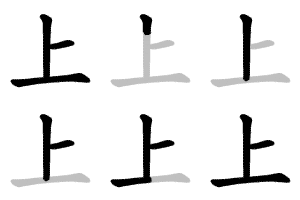 | |||
| Stroke order | |||
|---|---|---|---|
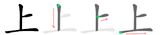 | |||
Han character
上 (radical 1, 一+2, 3 strokes, cangjie input 卜一 (YM), four-corner 21100, composition ⿱卜一)
References
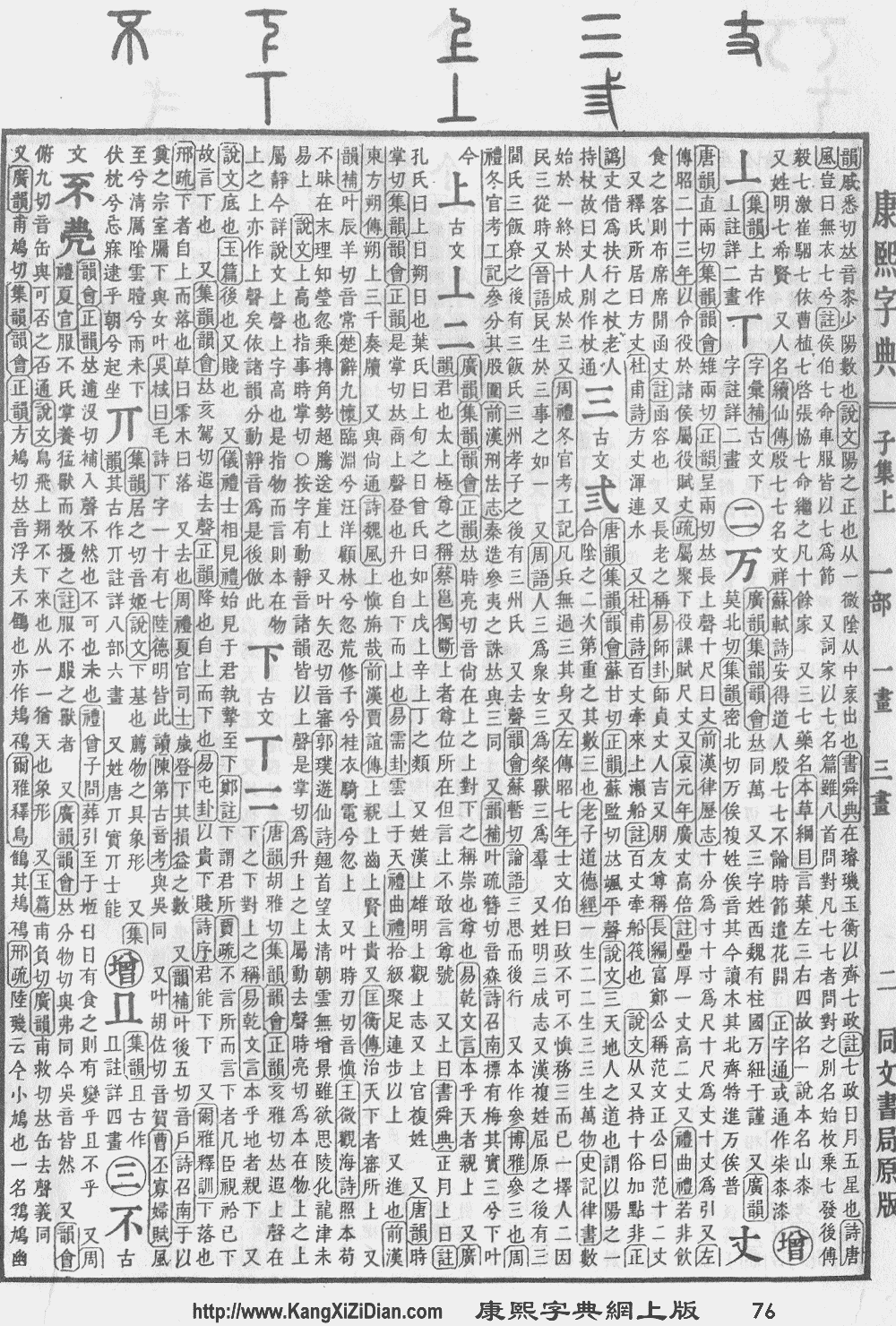
- KangXi: page 76, character 7
- Dai Kanwa Jiten: character 13
- Dae Jaweon: page 145, character 1
- Hanyu Da Zidian: volume 1, page 5, character 4
- Unihan data for U+4E0A
Chinese
| simp. and trad. |
上 | |
|---|---|---|
| alt. forms | 丄 𠄞 尚 Min Nan “most” | |
Glyph origin
| Historical forms of the character 上 | |||||||||||||||||||||||||||||||||||||||||||||||||||||||||
|---|---|---|---|---|---|---|---|---|---|---|---|---|---|---|---|---|---|---|---|---|---|---|---|---|---|---|---|---|---|---|---|---|---|---|---|---|---|---|---|---|---|---|---|---|---|---|---|---|---|---|---|---|---|---|---|---|---|
| Shang | Western Zhou | Warring States | Shuowen Jiezi (compiled in Han) | Liushutong (compiled in Ming) | |||||||||||||||||||||||||||||||||||||||||||||||||||||
| Oracle bone script | Bronze inscriptions | Chu Slip and silk script | Qin slip script | Ancient script | Small seal script | Transcribed ancient scripts | |||||||||||||||||||||||||||||||||||||||||||||||||||
 |
 |
 |
 |
 |
 |
 | |||||||||||||||||||||||||||||||||||||||||||||||||||
||||||
|
References: Mostly from Richard Sears' Chinese Etymology site (authorisation),
| |||||||||||||||||||||||||||||||||||||||||||||||||||||||||


| Characters in the same phonetic series (上) (Zhengzhang, 2003) | |
|---|---|
| Old Chinese | |
| 丄 | *djaŋʔ, *djaŋs |
| 上 | *djaŋʔ, *djaŋs |
Etymology 1
Pronunciation 1
Definitions
上
Pronunciation 2
Definitions
上
- to go up; to ascend
- to go to; to leave for (a place)
- to board; to get on
- to attend (class, work)
- to enter (a field); to appear (on stage)
- to fit; to install; to apply
- to screw; to tighten, to twist
- (colloquial) Short for 上線 (“to go online”).
- to connect to; browse (a website)
- (Min) to pull upwards or hang with a rope
- (Min Nan) to grow and attach
- (Xiamen Min Nan) to pile up
- (vulgar, of a male) to fuck; to have intercourse with a female
- Particle following verbs, indicating direction or achievement.
- 7th tetragram of the Taixuanjing
Pronunciation 3
Definitions
上
Compounds
|
|
|
Etymology 2
| For pronunciation and definitions of 上 – see 緔. (This character, 上, is the second-round simplified form of 緔.) |
Notes:
|
Etymology 3
| For pronunciation and definitions of 上 – see 鞝 (“the piece of leather used for soles on Chinese shoes. a patch”). (This character, 上, is the second-round simplified form of 鞝.) |
Notes:
|
Japanese
Kanji
- above, high, up
- earlier
- excellent, top
- certain time or place in the past
- limit
- climb, rise
- offer
- go to the center
- raise, bring up
- one of the four tones of Middle Chinese
- Kōzuke Province
Readings
- Goon: じょう (jō, Jōyō)←じやう (zyau, historical)
- Kan’on: しょう (shō, Jōyō, uncommon)←しやう (syau, historical)
- Sōon: しゃん (shan)←しやん (syan, historical)
- Kun: うえ (ue, 上, Jōyō)←うへ (ufe, historical); うわ (uwa, 上, Jōyō, uncommon)←うは (ufa, historical); かみ (kami, 上, Jōyō); あげる (ageru, 上げる, Jōyō); あがる (agaru, 上がる, Jōyō); のぼる (noboru, 上る, Jōyō); のぼす (nobosu, 上す, Jōyō); のぼせる (noboseru, 上せる, Jōyō); たてまつる (tatematsuru, 上る); ほとり (hotori, 上)
Compounds
Etymology 1
| Kanji in this term |
|---|
| 上 |
| うえ Grade: 1 |
| kun’yomi |
⟨upe1⟩ → */upwe/ → /ufe/ → /uwe/ → /ue/
From Old Japanese.
Bound apophonic form of uwa, ancient upa (see below), possibly by fusion with an empathic particle い (i).
Pronunciation
Noun
上 (hiragana うえ, rōmaji ue, historical hiragana うへ)
Antonyms
- 下 (shita)
Derived terms
Idioms
- 上に立つ (ue ni tatsu)
- 上には上がある (ue ni wa ue ga aru)
- 上見ぬ鷲 (ue minu washi)
- 上を行く (ue o iku)
- 上を下へ (ue o shita e)
- 上を見る (ue o miru)
Suffix
- suffix addressing to a superior
Derived terms
- 姉上 (ane-ue)
- 父上 (chichi-ue)
- 母上 (haha-ue)
Etymology 2
| Kanji in this term |
|---|
| 上 |
| うわ Grade: 1 |
| kun’yomi |
/upa/ → /ufa/ → /uwa/
From Old Japanese. The combining form of ue, ancient upe (see above).[1]
Noun
上 (hiragana うわ, rōmaji uwa, historical hiragana うは)
Derived terms
- 上上, 浮浮 (uwauwa)
- 上顎 (uwaago)
- 上臼 (uwausu)
- 上絵 (uwae)
- 上枝 (uwaeda)
- 上襟, 上衿, 上領 (uwaeri)
- 上帯 (uwaobi)
- 浮気 (uwaki)
- 上着 (uwagi)
- 上衣 (uwagi)
- 噂 (uwasa)
- 上棚, 上枻 (uwadana)
- 上手 (uwate)
- 上剥げ (uwahage)
- 後妻 (uwanari)
- 上荷 (uwani)
- 上値 (uwane)
- 上歯 (uwaba)
- 上履, 上履き (uwabaki)
- 上張, 上張り (uwabari)
- 上翳 (uwahi)
- 上辺 (uwabe)
- 上目 (uwame)
- 上屋 (uwaya)
Etymology 3
| Kanji in this term |
|---|
| 上 |
| へ Grade: 1 |
| kun’yomi |
| Kanji in this term |
|---|
| 上 |
| え Grade: 1 |
| Irregular |
⟨upe1⟩ → */ipe/ → ⟨pe1⟩ → */pwe/ → /fe/ → /he/
Short-form of or shift from ue, ancient upe (see above). Realized as -e in some compounds.
Usage notes
The senses are the same with ue.
Derived terms
- 尾上 (onoe)
Etymology 4
| Kanji in this term |
|---|
| 上 |
| かみ Grade: 1 |
| kun’yomi |
⟨kami1⟩ → */kamʲi/ → /kami/
From Old Japanese.
Bound apophonic form of ancient kamu (see kan below), possibly by fusion with an empathic particle い (i).
Distinct from 神 (/kami2/ → kami, “Shinto deity”).
Pronunciation
Noun
Antonyms
- 下 (shimo)
Derived terms
Idioms
- 上漏り下潤う (kami mori shimo uruou)
- 上を学ぶ下 (kami o manabu shimo)
Etymology 5
| Kanji in this term |
|---|
| 上 |
| かん Grade: 1 |
| kun’yomi |
/kamu/ → /kaɴ/
Shift from Old Japanese combining form kamu.
Usage notes
The senses are the same with kami.
Etymology 6
| Kanji in this term |
|---|
| 上 |
| じょう Grade: 1 |
| kun’yomi |
/d͡ʑɨau/ → /zjau/ → /zjɔː/ → /d͡ʑoː/
From Middle Chinese 上 (MC d͡ʑɨɐŋX, d͡ʑɨɐŋH).
Pronunciation
Noun
上 (hiragana じょう, rōmaji jō, historical hiragana じやう)
Derived terms
Suffix
上 (hiragana じょう, rōmaji -jō, historical hiragana じやう)
- from the standpoint of
- 理論上はありえないこと
- riron-jō wa arienai koto
- something that is impossible according to theory
- 法律上の争訟
- hōritsu-jō no sōchō
- legal dispute
- 理論上はありえないこと
- aboard (a plane or ship)
- above, in, on
Derived terms
References
Korean
Hanja
- This term needs a translation to English. Please help out and add a translation, then remove the text
{{rfdef}}.
References
Vietnamese
Han character
上 (thượng)