度
| ||||||||
Translingual
| Stroke order | |||
|---|---|---|---|
 | |||
Han character
度 (radical 53, 广+6, 9 strokes, cangjie input 戈廿水 (ITE), four-corner 00247, composition ⿸广⿱廿又)
Derived characters
References
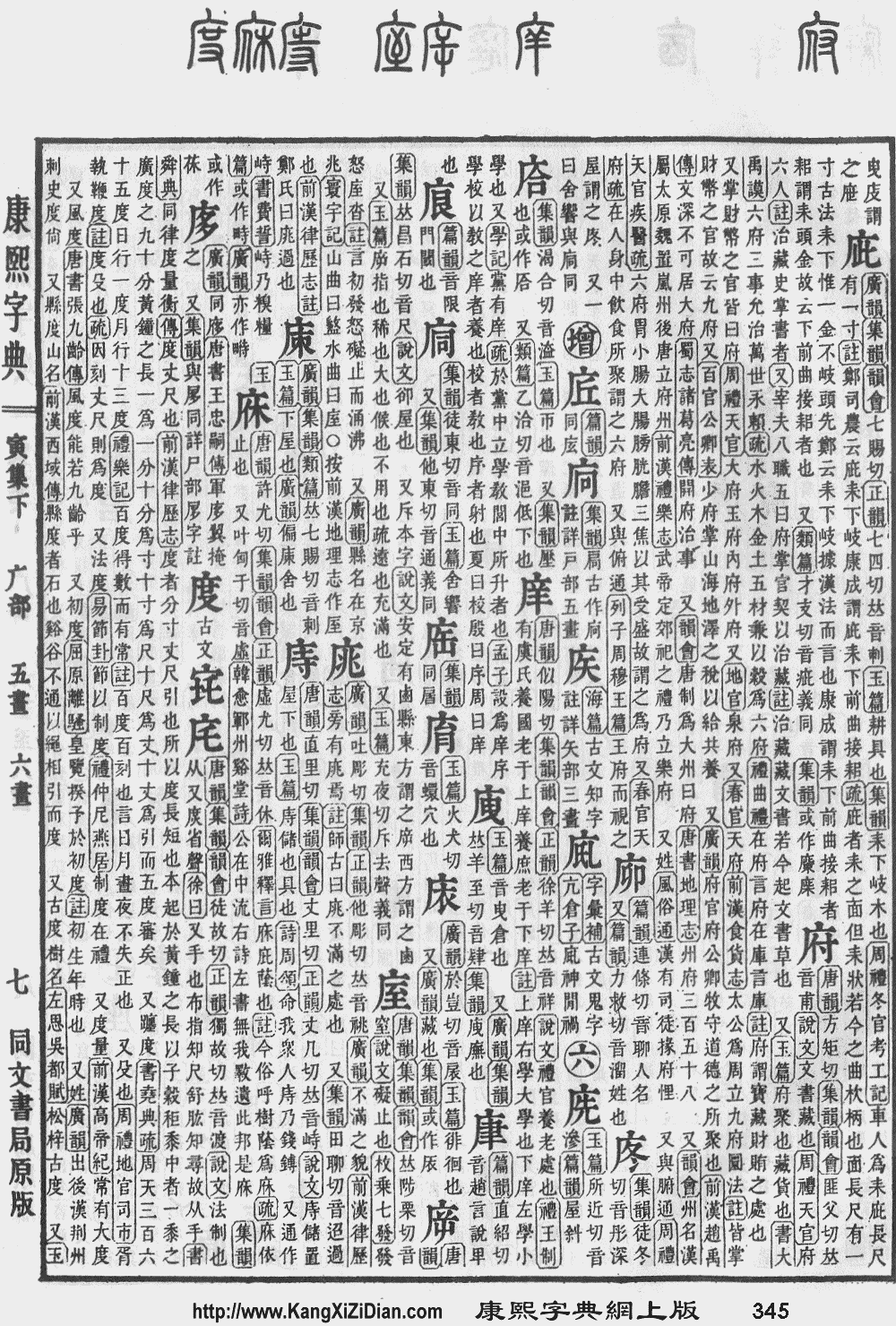
- KangXi: page 345, character 26
- Dai Kanwa Jiten: character 9313
- Dae Jaweon: page 655, character 15
- Hanyu Da Zidian: volume 2, page 880, character 6
- Unihan data for U+5EA6
Chinese
Glyph origin
| Characters in the same phonetic series (庶) (Zhengzhang, 2003) | |
|---|---|
| Old Chinese | |
| 褯 | *zljaːɡs |
| 遮 | *tjaː |
| 蔗 | *tjaːɡs |
| 鷓 | *tjaːɡs |
| 樜 | *tjaːɡs, *hljaɡs |
| 蟅 | *tjaːɡs, *tjaːɡ |
| 嗻 | *tjaːɡs |
| 鍍 | *daː, *daːɡs |
| 度 | *daːɡs, *daːɡ |
| 渡 | *daːɡs |
| 庶 | *hljaɡs |
| 剫 | *daːɡ |
| 踱 | *daːɡ |
| 喥 | *daːɡ |
| 謶 | *tjaɡ |
| 席 | *ljaːɡ |
| 蓆 | *ljaːɡ |
| 墌 | *tjaːɡ |
| 摭 | *tjaːɡ |
| 蹠 | *tjaːɡ |
Originally an ideogrammic compound (會意) : 石 (“rock”) + 又 (“hand”) — hand measuring a piece of rock. Also a phono-semantic compound (形聲) , with 石 (OC *djaɡ) as a phonetic component. 石 is then corrupted into ⿸广廿.
Shuowen considers it to be a phono-semantic compound (形聲, OC *daːɡs, *daːɡ) : phonetic 庶 (OC *hljaɡs) + semantic 又.
Etymology 1
| simp. and trad. |
度 | |
|---|---|---|
From Proto-Sino-Tibetan *m-twa (“handspan”). Cognate with Tibetan མཐོ (mtho, “span; span of thumb and middle finger”), Burmese ထွာ (htwa, “to measure by a handspan; a quarter yard”), အထွာ (a.htwa, “handspan; quarter yard”), တွက် (twak, “to consider, to reckon; to calculate; to refuse to do things because others would not”), အတွက် (a.twak, “calculation; because of; for the sake of”). It is unclear whether Proto-Mon-Khmer *cɗaʔ (“span; handspan”) (whence Mon ဍ (daˀ, “to measure by spans of thumb and middle finger”)) is related. Related to 圖 (OC *daː, “to plan; to consider; plan; map”).
Pronunciation 1
Definitions
度
- linear measure; size; measures
- 52nd tetragram of the Taixuanjing; "measure"
- consideration; thought; expectation
- law; standard; rule; convention
- extent; limit; quota
- tolerance; open-mindedness
- degree; level; measure (often used to translate English -ness, -ity)
- 色度 ― sèdù ― color saturation
- plan; design; programme
- to pass (time); to spend time
- to pass (physically); to go over
- (Buddhism) to say prayers or perform Buddhist service to release souls from purgatory
- (religion) to try to persuade someone to become a monk, nun or Taoist priest
- to write; to compose
- Classifier for degrees.
- (physics) Classifier for kilowatt-hour.
- (ophthalmology) Classifier for 0.01 dioptres.
- Classifier for alcohol concentration: percent
- Classifier for events or occurrences: time
- A surname.
Compounds
|
|
|
Pronunciation 2
Definitions
度
Compounds
Etymology 2
| simp. and trad. |
度 | |
|---|---|---|
| alt. forms | 道 | |
Pronunciation
Definitions
度
(Cantonese)
- Used to indicate location of something.
Synonyms
Compounds
See also
Etymology 3
| For pronunciation and definitions of 度 – see 宅 (“residence; dwelling; house; home; tomb; grave; etc.”). (This character, 度, is a variant form of 宅.) |
Japanese
Kanji
Readings
Compounds
Noun
See also
- 時 (toki)
Counter
度 (hiragana たび, rōmaji -tabi)
Suffix
- (geometry) degree of an angle
- degree in temperature, scale, and so on
- number of times
- percentage of alcohol concentration
度 (hiragana たび, rōmaji -tabi)
Korean
Hanja
度 • (do, tak) (hangeul 도, 탁, revised do, tak, McCune–Reischauer to, t'ak)
- This term needs a translation to English. Please help out and add a translation, then remove the text
{{rfdef}}.
Vietnamese
Han character
度 (độ, dạc, đác, đạc, đọ, đủ, đù, dác, đo, đồ, đợ)
- This term needs a translation to English. Please help out and add a translation, then remove the text
{{rfdef}}.