ど
See also: と
 | ||||||||||
Japanese
| Stroke order | |||
|---|---|---|---|
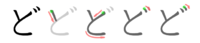 | |||
Pronunciation
- IPA(key): [do̞]
Etymology 1
The hiragana character と (to) with a dakuten (゛).
Syllable
ど (romaji do)
- The hiragana syllable ど (do). Its equivalent in katakana is ド (do).
See also
Etymology 2
Appears to be a relatively recent innovation. In mainstream Japanese, this prefix is used as an intensifier. In the Kansai region, the meaning has further developed to convey more negative overtones.[1][2]
The ultimate derivation is unclear. This may be an extension of the noun 度 (do, “degree, extent”).
Prefix
ど (rōmaji do-)
- super-
- どあほ
- do-aho
- dumbass
- 2015, 谷川ニコ, 『私がモテないのはどう考えてもお前らが悪い!』喪79, ガンガンONLINE:
- 八ツ橋のやわらかさは小学生のおっぱいと同じ… まじかよ 京都人ってど変態だな…
- Yatsuhashi no yawarakasa wa shōgakusei no oppai to onaji… maji ka yo Kyōto-jin tte do-hentai da na…
- Yatsuhashi are as soft as the tits of an elementary schooler… You serious? Kyoto must be seriously perverted…
- 八ツ橋のやわらかさは小学生のおっぱいと同じ… まじかよ 京都人ってど変態だな…
- どあほ
Etymology 3
Reading of various kanji characters.
Noun
ど (rōmaji do)
- 度: degree, extent
- 努: the third of the Eight Principles of Yong
Prefix
ど (rōmaji do-)
- 何: indeterminate prefix, used to form question words such as 何れ (dore, “which”, literally “which one”) or 何処 (doko, “where”, literally “what place”)
Suffix
ど (rōmaji -do)
References
This article is issued from
Wiktionary.
The text is licensed under Creative Commons - Attribution - Sharealike.
Additional terms may apply for the media files.