那
See also: 哪
| ||||||||
Translingual
| Stroke order | |||
|---|---|---|---|
 | |||
| Stroke order | |||
|---|---|---|---|
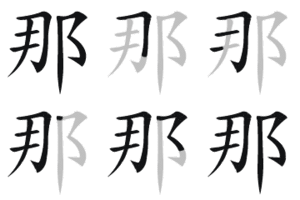 | |||
Han character
那 (radical 163, 邑+4, 7 strokes, cangjie input 尸手弓中 (SQNL), four-corner 17527, composition ⿰冄阝)
References
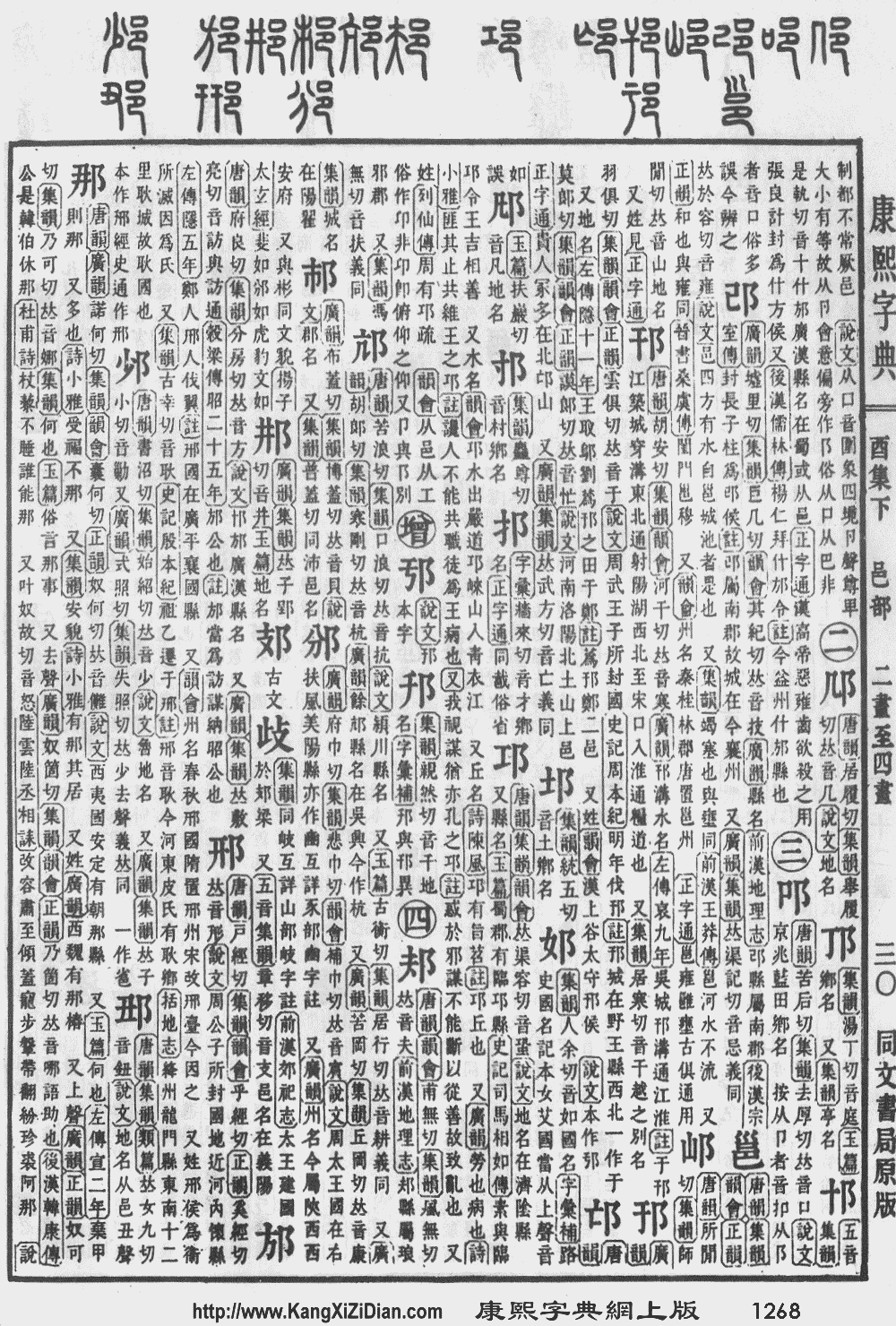
- KangXi: page 1268, character 30
- Dai Kanwa Jiten: character 39305
- Dae Jaweon: page 1767, character 21
- Hanyu Da Zidian: volume 6, page 3760, character 4
- Unihan data for U+90A3
Chinese
| simp. and trad. |
那 | |
|---|---|---|
| alt. forms | 𨚉 𨙻 𨚗 | |
Glyph origin
| Historical forms of the character 那 |
|---|
| Shuowen Jiezi (compiled in Han) |
| Small seal script |
 |
| Characters in the same phonetic series (冉) (Zhengzhang, 2003) | |
|---|---|
| Old Chinese | |
| 那 | *naːl, *naːlʔ, *naːls |
| 挪 | *naːl |
| 娜 | *naːlʔ |
| 柟 | *noːm, *njam, *njamʔ |
| 抩 | *noːm |
| 聃 | *n̥ʰaːm, *n̥ʰaːm |
| 舑 | *n̥ʰaːm, *njam |
| 坍 | *n̥ʰaːm |
| 髯 | *njam, *njams |
| 蚺 | *njam |
| 呥 | *njam |
| 冉 | *njam, *njamʔ |
| 袡 | *njam |
| 苒 | *njamʔ |
| 姌 | *njamʔ, *neːmʔ |
Phono-semantic compound (形聲, OC *naːl, *naːlʔ, *naːls) : phonetic 冄 (OC *njam, *njamʔ) + semantic 邑 (“city”).
Originally the name of a state; later borrowed for a distal demonstrative.
Etymology 1
Cognate with 若 (OC *njaɡ, “that”), 爾 (MC ȵiᴇX, “that”) (Norman, 1988). Also compare (Schuessler, 2007):
- Proto-Mon-Khmer *nɔʔ ~ *nɔh (“this”), whence Khmer នោះ (nuh, “that”), Vietnamese nọ (“this”);
- Khmu [script needed] (naa, “she”);
- Proto-Tai *najᶜ (“this”), whence Thai นี้ (níi, “this”), Zhuang neix (“this”).
Pronunciation
Definitions
那
- that; those
- 那年我將近十歲,住在四川成都郊區的百花橋。 [MSC, trad.]
- From: Dàshuǐ Guòhòu (After the Flood)
- Nà nián wǒ jiāngjìn shí suì, zhù zài Sìchuān Chéngdōu jiāoqū de Bǎihuāqiáo. [Pinyin]
- That year, I was about ten years old, living in Sichuan Province in a suburb of Chengdu city called Hundred Flowers.
那年我将近十岁,住在四川成都郊区的百花桥。 [MSC, simp.]
- (Can we clean up(+) this sense?) Used after 咋 (zǎ), 咋就. so; that
- then; in that case
Synonyms
| Dialectal synonyms of 那 (“that”) [map] | ||
|---|---|---|
| Variety | Location | Words |
| Formal (Written Standard Chinese) | 那 | |
| Mandarin | Beijing | 那 |
| Taiwan | 那 | |
| Tianjin | 那 | |
| Cantonese | Guangzhou | 嗰 |
| Hong Kong | 嗰 | |
| Taishan | 嚀、𡃕 | |
| Hakka | Miaoli (N. Sixian) | 該 |
| Liudui (S. Sixian) | 該 | |
| Hsinchu (Hailu) | 該 | |
| Dongshi (Dabu) | 該 | |
| Zhuolan (Raoping) | 該 | |
| Yunlin (Zhao'an) | 遐 | |
| Min Dong | Fuzhou | 許 |
| Min Nan | Xiamen | 彼、許 |
| Quanzhou | 彼、許 | |
| Zhangzhou | 彼、許 | |
| Taipei | 彼 | |
| Kaohsiung | 彼 | |
| Penang | 彼 | |
| Chaozhou | 許 | |
| Shantou | 許 | |
| Wu | Shanghai | 埃、伊 |
| Wenzhou | 許 | |
Compounds
Derived terms from 那
Etymology 2
Pronunciation
Definitions
那
- (dated) Alternative form of 哪 (nǎ, “which; where”).
Compounds
Etymology 3
Pronunciation
Definitions
那
- † many; much
- 不戢不難,受福不那。 [Classical Chinese, trad.]
- From: The Classic of Poetry, circa 11th – 7th centuries BCE, translated based on James Legge's version
- Bù jí bù nán, shòu fú bù nuó. [Pinyin]
- Are they not self-restrained? Are they not careful?
Will they not receive much happiness?
不戢不难,受福不那。 [Classical Chinese, simp.]
- † beautiful
- † calm; tranquil
- 王在在鎬,有那其居。 [Classical Chinese, trad.]
- From: The Classic of Poetry, circa 11th – 7th centuries BCE, translated based on James Legge's version
- Wáng zài zài Hào, yǒu nuó qí jū. [Pinyin]
- The king is here, here in Hao,
Dwelling in tranquillity.
王在在镐,有那其居。 [Classical Chinese, simp.]
- (historical) Nuo (a state)
- A surname.
Compounds
Etymology 4
Fusion of 如何 (OC *nja ɡaːl) or 奈何 (OC *naːls ɡaːl).
Pronunciation
Definitions
那
- † how
Etymology 5
Pronunciation
Definitions
那
- † Alternative form of 挪 (nuó, “to move”).
Compounds
Derived terms from 那
|
|
|
Etymology 6
Pronunciation
Definitions
那
Compounds
Derived terms from 那
|
Etymology 7
Pronunciation
Definitions
那
Etymology 8
Pronunciation
Definitions
那
Japanese
Kanji
那
Readings
Compounds
- 与那原 (yonabaru)
Korean
Hanja
那 • (na) (hangeul 나, revised na, McCune–Reischauer na, Yale na)
- This term needs a translation to English. Please help out and add a translation, then remove the text
{{rfdef}}.
Vietnamese
Han character
- This term needs a translation to English. Please help out and add a translation, then remove the text
{{rfdef}}.
This article is issued from
Wiktionary.
The text is licensed under Creative Commons - Attribution - Sharealike.
Additional terms may apply for the media files.