象
| ||||||||
Translingual
| Japanese | 象 |
|---|---|
| Simplified | 象 |
| Traditional | 象 |
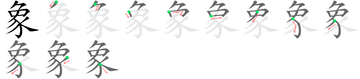
| Stroke order | |||
|---|---|---|---|
 | |||
Alternative forms
In simplified Chinese and Vietnamese, the middle component of 象 is written 口 overlapped by a downward ㇓ slash. In traditional Chinese, Korean and Japanese, the middle section is written 𫩏 followed by 𧰨.
Han character
象 (radical 152, 豕+4 in Chinese, 豕+5 in Japanese, 11 strokes in Chinese, 12 strokes in Japanese, cangjie input 弓日心人 (NAPO), four-corner 27232, composition ⿱⺈⿻口𧰨(GV) or ⿳⺈𫩏𧰨(HTJK))
References
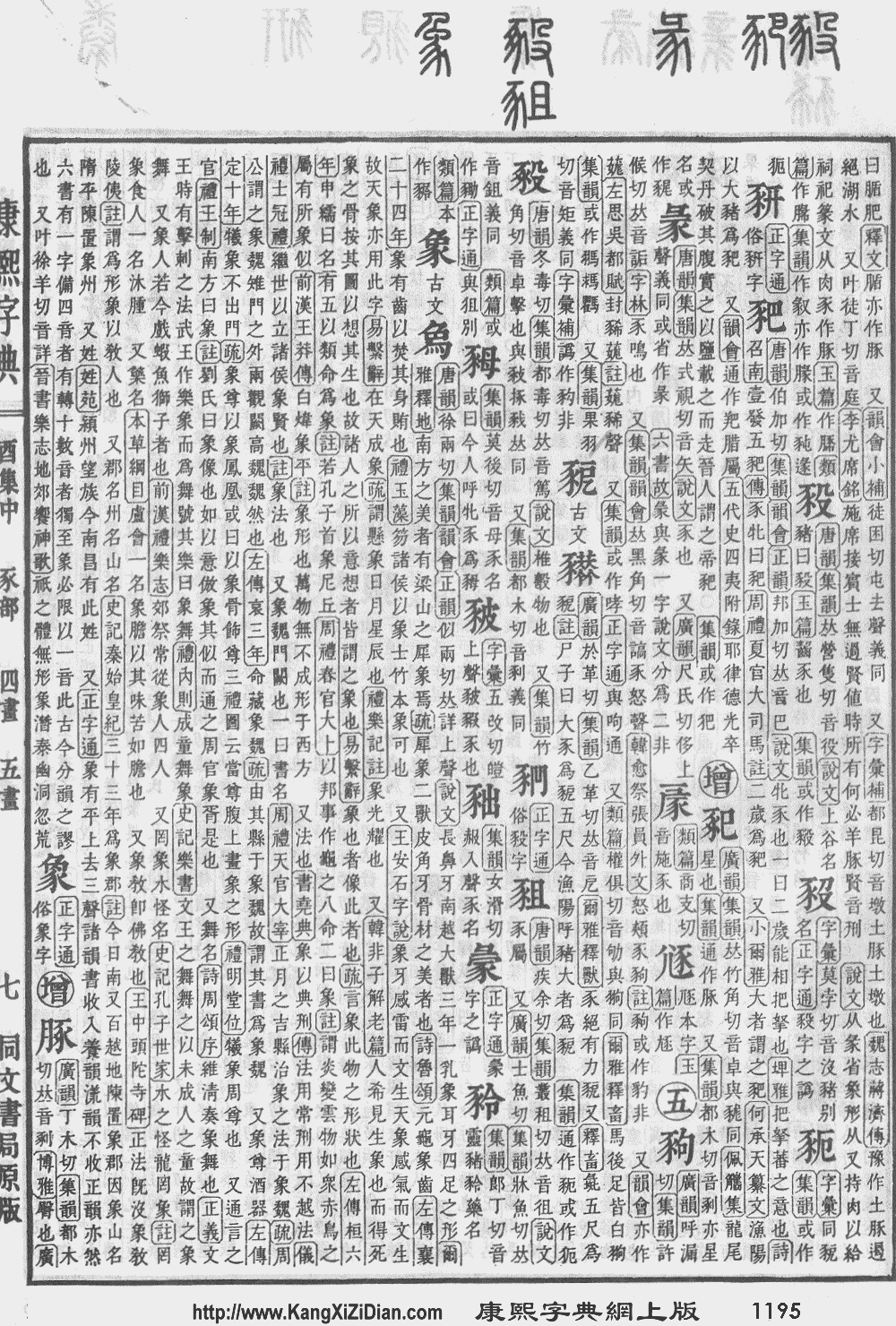
- KangXi: page 1195, character 21
- Dai Kanwa Jiten: character 36372
- Dae Jaweon: page 1658, character 1
- Hanyu Da Zidian: volume 6, page 3611, character 9
- Unihan data for U+8C61
Chinese
| simp. and trad. |
象 | |
|---|---|---|
Glyph origin
| Historical forms of the character 象 | |||
|---|---|---|---|
| Shang | Western Zhou | Shuowen Jiezi (compiled in Han) | Liushutong (compiled in Ming) |
| Oracle bone script | Bronze inscriptions | Small seal script | Transcribed ancient scripts |
 |
 |
 |
 |
| Characters in the same phonetic series (象) (Zhengzhang, 2003) | |
|---|---|
| Old Chinese | |
| 潒 | *l'aːŋʔ, *ljaŋʔ |
| 像 | *ljaŋʔ |
| 象 | *ljaŋʔ |
| 橡 | *ljaŋʔ |
| 蟓 | *ljaŋʔ, *hljaŋs |
| 襐 | *ljaŋʔ |
| 勨 | *ljaŋʔ, *laŋʔ |
| 鱌 | *ljaŋʔ |
| 嶑 | *ljaŋʔ |
Pictogram (象形) - pictographic representation of an elephant. ⺈ represents the trunk, 𫩏 represents the head, and 𧰨 represents the body.
Etymology 1
This character is used to represent two semantic fields ‘elephant; tusk’ and ‘to outline; to depict; to delineate; to represent; to resemble; to map’. Both fields are found from the earliest layers of the edited literature onwards, whereas only the first meaning is amply attested in oracle bone inscriptions.
Traditionally, the two senses are treated as related, with the sense of ‘to depict; to resemble’ considered a derivative of the sense of ‘elephant’. The derivation from the ‘elephant’ meaning to the ‘likeness’ meaning is explained in Han Feizi [ca. 221 BCE]: “Men rarely see living elephants. As they come by the skeleton of a dead elephant, they imagine its living form according to its features. Therefore it comes to pass that whatever people use for imagining the real is called 象.”
Modern etymology studies on Old Chinese have challenged this opinion.
As for the ‘elephant; tusk’ sense, this is a widely used area word in East and Southeast Asia. Literature opinions differ on the origin and immediate relationship of this Chinese word; some (e.g. Schuessler, 2007) believe the Chinese form is a loanword from a Southern language, since “it is hard to believe that people all over SE Asia and as far away as the Himalayan foothills would borrow a word for an indigenous animal from Northern China”. Others believe the direction of borrowing is reversed (i.e. Tai-Kadai borrowing from Chinese), and that Chinese 象 should be compared with Tibetan གླང (glang), གླང་ཆེན (glang chen, “elephant”) arising from a common Proto-Sino-Tibetan *glaŋ (“ox, bull; elephant”), which may ultimately have an Austroasiatic origin. The second viewpoint is supported by the early attestation of this character and the archaeological findings of the historical ranges of elephants.
See below for a tentative borrowing history of the various forms of this general area word.
Pronunciation
Definitions

象
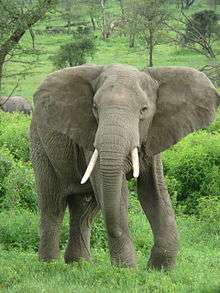
- elephant (Classifier: 頭/头 m)
- ivory; tusk
- Synonyms: 象牙 (xiàngyá)
- (Chinese chess) elephant (on the black side)
- Synonyms: 相 (xiāng)
- symbol; emblem
- shape; figure
- appearance; phenomenon
- (traditional Chinese medicine) complexion
- 病象 ― bìngxiàng ― disease signs and symptoms
- image; picture; portrait
- ⇒ 像
- sign; indication
- imagination
- law; legislation
- principle
- calendar
- to imitate; to follow the example of
- to trace; to outline; to depict
- to resemble
- ⇒ 像
- 象形字 ― xiàngxíngzì ― pictographic character
- like; similar to
- ⇒ 像
- A surname.
- (historical) an alternate name used for the Nanman tribes during the Ming Dynasty
Synonyms
| Dialectal synonyms of 大象 (“elephant”) [map] | ||
|---|---|---|
| Variety | Location | Words |
| Classical Chinese | 象 | |
| Formal (Written Standard Chinese) | 象 | |
| Taxonomic name | 象 | |
| Mandarin | Beijing | 大象 |
| Taiwan | 大象 | |
| Luoyang | 象 | |
| Jiedian | 象 | |
| Xi'an | 象 | |
| Ürümqi | 象 | |
| Wuhan | 象 | |
| Chengdu | 象 | |
| Guiyang | 象 | |
| Cantonese | Guangzhou | 大笨象 |
| Hong Kong | 大笨象 | |
| Dongguan | 大笨象 | |
| Taishan | 大笨象 | |
| Nanning | 大笨象 | |
| Wuzhou | 大笨象 | |
| Hepu | 大象 | |
| Gan | Nanchang | 象 |
| Hakka | Meixian | 象 |
| Miaoli (N. Sixian) | 象仔、大象 | |
| Liudui (S. Sixian) | 象仔、大象 | |
| Hsinchu (Hailu) | 象、大象 | |
| Dongshi (Dabu) | 象、大象 | |
| Zhuolan (Raoping) | 象、大象 | |
| Yunlin (Zhao'an) | 象、大象 | |
| Jin | Taiyuan | 象 |
| Min Bei | Jian'ou | 象 |
| Min Nan | Xiamen | 象 |
| Quanzhou | 象 | |
| Zhangzhou | 象 | |
| Penang | 象 | |
| Philippines (Manila) | 象 | |
| Pingnan | 象 | |
| Haikou | 象 | |
| Pinghua | Nanning | 大象 |
| Guilin | 象 | |
| Wu | Shanghai | 象、象鼻頭 |
| Suzhou | 象 | |
| Hangzhou | 象 | |
| Chongming | 象 | |
| Danyang | 象 | |
| Xiang | Quanzhou | 大象 |
Coordinate terms
Compounds
|
|
|
Descendants
Proto-Sino-Tibetan *glaŋ (“ox, bull; elephant”) (?)
- Old Chinese: 象 (*C.laŋʔ)
- Late Han Chinese: 象 (ziɑŋB)
- → Proto-Vietic *ʔa-ɟaːŋ (“elephant”)
- Early Middle Chinese: 象 (zɨaŋB)
- Late Han Chinese: 象 (ziɑŋB)
Etymology 2
| For pronunciation and definitions of 象 – see 像 (“picture; image; figure; statue; figure; sculpture; etc.”). (This character, 象, is the former (1964-1986) first-round simplified form of 像.) |
Notes:
|
Usage notes
- 象 was the official simplified form of 像 only until 1986.
Japanese
Kanji
Readings
Etymology 1
.jpg)
| Kanji in this term |
|---|
| 象 |
| ぞう Grade: 4 |
| on’yomi |
/zau/ → /zɔː/ → /zoː/
From Middle Chinese 象 (zjangX, “elephant; image, resemblance”). Compare modern Cantonese reading zoeng6.
The goon reading, so likely the initial borrowing.
Pronunciation
Noun
象 (counter 頭, hiragana ぞう, katakana ゾウ, rōmaji zō, historical hiragana ざう)
Derived terms
- アジア象 (ajiazō): Asian elephant
- アフリカ象 (afurikazō): African elephant
- インド象 (indozō): Indian elephant
- 象嵌 (zōgan), 象眼 (zōgan): inlay
- 象牙 (zōge): ivory
- 象牙の塔 (zōgenotō): ivory tower
Etymology 2
| Kanji in this term |
|---|
| 象 |
| しょう Grade: 4 |
| on’yomi |
/sjau/ → /sjɔː/ → /ɕɔː/ → /ɕoː/
From Middle Chinese 象 (zjangX, “elephant; image, resemblance”). Compare modern Min Nan reading siōng or Mandarin xiàng.
The kan'on reading, so likely a later borrowing.
Pronunciation
Noun
象 (hiragana しょう, rōmaji shō, historical hiragana しやう)
Derived terms
- 象形 (shōkei): hieroglyphics
- 象徴 (shōchō): symbol
- 抽象 (chūshō): abstraction
Etymology 3
| Kanji in this term |
|---|
| 象 |
| きさ Grade: 4 |
| Irregular |
From Old Japanese. Cognate with 橒 (kisa, “wood grain”), from the way that ivory also has a grain.[3]
Pronunciation
- (Irregular reading)
- IPA(key): [kʲisa̠]
Noun
象 (hiragana きさ, rōmaji kisa)
- (obsolete) elephant
- 931–938, Wamyō Ruijushō, book 7, page 52:
- 象 [...] 岐佐 [...] 獣名、似水牛、大耳、長鼻、眼細、牙長者也
- 970-999, Utsubo Monogatari (Toshikage)
- それより西を行ケば、虎狼ひと山さワぐ所有り。キサ出デてその山をこしつ。
- 931–938, Wamyō Ruijushō, book 7, page 52:
References
- Kōno, Tama (c. 970–999) Nihon Koten Bungaku Taikei 10: Utsubo Monogatari 1 (in Japanese), Tōkyō: Iwanami Shoten, published 1959, →ISBN.
- Minamoto, Shitagō; Kyōto Daigaku Bungakubu Kokugogaku Kokubungaku Kenkyūshitu (931–938) Shohon Shūsei Wamyō Ruijushō: Honbunhen (in Japanese), Kyōto: Rinsen, published 1968, →ISBN.
Korean
Hanja
象 • (sang) (hangeul 상)
- This term needs a translation to English. Please help out and add a translation, then remove the text
{{rfdef}}.
Vietnamese
Han character
象 (tượng)
- This term needs a translation to English. Please help out and add a translation, then remove the text
{{rfdef}}.