常
| ||||||||
Translingual
| Stroke order | |||
|---|---|---|---|
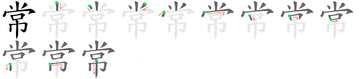 | |||
Han character
常 (radical 50, 巾+8, 11 strokes, cangjie input 火月口中月 (FBRLB), four-corner 90227, composition ⿱尚巾 or ⿱龸吊)
References
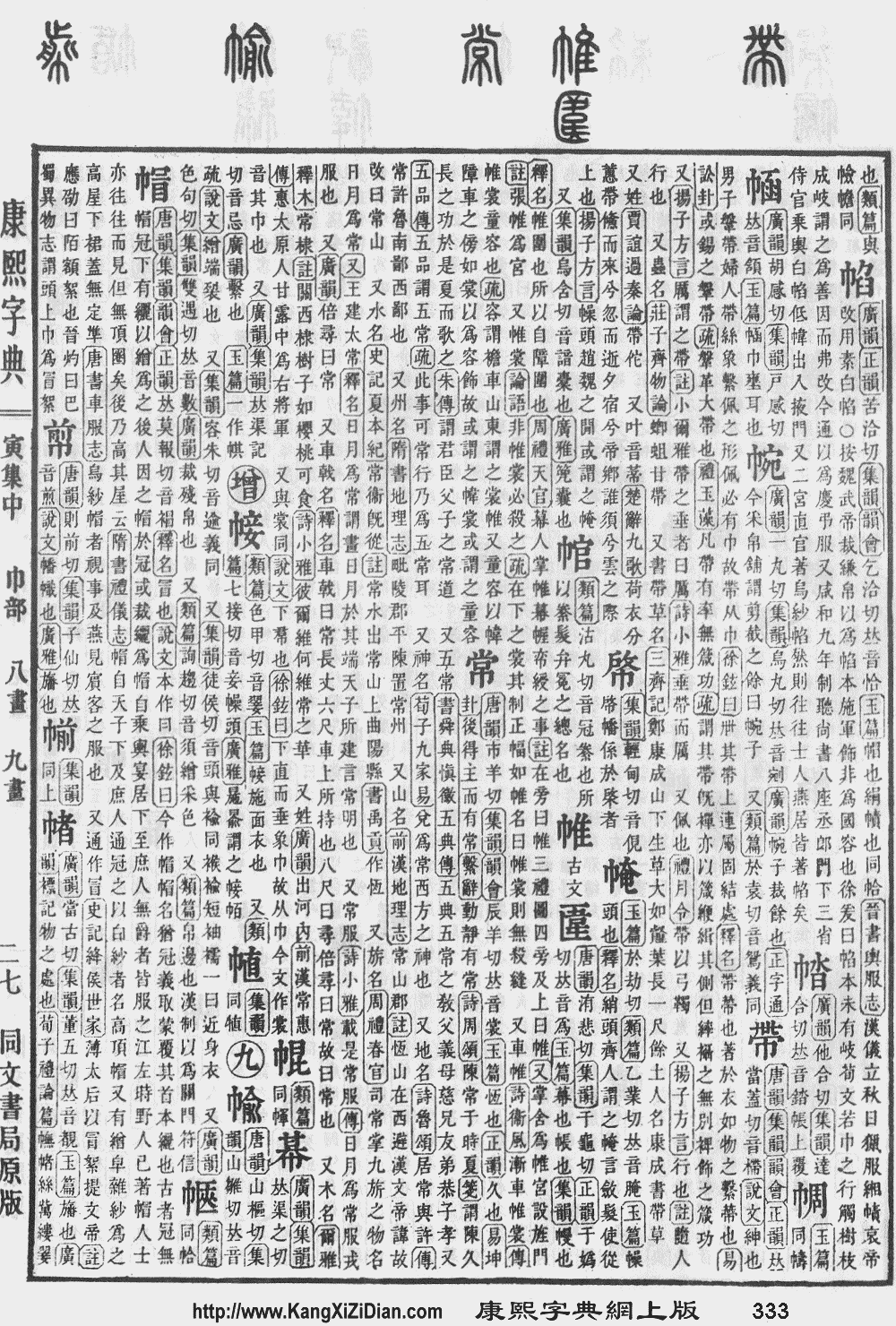
- KangXi: page 333, character 12
- Dai Kanwa Jiten: character 8955
- Dae Jaweon: page 639, character 13
- Hanyu Da Zidian: volume 1, page 744, character 1
- Unihan data for U+5E38
Chinese
| simp. and trad. |
常 | |
|---|---|---|
Glyph origin
| Characters in the same phonetic series (尚) (Zhengzhang, 2003) | |
|---|---|
| Old Chinese | |
| 當 | *taːŋ, *taːŋs |
| 襠 | *taːŋ |
| 鐺 | *taːŋ, *sʰraːŋ |
| 簹 | *taːŋ |
| 璫 | *taːŋ |
| 檔 | *taːŋ, *taːŋs |
| 儅 | *taːŋ, *taːŋs |
| 蟷 | *taːŋ |
| 擋 | *taːŋʔ, *taːŋs |
| 黨 | *taːŋʔ, *tʰaːŋʔ |
| 讜 | *taːŋʔ |
| 欓 | *taːŋʔ |
| 譡 | *taːŋs |
| 闣 | *taːŋs |
| 瓽 | *taːŋs |
| 鏜 | *tʰaːŋ |
| 闛 | *tʰaːŋ, *daːŋ |
| 鼞 | *tʰaːŋ |
| 曭 | *tʰaːŋʔ |
| 儻 | *tʰaːŋʔ, *tʰaːŋs |
| 戃 | *tʰaːŋʔ |
| 矘 | *tʰaːŋʔ |
| 爣 | *tʰaːŋʔ |
| 攩 | *hl'aːŋʔ, *ɦʷlaːŋʔ, *ɦʷlaːŋs |
| 淌 | *tʰaːŋʔ |
| 倘 | *tʰaːŋʔ |
| 躺 | *tʰaːŋʔ |
| 趟 | *tʰaːŋs, *rtaːŋ, *rtaːŋs |
| 堂 | *daːŋ |
| 坣 | *daːŋ |
| 棠 | *daːŋ |
| 糛 | *daːŋ |
| 螳 | *daːŋ |
| 隚 | *daːŋ |
| 橖 | *daːŋ |
| 掌 | *tjaŋʔ |
| 廠 | *tʰjaŋʔ, *tʰjaŋs |
| 敞 | *tʰjaŋʔ |
| 僘 | *tʰjaŋʔ |
| 氅 | *tʰjaŋʔ |
| 常 | *djaŋ |
| 嘗 | *djaŋ |
| 裳 | *djaŋ |
| 徜 | *djaŋ |
| 尚 | *djaŋ, *djaŋs |
| 甞 | *djaŋ |
| 鋿 | *djaŋ |
| 嫦 | *djaŋ |
| 償 | *djaŋ, *djaŋs |
| 賞 | *hjaŋʔ |
| 瞠 | *rtʰaːŋ |
| 撐 | *rtʰaːŋ |
| 樘 | *rtʰaːŋ |
| 橕 | *rtʰaːŋ |
| 牚 | *rtʰaːŋs |
| 埫 | *tʰoŋʔ |
Phono-semantic compound (形聲, OC *djaŋ) : phonetic 尚 (OC *djaŋ, *djaŋs) + semantic 巾.
Pronunciation
Definitions
常
- normal; general; common
- constant; invariable
- often; frequently
- 51st tetragram of the Taixuanjing; "constancy"
- A surname.
Synonyms
| Dialectal synonyms of 常常 (“often; frequently”) [map] | ||
|---|---|---|
| Variety | Location | Words |
| Formal (Written Standard Chinese) | 經常、時常、常常、時時、往往、每每 | |
| Mandarin | Beijing | 常 |
| Taiwan | 常常 | |
| Jinan | 常常、常、時常 | |
| Xi'an | 常常、常、時常 | |
| Wuhan | 帶常、時常 | |
| Chengdu | 時常、常常、隨時 | |
| Yangzhou | 常 | |
| Hefei | 常 | |
| Cantonese | Guangzhou | 時時、長時、周時、遇時 |
| Hong Kong | 成日、經常、時時、周時、周不時 | |
| Hong Kong (Weitou) | 經常 | |
| Yangjiang | 周時 | |
| Gan | Nanchang | 千長、時常 |
| Hakka | Meixian | 輒常、長時、時常 |
| Miaoli (N. Sixian) | 輒輒、輒常、長透、常常、時常、不時、時時 | |
| Liudui (S. Sixian) | 輒輒、輒常、長透、登常、常常、時常、不時、時時 | |
| Hsinchu (Hailu) | 輒輒、輒常、長透、常常、時常、不時、時時 | |
| Dongshi (Dabu) | 輒輒、長在、輒常、常常、時常、不時、時時 | |
| Zhuolan (Raoping) | 輒輒、常勻、輒常、長透、常常、時常、不時、時時 | |
| Yunlin (Zhao'an) | 輒輒、不時、輒、恬恬、長透、時時 | |
| Hong Kong | 長日 | |
| Jin | Taiyuan | 常常、時常 |
| Min Dong | Fuzhou | 稠稠、稠、盡稠 |
| Min Nan | Xiamen | 定定、長長、四常、時常、常常 |
| Quanzhou | 定定、長長、四常、時常、常常 | |
| Zhangzhou | 定定、時常、常常 | |
| Chaozhou | 長時 | |
| Wu | Suzhou | 時常、常時、常樁 |
| Wenzhou | 清清 | |
| Xiang | Changsha | 練常、打常、扯常 |
| Shuangfeng | 練常、常常 | |
Compounds
|
|
|
References
- “Query for 常”, in 臺灣閩南語常用詞辭典 [Dictionary of Frequently-Used Taiwan Minnan], Ministry of Education, R.O.C., 2011.
Japanese
Kanji
Readings
- Goon: じょう (jō, Jōyō)←じやう (zyau, historical)
- Kan’on: しょう (shō)←しやう (syau, historical)
- Kun: きだ (kida, 常); つね (tsune, 常, Jōyō); とこ (toko, 常); とことわ (tokotowa, 常); とわ (towa, 常)
- Nanori: のぶ (nobu); ひ (hi); ひた (hita); とき (toki)
Compounds
Etymology 1
| Kanji in this term |
|---|
| 常 |
| じょう Grade: 5 |
| on’yomi |
/d͡ʑau/ → /d͡ʑɔː/ → /d͡ʑoː/
From Middle Chinese 常 (dzyang, “constant”).
Pronunciation
Adverb
常 (hiragana じょう, rōmaji jō, historical hiragana じやう)
- (obsolete) always, constantly, consistently
Noun
常 (hiragana じょう, rōmaji jō, historical hiragana じやう)
- a traditional Japanese unit of length, equal to one 丈 (jō, roughly three meters) and three 尺 (shaku, roughly one foot or thirty centimeters)
Etymology 2
| Kanji in this term |
|---|
| 常 |
| きだ Grade: 5 |
| kun’yomi |
Cognate with root kiza in 刻む (kizamu, “to mince; to slice; to cut a thing into pieces; to groove, to nick, to notch”).[1]
Also sometimes read as kita.
Pronunciation
Alternative forms
Noun
常 (hiragana きだ, rōmaji kida, alternative reading きた, rōmaji kita)
- (obsolete) a traditional Japanese unit of measure for the length of cut cloth
- (obsolete) a traditional Japanese unit of measure for the area of an agricultural field or paddy
Counter
常 (hiragana きだ, rōmaji -kida)
- counter for cuts or strips of something
Etymology 3
| Kanji in this term |
|---|
| 常 |
| つね Grade: 5 |
| kun’yomi |
From Old Japanese. Appears in the Man'yōshū, compiled around 759 CE.[1] May be cognate with 綱 (tsuna, “thick rope; binding”), with underlying ideas of connection, continuance.
Pronunciation
Alternative forms
Adjective
常 (-na inflection, hiragana つね, rōmaji tsune)
Usage notes
This appears as an adjective in older texts with the classical attributive form tsune naru. When used attributively in modern Japanese, this term is used with the particle の (no) instead:
- 常の人
- tsune no hito
- everyday people, regular people
Modern Japanese does still use this term as an adverb, with particle に (ni):
- このカメラは常にオンになっている。
- Kono kamera wa tsune ni on ni natte iru.
- This camera is always on.
- あの会社はサービスが常に悪い。
- Ano kaisha wa sābisu ga tsune ni warui.
- That company has consistently bad service.
Synonyms
(normal, usual):
Noun
- constancy, continuance
- the ordinary, the everyday
Etymology 4
| Kanji in this term |
|---|
| 常 |
| とこ Grade: 5 |
| kun’yomi |
From Old Japanese. Possibly cognate with 時 (toki, “time”).
The way the term is used in the historical record suggests that this was originally a noun. By the time of written Japanese, however, this term only appears in compounds, never on its own, and its usage is more as an adjective to modify other nouns.
Pronunciation
Prefix
常 (hiragana とこ, rōmaji toko-)
Usage notes
Only used in compounds. Attaches to nouns and other nominals, often (but not always) with the now-obsolete possessive particle つ (tsu).
- 常つ御門、常夏、常とわ
- toko tsu mikado, tokonatsu, tokotowa
- the eternal palace, eternal summer, eternal permanence [→ eternity]
Derived terms
- 常春 (tokoharu)
- 常夏 (tokonatsu)
- 常秋 (tokoaki)
- 常冬 (tokofuyu)
- 常乙女 (toko otome)
- 常し (tokoshi)
- 常しえ (tokoshie)
- 常つ国 (toko tsu kuni)
- 常闇 (tokoyami)
- 常世 (tokoyo)
- 常葉 (tokowa)
Etymology 5
| Kanji in this term |
|---|
| 常 |
| とことわ Grade: 5 |
| kun’yomi |
/tokotoba/ → /tokotowa/
From Old Japanese. Read as tokotoba until the Heian period.[1][2]
Appears to be originally a compound of 常 (toko, “eternal”, see above) + とわ (towa, “permanence, unchangingness”, from earlier とば toba).
This latter element is of unclear derivation. Some sources[1] indicate that towa as an independent term arose as a contraction of earlier tokotoba, suggesting the possibility that toba was initially a compound of particles と (to, adverbial particle) + は (wa, formerly ba, even earlier pa; topic particle). However, other sources[4] describe tokotowa as an intensified or emphatic form of towa.
Pronunciation
Alternative forms
- 常とわ, 恒とわ, (rare) 永久
Adjective
常 (-na inflection, hiragana とことわ, rōmaji tokotowa, historical hiragana とことは)
Usage notes
Listed in dictionaries[1][2][5] as a 形容動詞 (keiyō dōshi, “-na adjective”). However, actual usage suggests that this was only used with particle に (ni) as an adverb, and never with particle な (na) or classical なる (naru) as an adjective. When this appears attributively, it is followed by particle の (no),[4] the usual construction when using a noun to modify another noun.
Synonyms
- (permanent, eternal): 常しえ (tokoshie)
- (usual, ordinary): 常 tsune (see above)
Noun
常 (hiragana とことわ, rōmaji tokotowa, historical hiragana とことは)
- (archaic, rare) permanence, eternity
Synonyms
- 常しえ (tokoshie)
Etymology 6
| Kanji in this term |
|---|
| 常 |
| とわ Grade: 5 |
| kun’yomi |
/toba/ → /towa/
From Old Japanese. Appears in the Tales of Ise, likely dating to the early 900s CE. Pronounced as toba until the later Heian period.[1]
Ultimate derivation unknown. May be a contraction of earlier tokotoba (see above),[1] or may have been an independent term used to form tokotoba as a compound.[4]
Pronunciation
Alternative forms
- (rare) 永久
Adjective
常 (-na inflection, hiragana とわ, rōmaji towa, historical hiragana とは)
Usage notes
Listed in some dictionaries[1][2][5] as a 形容動詞 (keiyō dōshi, “-na adjective”); other sources[4] only list this as a 副詞 (fukushi, “adverb”). Historical usage suggests that this was only used with particle に (ni) as an adverb, and not with particle な (na) or classical なる (naru) as an adjective. When this appears attributively, it is followed by particle の (no),[2][5][4] the usual construction when using a noun to modify another noun.
Synonyms
- 常しえ (tokoshie)
Noun
常 (hiragana とわ, rōmaji towa, historical hiragana とは)
Synonyms
- 常しえ (tokoshie)
References
- 1 2 3 4 5 6 7 8 1988, 国語大辞典(新装版) (Kokugo Dai Jiten, Revised Edition) (in Japanese), Tōkyō: Shogakukan
- 1 2 3 4 5 6 2006, 大辞林 (Daijirin), Third Edition (in Japanese), Tōkyō: Sanseidō, →ISBN
- 1 2 1998, NHK日本語発音アクセント辞典 (NHK Japanese Pronunciation Accent Dictionary) (in Japanese), Tōkyō: NHK, →ISBN
- 1 2 3 4 5 6 7 8 1997, 新明解国語辞典 (Shin Meikai Kokugo Jiten), Fifth Edition (in Japanese), Tōkyō: Sanseidō, →ISBN
- 1 2 3 1995, 大辞泉 (Daijisen) (in Japanese), Tōkyō: Shogakukan, →ISBN
Korean
Hanja
常 • (sang) (hangeul 상, revised sang, McCune–Reischauer sang)
- This term needs a translation to English. Please help out and add a translation, then remove the text
{{rfdef}}.
Vietnamese
Han character
- This term needs a translation to English. Please help out and add a translation, then remove the text
{{rfdef}}.