行
| ||||||||
Translingual
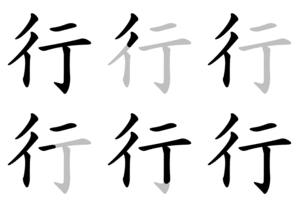
| Stroke order | |||
|---|---|---|---|
 | |||
Han character
行 (radical 144, 行+0, 6 strokes, cangjie input 竹人一一弓 (HOMMN), four-corner 21221, composition ⿰彳亍)
- Kangxi radical #144, ⾏.
Usage notes
行 itself is also used as a radical (in addition to 彳); unusually for radicals, the phonetic is placed in the middle – with 彳 on the left and 亍 on the right – corresponding to the phonetic originally being placed at the middle of the intersection.
Derived characters
- Index:Chinese radical/行
- 鵆
References
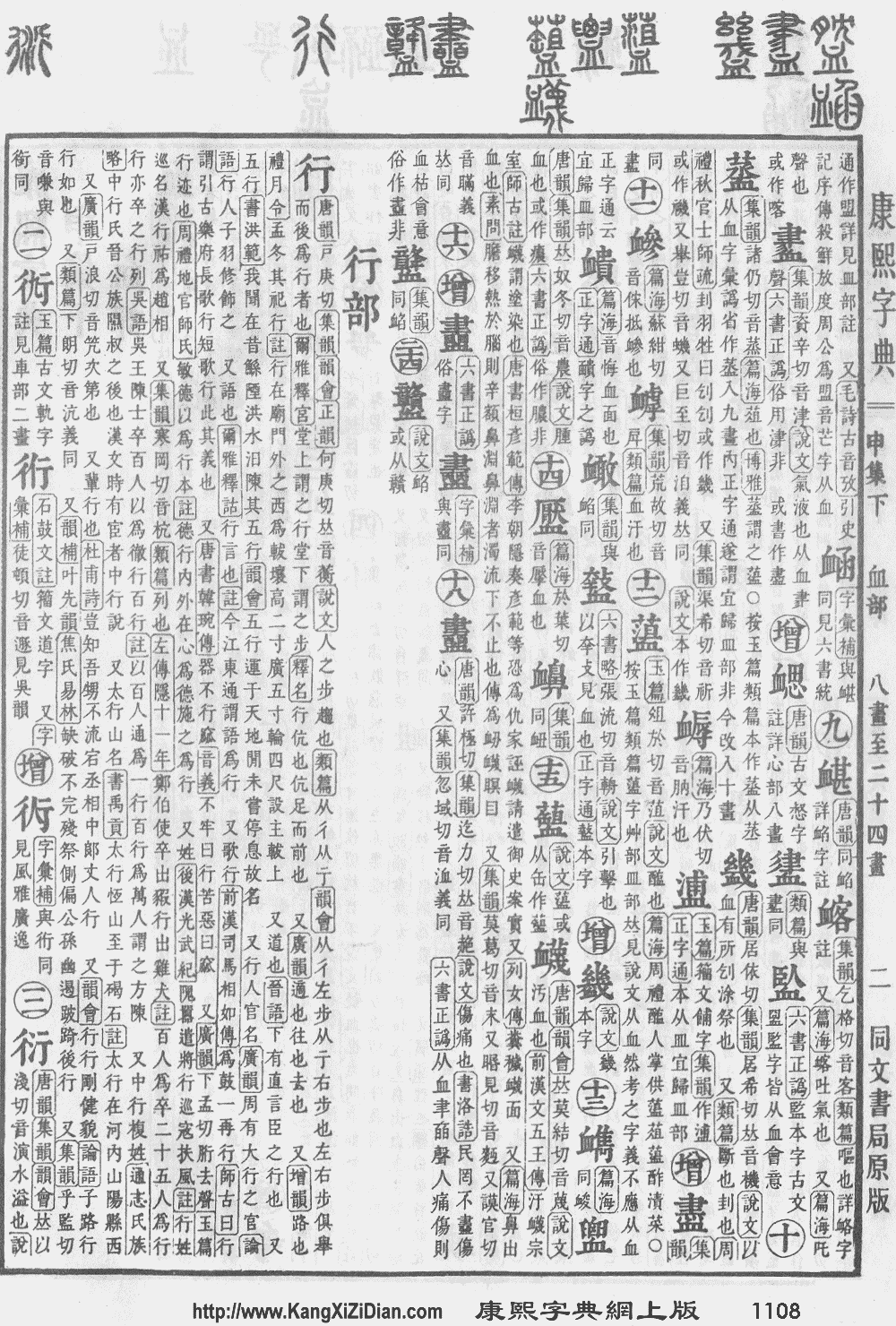
- KangXi: page 1108, character 31
- Dai Kanwa Jiten: character 34029
- Dae Jaweon: page 1570, character 31
- Hanyu Da Zidian: volume 2, page 811, character 6
- Unihan data for U+884C
Chinese
| simp. and trad. |
行 | |
|---|---|---|
Glyph origin
| Historical forms of the character 行 | |||
|---|---|---|---|
| Shang | Western Zhou | Shuowen Jiezi (compiled in Han) | Liushutong (compiled in Ming) |
| Oracle bone script | Bronze inscriptions | Small seal script | Transcribed ancient scripts |
 |
 |
 |
 |
| Characters in the same phonetic series (行) (Zhengzhang, 2003) | |
|---|---|
| Old Chinese | |
| 筕 | *ɡaːŋ, *ɡraːŋ |
| 桁 | *ɡaːŋ, *ɡraːŋ |
| 行 | *ɡaːŋ, *ɡaːŋs, *ɡraːŋ, *ɡraːŋs |
| 胻 | *ɡaːŋ, *ɡraːŋ, *ɡraːŋs |
| 衡 | *ɡraːŋ |
| 蘅 | *ɡraːŋ |
| 珩 | *ɡraːŋ |
| 洐 | *ɡraːŋ |
| 荇 | *ɡraːŋʔ |
| 絎 | *ɡraːŋs |
Pictogram (象形) – a street intersection.
Originally symmetric, it has been simplified asymmetrically; the left half 彳 is widely used as a radical, while the right half 亍 finds occasional use, and the character can be broken up as 彳 + 亍, though originally it was not a compound.
Pronunciation 1
Definitions
行
- (literary or dialectal) to walk
- to go; to move
- to carry out; to execute
- to perform (a salute)
- OK; good
- to be good; to work
- to be good (opposed to bad) (usually in negative sentences, or with 還)
- to be able to do something (usually mentioned before)
Usage notes
Notice that when meaning “be able to do something”, 行 can only be used without a complement. This is different from 能 (néng, “to be able to (do something)”).
Compounds
|
|
|
Pronunciation 2
Definitions
行
- profession; industry; trade; business
- place for specific transaction
- line of objects; row
- (Mainland China) row (in data tables)
- (Taiwan) column (in data tables)
Compounds
|
|
|
Pronunciation 3
Definitions
行
Compounds
Pronunciation 4
Definitions
行
Pronunciation 5
Definitions
行
References
- (Min Nan) “Entry #2617”, in 臺灣閩南語常用詞辭典 [Dictionary of Frequently-Used Taiwan Minnan] (in Chinese and Min Nan), Ministry of Education, R.O.C., 2011.
Japanese
Kanji
Readings
- Goon: ぎょう (gyō, Jōyō)←ぎやう (gyau, historical); ごう (gō)←がう (gau, historical)
- Kan’on: こう (kō, Jōyō)←かう (kau, historical)
- Tōon: あん (an, Jōyō, uncommon); ひん (hin)
- Kan’yōon: ぎょう (gyō, Jōyō)←ぎやう (gyau, historical)
- Sōon: あん (an, Jōyō, uncommon); へん (hen)
- Kun: いく (iku, 行く, Jōyō); ゆく (yuku, 行く, Jōyō); おこなう (okonau, 行う, Jōyō)←おこなふ (okonafu, historical); おこなう (okonau, 行なう)←おこなふ (okonafu, historical); くだり (kudari, 行)
- Nanori: つら (tsura); ゆき (yuki)
Compounds
|
|
Etymology 1
| Kanji in this term |
|---|
| 行 |
| ぎょう Grade: 2 |
| on’yomi |
From Middle Chinese 行 (MC ɦˠæŋ). (Can this(+) etymology be sourced?)
The kan'yōon pronunciation, possibly influenced by the goon pronunciation below.
Pronunciation
Noun
行 (hiragana ぎょう, rōmaji gyō, historical hiragana ぎやう)
- a line of text
- (mathematics) a row of a matrix
- (calligraphy) Abbreviation of 行書 (“semi-cursive script”).
Suffix
行 (hiragana ぎょう, rōmaji -gyō)
- row (in a table of the kana)
- は行う段
- ha-gyō u-dan
- row ha, section u
- は行う段
Coordinate terms
- 段 (dan)
Etymology 2
| Kanji in this term |
|---|
| 行 |
| ぎょう Grade: 2 |
| on’yomi |
From Middle Chinese 行 (MC ɦˠæŋ). (Can this(+) etymology be sourced?)
The goon pronunciation, so likely an earlier borrowing.
- For the "formations" definition, translation of Sanskrit संस्कार (saṃskāra)
- For "austerities", translation of Sanskrit चर्या (caryā)
- For "walking", translation of Sanskrit गमन (gamana)
Pronunciation
Noun
行 (hiragana ぎょう, rōmaji gyō, historical hiragana ぎやう)
- (Buddhism) saṅkhāra: formations, mental activity; one of the 五蘊 (goun, “five skandhas”)
- (Buddhism) caryā: austerities; practice or discipline for enlightenment (Can we verify(+) this sense?)
- (Buddhism) gamana: manner of going forward or walking (Can we verify(+) this sense?)
- (by extension, rare) going, travelling
Usage notes
The "going, travelling" definition is superseded by こう below.
Synonyms
- (formations): 行蘊 (gyōun)
See also
Proper noun
行 (hiragana ぎょう, rōmaji Gyō)
- A surname.
- A unisex given name
Etymology 3
| Kanji in this term |
|---|
| 行 |
| こう Grade: 2 |
| on’yomi |
From Middle Chinese 行 (MC ɦɑŋ, ɦˠæŋ, ɦɑŋH, ɦˠæŋH). (Can this(+) etymology be sourced?)
The kan'on pronunciation, so likely the later borrowing.
Pronunciation
Noun
行 (hiragana こう, rōmaji kō, historical hiragana かう)
- going; travelling (UK), traveling (US)
- type of classical Chinese verse (usually an epic)
- (archaic) merchant's association; guild
- bank (Can we verify(+) this sense?)
Proper noun
- A unisex given name
Etymology 4
| Kanji in this term |
|---|
| 行 |
| くだり Grade: 2 |
| kun’yomi |
Cognate with 下り (kudari, “downward-going”).[1]
Pronunciation
Noun
行 (hiragana くだり, rōmaji kudari)
Suffix
行 (hiragana くだり, rōmaji -kudari)
- used to count lines of sentences (Can we verify(+) this sense?)
Etymology 5
Various nanori readings.
Proper noun
行 (hiragana あきら, rōmaji Akira)
- A unisex given name
行 (hiragana あるき, rōmaji Aruki)
- A place name
- A female given name
行 (hiragana いく, rōmaji Iku)
- A female given name
行 (hiragana いたる, rōmaji Itaru)
- A female given name
行 (hiragana すすむ, rōmaji Susumu)
- A unisex given name
行 (hiragana つとむ, rōmaji Tsutomu)
- A male given name
行 (hiragana つよし, rōmaji Tsuyoshi)
- A male given name
- A unisex given name
行 (hiragana まこと, rōmaji Makoto)
- A unisex given name
- A place name
- A surname.
- A female given name
行 (hiragana ゆくえ, rōmaji Yukue)
- A female given name
References
Korean
Hanja
行 (eumhun 항렬 항 (hangnyeol hang))
- degree of familial relation
Compounds
- (movement): 행동
- (degree of relation): 항렬
Vietnamese
Han character
行 (hàng, hạnh, hành, ngành, hãng, hăng)
Compounds
- 行客 (hành khách)
- 行李 (hành lý)
- 銀行 (ngân hàng)