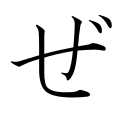
ぜ
 | ||||||||||
Japanese
| Stroke order | |||
|---|---|---|---|
 | |||
Pronunciation
- IPA(key): [d͡ze̞]
Etymology 1
The hiragana character せ (se) with a dakuten (゛).
Syllable
ぜ (romaji ze)
- The hiragana syllable ぜ (ze). Its equivalent in katakana is ゼ (ze).
See also
Etymology 2
Appears in the Edo Period as alteration from older zoe, itself likely rendaku (連濁) applied to the stem soe of verb 添える, 副える (soeru, “to add or attach to something else”). See also そえに (soe ni, “what's more, furthermore, in addition”), さえ (sae, “also”).
Particle
ぜ (rōmaji ze)
- (colloquial, men's speech) sentence-ending particle signifying emphasis
Usage notes
Similar to ぞ (zo), ぜ is mostly used by males. Unlike ぞ, ぜ is never considered polite, and is considered somewhat more forceful and rougher or informal than ぞ.
Etymology 3
Reading of various kanji.
Noun
ぜ (rōmaji ze)
Suffix
ぜ (rōmaji -ze)
This article is issued from
Wiktionary.
The text is licensed under Creative Commons - Attribution - Sharealike.
Additional terms may apply for the media files.