得
| ||||||||
 | ||||||||
Translingual
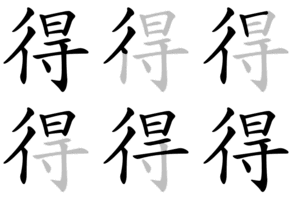
| Stroke order | |||
|---|---|---|---|
 | |||
Han character
得 (radical 60, 彳+8, 11 strokes, cangjie input 竹人日一戈 (HOAMI), four-corner 26241, composition ⿰彳㝵)
Derived characters
- 𫣓, 嘚, 𡐙, 𪮦, 𬈫, 𣘱, 𬋂, 𥊤, 𥕣, 𮔹, 𤹬, 𭏢
References
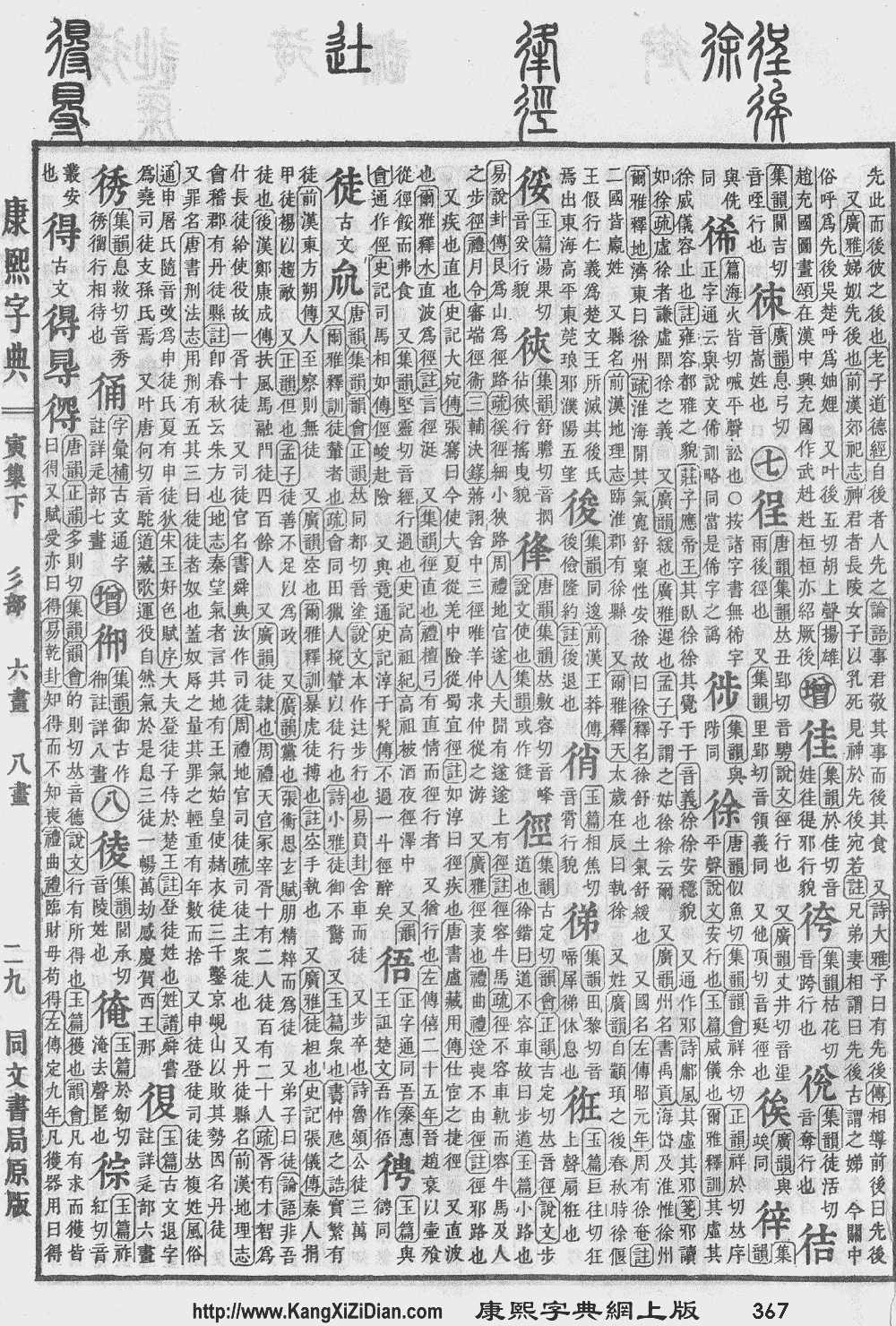
- KangXi: page 367, character 31
- Dai Kanwa Jiten: character 10137
- Dae Jaweon: page 691, character 16
- Hanyu Da Zidian: volume 2, page 828, character 3
- Unihan data for U+5F97
Chinese
| simp. and trad. |
得 | |
|---|---|---|
| alt. forms | 𠭁 𧴫 㝵 | |
Glyph origin
| Historical forms of the character 得 | |||
|---|---|---|---|
| Shang | Western Zhou | Warring States | Shuowen Jiezi (compiled in Han) |
| Oracle bone script | Bronze inscriptions | Chu Slip and silk script | Small seal script |
 |
 |
 |
 |
| Characters in the same phonetic series (得) (Zhengzhang, 2003) | |
|---|---|
| Old Chinese | |
| 得 | *tɯːɡ |
| 淂 | *tɯːɡ |
| 棏 | *dɯːɡ, *rtɯːɡ |
Ideogrammic compound (會意) . The ancient form of 得 is 㝵, composed of 貝 (“cowry”) + 又 (“hand”) — to pick up a cowry > to obtain valuables. A component 彳 was sometimes added to show that the cowry was picked up on the road.
In the Qin Bamboo and Slip script:
- a horizontal line was add to the 又, which means it is replaced with the related 寸. This is a feature of Qin script, and many characters which used to compound with 又 now compound with 寸.
In the Shouwen seal script:
- the 貝 corrupts into something resembling 見. However, this should be an error of Shouwen, because it only can be only found in Shouwen rather historical Qin Seal script and Qin Bamboo and Slip script.
In the clerical script:
- the 貝 simplified as 目 (“eye”), such simplification can be seen in its early form like Spring and Autumn and Warring States bronze inscriptions and Chu Bamboo an Silk script as well as other characters such as 具. Then it corrupts into 旦 (“dawn”) in later clerical script, and Regular script inherited it.
Pronunciation 1
Definitions
得
- to get; to obtain; to gain, to acquire
- to contract (disease); to become ill with
- to result in; to produce
- to be ready; finished
- to suit; to fit
- fit; proper
- satisfied; contented
- (formal, often used in the negative) can; may
- 非依法定程序之逮捕、拘禁、審問、處罰,得拒絕之。 [MSC, trad.]
- From: Article 8, Constitution of the Republic of China (Taiwan)
- Fēi yī fǎdìng chéngxù zhī dàibǔ, jūjìn, shěnwèn, chùfá, dé jùjué zhī. [Pinyin]
- Any arrest, detention, trial, or punishment which is not in accordance with the procedure prescribed by law may be resisted.
非依法定程序之逮捕、拘禁、审问、处罚,得拒绝之。 [MSC, simp.]
- interjective particle expressing approval or prohibition; see 得了
- interjective particle expressing frustration or helplessness
Compounds
Derived terms from 得
|
|
|
Pronunciation 2
Definitions
得
Usage notes
- When it is used between a verb and the complement, and the complement is used to indicate possibility or capacity, the negative form replaces 得 with 不 (bù).
- If there is no complement, or if the complement describes the result or the extent of the verb, the negative form has 得不 in the place of 得.
- If it is used after a verb-object construction, the verb is repeated again as "verb-object-verb-得-complement".
- "Object-verb-得-complement" is also used.
Compounds
Derived terms from 得
|
|
|
Pronunciation 3
Definitions
得
Compounds
Japanese
Kanji
得
- acquire
Readings
Derived terms
- 得る (eru)
Korean
Hanja
得 • (deuk) (hangeul 득, revised deuk, McCune–Reischauer tŭk, Yale tuk)
Derived terms
Vietnamese
Han character
- This term needs a translation to English. Please help out and add a translation, then remove the text
{{rfdef}}.
This article is issued from
Wiktionary.
The text is licensed under Creative Commons - Attribution - Sharealike.
Additional terms may apply for the media files.