正
| ||||||||
Translingual
| Stroke order | |||
|---|---|---|---|
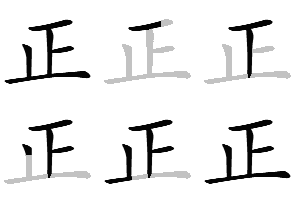 | |||
| Stroke order | |||
|---|---|---|---|
 | |||
Alternative forms
In complex characters, often written with last two strokes different, as 𤴓; compare 昰 and 是.
Han character
正 (radical 77, 止+1, 5 strokes, cangjie input 一卜中一 (MYLM), four-corner 10101, composition ⿱一止)
Usage notes
- (tally marks, 5): The successive strokes of 正 (



Derived characters
References
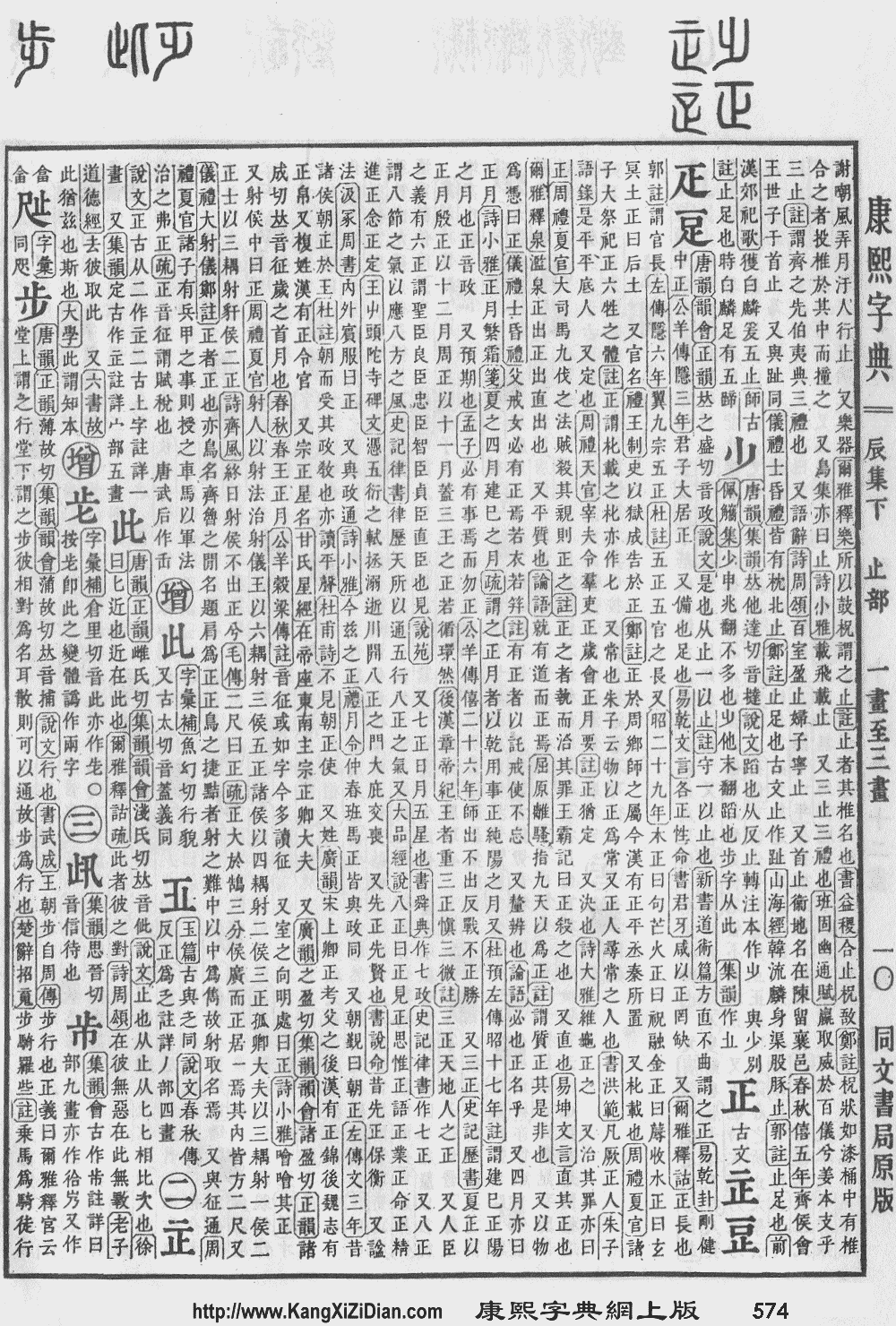
- KangXi: page 574, character 2
- Dai Kanwa Jiten: character 16255
- Dae Jaweon: page 962, character 2
- Hanyu Da Zidian: volume 2, page 1436, character 1
- Unihan data for U+6B63
Chinese
| simp. and trad. |
正 | |
|---|---|---|
Glyph origin
| Historical forms of the character 正 | |||
|---|---|---|---|
| Shang | Western Zhou | Shuowen Jiezi (compiled in Han) | Liushutong (compiled in Ming) |
| Oracle bone script | Bronze inscriptions | Small seal script | Transcribed ancient scripts |
 |
 |
 |
 |
| Characters in the same phonetic series (正) (Zhengzhang, 2003) | |
|---|---|
| Old Chinese | |
| 綻 | *rdeːns |
| 淀 | *deːns |
| 靛 | *deːns |
| 症 | *tjɯŋs |
| 竀 | *rtʰeːŋ, *tʰeŋ |
| 征 | *tjeŋ |
| 怔 | *tjeŋ |
| 正 | *tjeŋ, *tjeŋs |
| 鉦 | *tjeŋ |
| 鴊 | *tjeŋ, *tjeŋs |
| 眐 | *tjeŋ |
| 佂 | *tjeŋ |
| 整 | *tjeŋʔ |
| 政 | *tjeŋs |
| 証 | *tjeŋs |
| 定 | *teːŋs, *deːŋs |
| 顁 | *teːŋs |
| 錠 | *teːŋs, *deːŋʔ, *deːŋs |
| 掟 | *deːŋs |
Phono-semantic compound (形聲, OC *tjeŋ, *tjeŋs) : phonetic 丁 (OC *rteːŋ, *teːŋ) + semantic 止 (“foot”) – to go on a long journey. Original form of 征 (OC *tjeŋ, “to go on long campaign”).
Etymology
Sino-Tibetan or area word: “centre; target; first (month); straight; correct”.
Compare Mizo dîng (“to go straight or direct (as person, arrow etc.); to go straight through without breaking the journey; straight; direct”). Matisoff sets up Proto-Sino-Tibetan *m-tjak/ŋ ~ tik/ŋ (“good; very; real; straight”) for this, which includes 正, 直 (OC *dɯɡ, “straight; right”) and 實 (OC *ɦliɡ, “solid; true”).
Additionally, Matisoff has Proto-Sino-Tibetan *t(r)waŋ (“straight; straighten”), whence Chepang dʰeŋ- (“straight”), Jingpho ding (“straight”), Tibetan དྲང་པོ (drang po, “straight; correct; upright; just; fair”), Burmese တန်း (tan:, “straight; to head straight for”). Also compare Khmer ទៀង (tiəng, “accurate; correct; exact; precise; honest”).
Derivatives:
Pronunciation 1
Definitions
正
- straight; upright; central; in proper position
- Antonyms: 歪 (wāi)
- right; proper; correct
- exact; standardized; just so
- regular-shaped; regular; square
- primary; chief; main
- pure; unmixed; authentic; true
- pretty; attractive; beautiful
- honest; upright; honourable
- (Cantonese) awesome; fantastic
- just now; right now; in the process of
- to straighten; to make straight; to adjust
- to make right; to rectify; to correct
- (tally marks) 5
- (numismatics) obverse
- (numeral) 1040
- (mathematics) positive; plus
- (physics) positive
- A surname.
Compounds
|
|
|
See also
| Chinese numerals | ||||||||||||
|---|---|---|---|---|---|---|---|---|---|---|---|---|
| 104 | 108 | 1012 | 1016 | 1020 | 1024 | 1028 | 1032 | 1036 | 1040 | 1044 | ||
| 萬/万 | 億/亿 | 兆 (Taiwan) | 京 (Taiwan) | 垓 | 秭 | 穰 | 溝/沟 | 澗/涧 | 正 | 載/载 | ||
| 萬億/万亿 (Mainland China) |
億億/亿亿 (Mainland China) | |||||||||||
Pronunciation 2
Definitions
正
Compounds
Descendants
Japanese
Kanji
Readings
Compounds
Numeral
- A number of 1040 in modern Japanese since 17th century.
- 5. Similar to four vertical lines followed by a slanted horizontal line crossing through them, this character is used to count to 5 stroke by stroke. Thus this kanji written up to the third stroke represents 3. After the fifth and final stroke, when this character is completed, one starts writing this character again to count to higher numbers.
Proper noun
正 (hiragana ただし, rōmaji Tadashi)
- A male given name
Korean
Hanja
正 • (jeong)
- This term needs a translation to English. Please help out and add a translation, then remove the text
{{rfdef}}.
Vietnamese
Han character
正 (chính, chánh, chếnh, giêng)
- This term needs a translation to English. Please help out and add a translation, then remove the text
{{rfdef}}.