via
English
Pronunciation
- IPA(key): /ˈvaɪə/, /ˈvi.ə/
Etymology 1
Borrowed from Latin via (“road”), of uncertain origin, plausibly cognate with vehere (“to conduct”).
Noun
- A main road or highway, especially in ancient Rome. (Mainly used in set phrases, below.)
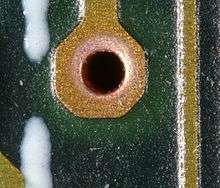
- (electronics) A small hole in a printed circuit board filled with metal which connects two or more layers.
Derived terms
|
|
Related terms
Etymology 2
Borrowed from Latin viā, ablative singular of via (“way, road”).
Alternative forms
Preposition
via
- By way of; passing through.
- They drove from New York to Los Angeles via Omaha.
- You can enter the building via the western gate.
- By (means of); using (a medium).
- I'll send you the information via e-mail.
- 2012 December 1, “An internet of airborne things”, in The Economist, volume 405, number 8813, page 3 (Technology Quarterly):
- A farmer could place an order for a new tractor part by text message and pay for it by mobile money-transfer. A supplier many miles away would then take the part to the local matternet station for airborne dispatch via drone.
- As per (a mathematical equation).
- 2005, Enrico Forestieri (ed.), “Capacity Bounds For MIMO Poisson Channels With Intersymbol Interference, Appendix C”, in Optical Communication Theory and Techniques, →ISBN, page 44:
- Under the assumptions of Proposition 5 the entropies h(τ) and H(k) are related via the following equation: […]
-
Translations
|
|
|
Anagrams
Catalan
Etymology
Pronunciation
Noun
via f (plural vies)
Synonyms
- (railway track): via fèrria
Derived terms
- Via Làctia
Related terms
Preposition
via
Further reading
- “via” in Diccionari de la llengua catalana, segona edició, Institut d’Estudis Catalans.
Dutch
Etymology
Borrowed from Latin viā, the ablative of via (“road, way”), of uncertain origin, plausibly cognate with vehere (“to conduct”). Entered Dutch in the Latin phrase per via de (“by way of”), after the Portuguese por via de.
Pronunciation
Audio (file)
Preposition
via
Synonyms
Derived terms
- via via (“using various intermediaries”)
Esperanto
Etymology
From Esperanto second-person pronoun vi + possessive ending -a.
Determiner
via (accusative singular vian, plural viaj, accusative plural viajn)
See also
Fijian
Etymology
From Proto-Oceanic, from Proto-Malayo-Polynesian *biʀaq (compare Malay birah), from Proto-Austronesian.
Noun
via
Finnish
Adverb
via
Anagrams
Franco-Provençal
Etymology
Noun
via f (plural vies)
Related terms
French
Etymology
Borrowed from Latin viā, the ablative of via (“road, way”), of uncertain origin, plausibly cognate with vehō (“convey”).
Pronunciation
- IPA(key): /vja/
Preposition
via
Further reading
- “via” in le Trésor de la langue française informatisé (The Digitized Treasury of the French Language).
Italian
Etymology
Pronunciation
- IPA(key): /via̯/, [viä̯]
Audio (file) Audio (file) - Stress: vìa
- Hyphenation: via
Noun
via f (plural vie)
Synonyms
- (street, road, etc.): strada
Derived terms
Related terms
Adverb
via
Preposition
via da
- away from
Interjection
via!
Anagrams
Latin
Etymology
- From Proto-Italic *wijā, from Proto-Indo-European *wih₁eh₂-.[1], from *weyh₁- (“to pursue, be strong”). Cognate with Lithuanian vyti (“to pursuit”). See also vīs, invītus, invītō, Ancient Greek οἶμος (oîmos).
- Or perhaps from Proto-Indo-European *weǵʰyeh₂-, from *weǵʰ- (whence vehō)[2], hypothesis rejected by De Vaan.
Pronunciation
- (Classical) IPA(key): /ˈwi.a/
Audio (Classical) (file)
Noun
via f (genitive viae); first declension
Inflection
First declension.
| Case | Singular | Plural |
|---|---|---|
| nominative | via | viae |
| genitive | viae | viārum |
| dative | viae | viīs |
| accusative | viam | viās |
| ablative | viā | viīs |
| vocative | via | viae |
Synonyms
- (road): iter
Derived terms
Related terms
Descendants
References
- via in Charlton T. Lewis and Charles Short (1879) A Latin Dictionary, Oxford: Clarendon Press
- via in Charlton T. Lewis (1891) An Elementary Latin Dictionary, New York: Harper & Brothers
- via in Charles du Fresne du Cange’s Glossarium Mediæ et Infimæ Latinitatis (augmented edition, 1883–1887)
- via in Gaffiot, Félix (1934) Dictionnaire Illustré Latin-Français, Hachette
- Carl Meissner; Henry William Auden (1894) Latin Phrase-Book, London: Macmillan and Co.
- the country-house stands near the road: villa tangit viam
- the road is the same length: tantundem viae est
- to pave a road: viam sternere (silice, saxo)
- to make a gravel path: substruere viam glarea (Liv. 41. 27)
- a street, a made road: via strata
- a well-trodden, much-frequented way: via trita
- to make a road: viam munire
- to open a route: viam patefacere, aperire
- to cut one's way (through the enemies' ranks): ferro viam facere (per confertos hostes)
- to obstruct a road; to close a route: viam intercludere
- a road leads somewhere: via fert, ducit aliquo
- to set out on a journey: in viam se dare
- to set out on a journey: viae se committere
- to enter upon a route; to take a road: viam ingredi, inire (also metaphorically)
- to turn aside from the right way; to deviate: de via declinare, deflectere (also metaphorically)
- make way for any one: (de via) decedere alicui
- to set out by the Appian road: Appia via proficisci
- to direct a person who has lost his way: erranti viam monstrare
- to continue one's journey, pursue one's course: viam persequi (also metaphorically)
- to accomplish a long journey: longam viam conficere
- weary with travelling; way-worn: fessus de via
- in a straight line: recta (regione, via); in directum
- to bring a person back to the right way: in viam reducere aliquem
- to return to the right way: in viam redire
- to enter upon a career: viam vitae ingredi (Flacc. 42. 105)
- to give a scientific explanation of a thing: artificio et via tradere aliquid
- to proceed, carry on a discussion logically: ratione et via, via et ratione progredi, disputare (Or. 33. 116)
- to walk in the ways of virtue: viam virtutis ingredi (Off. 1. 32. 118)
- to receive tenders for the construction of temples, highroads: locare aedes, vias faciendas (Phil. 9. 7. 16)
- the country-house stands near the road: villa tangit viam
- via in Harry Thurston Peck, editor (1898) Harper's Dictionary of Classical Antiquities, New York: Harper & Brothers
- Pokorny, Julius (1959) Indogermanisches etymologisches Wörterbuch [Indo-European Etymological Dictionary] (in German), Bern, München: Francke Verlag
- ↑ De Vaan, Michiel (2008) Etymological Dictionary of Latin and the other Italic Languages (Leiden Indo-European Etymological Dictionary Series; 7), Leiden, Boston: Brill
- ↑ Edward A. Roberts, Bárbara Pastor, Diccionario etimológico indoeuropeo de la lengua española, Alianza Editorial 2009, →ISBN
Norwegian Bokmål
Etymology 1
Preposition
via
Etymology 2
Alternative forms
Verb
via
References
- “via” in The Bokmål Dictionary.
Norwegian Nynorsk
Etymology
Preposition
via
References
- “via” in The Nynorsk Dictionary.
Portuguese
Pronunciation
Etymology 1
From Old Portuguese via, from Latin via (“road”). See Latin via for details.
Noun
via f (plural vias)
- a way; a path
- (rail transport) gauge (distance between the rails of a railway)
- medium (means or channel by which an aim is achieved)
- an example of a document
Synonyms
Derived terms
|
|
|
Related terms
|
Etymology 2
Directly from Latin via (“road”).
Preposition
via
Noun
via f (plural vias)
- (historical) via (road built by the ancient Romans)
Etymology 3
Inflected form of ver (“to see”).
Verb
via
- First-person singular (eu) imperfect indicative of ver
- Third-person singular (ele, ela, also used with tu and você?) imperfect indicative of ver
Romanian
Etymology 1
Borrowed from French and Latin via.
Pronunciation
- IPA(key): /ˈvi.a/
Preposition
via (+accusative)
Etymology 2
From an older form vie, from Latin vīvere, present active infinitive of vīvō, from Proto-Italic *gʷīwō, from Proto-Indo-European *gʷíh₃weti (“to live, be alive”).
Alternative forms
- vie (regional, archaic)
Pronunciation
- IPA(key): /viˈa/
Verb
a via (third-person singular present viază, past participle viat) 1st conj.
Conjugation
| infinitive | a via | ||||||
|---|---|---|---|---|---|---|---|
| gerund | viind | ||||||
| past participle | viat | ||||||
| number | singular | plural | |||||
| person | 1st person | 2nd person | 3rd person | 1st person | 2nd person | 3rd person | |
| indicative | eu | tu | el/ea | noi | voi | ei/ele | |
| present | viez | viezi | viază | viem | viați | viază | |
| imperfect | viam | viai | via | viam | viați | viau | |
| simple perfect | viai | viași | vie | viarăm | viarăți | viară | |
| pluperfect | viasem | viaseși | viase | viaserăm | viaserăți | viaseră | |
| subjunctive | eu | tu | el/ea | noi | voi | ei/ele | |
| present | să viez | să viezi | să vieze | să viem | să viați | să vieze | |
| imperative | — | tu | — | — | voi | — | |
| affirmative | viază | viați | |||||
| negative | nu via | nu viați | |||||
Synonyms
Derived terms
Related terms
Etymology 3
Form of the adjective viu.
Pronunciation
- IPA(key): /ˈvi.a/
Adjective
via
- inflection of viu (“live, alive”):
- definite feminine singular nominative
- definite feminine singular accusative
Etymology 4
Form of the noun vie.
Pronunciation
- IPA(key): /ˈvi.a/
Noun
via
Romansch
Alternative forms
- (Sutsilvan, Surmiran) veia
Etymology
Noun
via f (plural vias)
Synonyms
- (Rumantsch Grischun, Sutsilvan: road, street) strada
Swedish
Preposition
via