river
See also: River
English
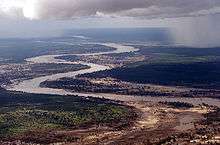
A river
Etymology 1
From Middle English river, rivere, borrowed from Anglo-Norman rivere, from Old French riviere, from Vulgar Latin *riparia (“riverbank, seashore, river”), from Latin riparius (“of a riverbank”), from ripa (“river bank”), from Proto-Indo-European *rey- (“to scratch, tear, cut”). Compare West Frisian rivier (“river”), Dutch rivier (“river”), Middle Low German rivêr (“river”), Middle High German rivier (“brook, stream”), Middle High German rivier, riviere, revier ("district"; > German Revier (“area, territory, district”)).
Pronunciation
- (Received Pronunciation) IPA(key): /ˈɹɪvə/
- (General American) IPA(key): /ˈɹɪvɚ/
Audio (US) (file) Audio (UK) (file) - Rhymes: -ɪvə(ɹ)
- Hyphenation: riv‧er
Noun
river (plural rivers)
- A large and often winding stream which drains a land mass, carrying water down from higher areas to a lower point, ending at an ocean or in an inland sea.
- 1908, Kenneth Grahame, The Wind in the Willows
- By the side of the river he trotted as one trots, when very small, by the side of a man who holds one spell-bound by exciting stories; and when tired at last, he sat on the bank, while the river still chattered on to him, a babbling procession of the best stories in the world, sent from the heart of the earth to be told at last to the insatiable sea.
- 2013 June 29, “High and wet”, in The Economist, volume 407, number 8842, page 28:
- Floods in northern India, mostly in the small state of Uttarakhand, have wrought disaster on an enormous scale. The early, intense onset of the monsoon on June 14th swelled rivers, washing away roads, bridges, hotels and even whole villages. Rock-filled torrents smashed vehicles and homes, burying victims under rubble and sludge.
- Occasionally rivers overflow their banks and cause floods.
- 1908, Kenneth Grahame, The Wind in the Willows
- Any large flow of a liquid in a single body.
- a river of blood
- (poker) The last card dealt in a hand.
Usage notes
- As with the names of lakes and mountains, the names of rivers are typically formed by adding the word before or after the unique term: the River Thames or the Yangtze River. Generally speaking, names formed using adjectives or attributives see river added to the end, as with the Yellow River. It is less common to add river before names than it is with lakes, but many the rivers of Britain are written that way, as with the River Severn; indeed, British English tends to use "River X" in such cases while American and Australian English use "X River". The former derives from the earlier but now uncommon form river of ~: the 19th century River of Jordan is now usually simply the River Jordan.
- It is common to preface the proper names of rivers with the article the.
Derived terms
Terms derived from river (etymology 1, noun)
- cry someone a river
- Eagle River
- Elk River
- Fall River
- Green River
- Hood River
- Indian River
- Little River
- Pearl River
- Powder River
- riverbank
- riverbed
- river basin
- river bed
- river birch
- river blindness
- riverboat/river boat
- river bottom
- river boulder
- river dolphin
- river duck
- riverfront
- river hog
- river horse
- riverine
- river lamprey
- river limper
- river mouth
- river otter
- river pear
- river prawn
- river runner
- river shad
- riverside
- riverward
- riverway
- salmon river, Salmon River
- sell down the river
- submarine river
- Three Rivers
- up the river
- White River
Translations
large stream which drains a landmass
|
|
any large flow of a liquid
- The translations below need to be checked and inserted above into the appropriate translation tables, removing any numbers. Numbers do not necessarily match those in definitions. See instructions at Wiktionary:Entry layout#Translations.
Translations to be checked
|
|
See also
- Category:Rivers
Verb
river (third-person singular simple present rivers, present participle rivering, simple past and past participle rivered)
- (poker) To improve one’s hand to beat another player on the final card in a poker game.
- Johnny rivered me by drawing that ace of spades.
Etymology 2
Pronunciation
- (Received Pronunciation) IPA(key): /ˈɹaɪvə/
- (General American) IPA(key): /ˈɹaɪvɚ/
- Rhymes: -aɪvə(ɹ)
Noun
river (plural rivers)
References
- river in Webster’s Revised Unabridged Dictionary, G. & C. Merriam, 1913
Danish
Noun
river c
- plural indefinite of rive
Verb
river
- present tense of rive
French
Etymology
Pronunciation
- IPA(key): /ʁi.ve/
Verb
river
- to drive/set a rivet
Conjugation
Conjugation of river (see also Appendix:French verbs)
| simple | compound | ||||||
|---|---|---|---|---|---|---|---|
| infinitive | river | avoir rivé | |||||
| gerund | en rivant | en ayant rivé | |||||
| present participle | rivant /ʁi.vɑ̃/ | ||||||
| past participle | rivé /ʁi.ve/ | ||||||
| person | singular | plural | |||||
| first | second | third | first | second | third | ||
| indicative | je (j’) | tu | il | nous | vous | ils | |
| simple tenses |
present | rive /ʁiv/ |
rives /ʁiv/ |
rive /ʁiv/ |
rivons /ʁi.vɔ̃/ |
rivez /ʁi.ve/ |
rivent /ʁiv/ |
| imperfect | rivais /ʁi.vɛ/ |
rivais /ʁi.vɛ/ |
rivait /ʁi.vɛ/ |
rivions /ʁi.vjɔ̃/ |
riviez /ʁi.vje/ |
rivaient /ʁi.vɛ/ | |
| past historic1 | rivai /ʁi.ve/ |
rivas /ʁi.va/ |
riva /ʁi.va/ |
rivâmes /ʁi.vam/ |
rivâtes /ʁi.vat/ |
rivèrent /ʁi.vɛʁ/ | |
| future | riverai /ʁi.vʁe/ |
riveras /ʁi.vʁa/ |
rivera /ʁi.vʁa/ |
riverons /ʁi.vʁɔ̃/ |
riverez /ʁi.vʁe/ |
riveront /ʁi.vʁɔ̃/ | |
| conditional | riverais /ʁi.vʁɛ/ |
riverais /ʁi.vʁɛ/ |
riverait /ʁi.vʁɛ/ |
riverions /ʁi.və.ʁjɔ̃/ |
riveriez /ʁi.və.ʁje/ |
riveraient /ʁi.vʁɛ/ | |
| compound tenses |
present perfect | Use the present tense of avoir followed by the past participle | |||||
| pluperfect | Use the imperfect tense of avoir followed by the past participle | ||||||
| past anterior1 | Use the past historic tense of avoir followed by the past participle | ||||||
| future perfect | Use the future tense of avoir followed by the past participle | ||||||
| conditional perfect | Use the conditional tense of avoir followed by the past participle | ||||||
| subjunctive | que je (j’) | que tu | qu’il | que nous | que vous | qu’ils | |
| simple tenses |
present | rive /ʁiv/ |
rives /ʁiv/ |
rive /ʁiv/ |
rivions /ʁi.vjɔ̃/ |
riviez /ʁi.vje/ |
rivent /ʁiv/ |
| imperfect1 | rivasse /ʁi.vas/ |
rivasses /ʁi.vas/ |
rivât /ʁi.va/ |
rivassions /ʁi.va.sjɔ̃/ |
rivassiez /ʁi.va.sje/ |
rivassent /ʁi.vas/ | |
| compound tenses |
past | Use the present subjunctive tense of avoir followed by the past participle | |||||
| pluperfect1 | Use the imperfect subjunctive tense of avoir followed by the past participle | ||||||
| imperative | – | tu | – | nous | vous | – | |
| — | rive /ʁiv/ |
— | rivons /ʁi.vɔ̃/ |
rivez /ʁi.ve/ |
— | ||
| 1literary tenses | |||||||
Related terms
Further reading
- “river” in le Trésor de la langue française informatisé (The Digitized Treasury of the French Language).
Anagrams
Latin
Verb
rīver
- first-person singular present passive subjunctive of rīvō
Norwegian Bokmål
Noun
river m, f
- indefinite plural of rive
Verb
river
- present tense of rive
Norwegian Nynorsk
Noun
river f
- indefinite plural of rive
Swedish
Verb
river
- present tense of riva.
This article is issued from
Wiktionary.
The text is licensed under Creative Commons - Attribution - Sharealike.
Additional terms may apply for the media files.