相
| ||||||||
Translingual
| Stroke order | |||
|---|---|---|---|
 | |||
Han character
相 (radical 109, 目+4, 9 strokes, cangjie input 木月山 (DBU), four-corner 46900, composition ⿰木目)
Derived characters
References
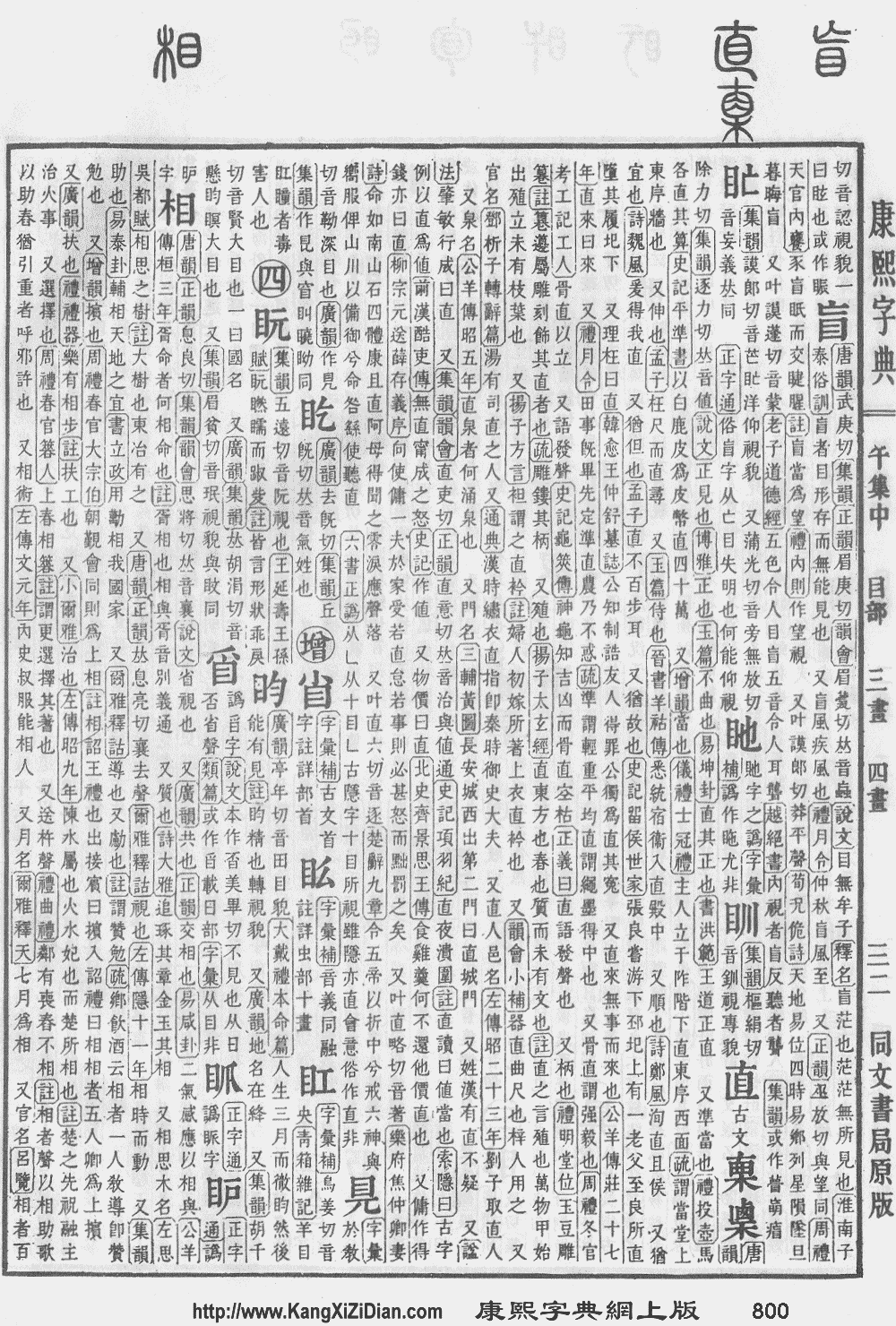
- KangXi: page 800, character 18
- Dai Kanwa Jiten: character 23151
- Dae Jaweon: page 1216, character 8
- Hanyu Da Zidian: volume 4, page 2470, character 13
- Unihan data for U+76F8
Chinese
| simp. and trad. |
相 | |
|---|---|---|
Glyph origin
| Characters in the same phonetic series (相) (Zhengzhang, 2003) | |
|---|---|
| Old Chinese | |
| 相 | *slaŋ, *slaŋs |
| 廂 | *slaŋ |
| 湘 | *slaŋ |
| 緗 | *slaŋ |
| 箱 | *slaŋ |
| 葙 | *slaŋ |
| 想 | *slaŋʔ |
| 霜 | *sraŋ |
| 孀 | *sraŋ |
| 鸘 | *sraŋ |
| 驦 | *sraŋ |
Ideogrammic compound (會意) : 木 (“tree”) + 目 (“eye”) – looking at, or watching the tree.
Etymology
An allofam is 胥 (OC *sŋa, *sŋaʔ, “each other; mutually; all; to observe; to assist”) (Schuessler, 2007).
Derivative: 想 (OC *slaŋʔ, “to think”) (“appearance > to visualise > to think”).
Pronunciation 1
Definitions
相
- to see for oneself; to evaluate by seeing for oneself
- mutually; reciprocally; towards each other; one another
- together; jointly
- successively; one after another
- towards; to
- A surname.
Compounds
|
|
|
Pronunciation 2
Definitions
相
- to look at; to examine the appearance and judge; to observe
- looks; appearance; features
- posture; carriage; bearing
- photo; picture; photograph (Classifier: 張/张 c)
- phase; exterior; stage; period
- (physics) phase
- (geology) facies
- to physiognomise; to practise physiognomy; to tell fortune by reading the subject's facial features
- physiognomy; practice of physiognomy
- to choose; to pick
- to assist; to help; to oversee
- (historical) prime minister; minister
- (Chinese chess) minister (on the red side)
- (historical) master of ceremonies
- (historical) attendant
- to administer; to govern
- to teach; to instruct
- A surname.
Coordinate terms
Compounds
|
|
|
Japanese
Kanji
Readings
Compounds
- 相手 (aite): companion, partner, opponent
- 液相 (ekisō): liquid phase
- 気相 (kisō): gaseous phase
- 固相 (kosō): solid phase
- 相撲 (sumō): sumo
- 相談 (sōdan): consultation
Etymology 1
From Old Japanese stem form of verb あう: to meet, to be together, etc.
Pronunciation
Prefix
相 (hiragana あい, rōmaji ai-)
- mutual, together, each other, meeting
- 兄弟はいつも相戦うものだ。
- Kyōdai wa itsumo ai-tatakau mono da.
- Brothers (siblings) will always fight (with each other).
- 兄弟はいつも相戦うものだ。
Suffix
Usage notes
Generally, 相 when used as a prefix, 合い when used as a suffix.
Etymology 2
Originally a compound of Old Japanese elements 此 (ko, “this”) + も (mo, “too”) + 此 (ko, “this”) + も (mo, “too”). Appears as komokomo in older texts, evolving into komogomo in modern Japanese.
Pronunciation
Alternative forms
Adverb
相 (hiragana こもごも, rōmaji komogomo)
- alternating, one after another
- 悲喜相
- hiki komogomo
- sadness and happiness one after another ⇒ mixed feelings
- 悲喜相
- all mixed up and indistinct
- 相考える
- komogomo kangaeru
- to be mixed up in one's thoughts, to think confusedly
- 相考える
Usage notes
Most often seen spelled in hiragana as こもごも. May also be spelled variously as 交交, 交, 更.
Etymology 3
From Old Japanese.
Pronunciation
Alternative forms
Noun
- nature, personality
- fate, destiny
- a habit, custom, or practice
- the good and bad of a person; especially, one's faults
Synonyms
Etymology 4
From Middle Chinese, deriving from the meaning of with from the way that a minister would always be with their lord. Kan'on, so likely a later borrowing than the sō reading.
Pronunciation
Suffix
相 (hiragana しょう, rōmaji -shō, historical hiragana しゃう)
- minister of state
- 首相
- shushō
- prime minister
- 内相
- naishō
- minister of the interior
- 首相
Synonyms
Etymology 5
From Middle Chinese. Goon, so likely an earlier borrowing than the shō reading.
Pronunciation
Noun
相 (hiragana そう, rōmaji sō, historical hiragana さう)
- appearance, how something looks
- an aspect of something
- 大自然の色々な相
- daishizen no iroiro na sō
- various aspects of nature
- 大自然の色々な相
- (grammar) grammatical aspect
- (physics) a phase, as of matter
- (ikebana) the central supporting branch of an ikebana arrangement
Related terms
- (ikebana): 役枝 (やくえだ, yakueda)
References
Korean
Hanja
相 • (sang) (hangeul 상)
- This term needs a translation to English. Please help out and add a translation, then remove the text
{{rfdef}}.
Vietnamese
Han character
- This term needs a translation to English. Please help out and add a translation, then remove the text
{{rfdef}}.