さ
 | ||||||||
Japanese
| Stroke order | |||
|---|---|---|---|
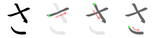 | |||
Pronunciation
- IPA(key): [sa̠]
Etymology 1
Derived in the Heian period from writing the man'yōgana kanji 左 in the cursive sōsho style.
Syllable
さ (romaji sa)
- The hiragana syllable さ (sa). Its equivalent in katakana is サ (sa). It is the eleventh syllable in the gojūon order; its position is さ行あ段 (sa-gyō a-dan, “row sa, section a”).
Derived terms
- ざ (za)
See also
Etymology 2
Cognate with し (shi).
Pronoun
さ (rōmaji sa)
- third person personal pronoun; they
- c. late 10th century Taketori Monogatari
- 翁言ふやう、「御迎へに來む人をば、長き爪して、眼をつかみ潰さん。 さが髪をとりて、かなぐり落とさむ。さが尻をかき出でて、ここらの公人に見せて、恥を見せん」と腹立ちをる。
- c. late 10th century Taketori Monogatari
See also
- し (shi)
Etymology 3
Suffix
さ (rōmaji -sa)
References
- Sakakura, Atsuyoshi; Yūichi Ōtsu, Hiroshi Tsukishima, Toshiko Abe, Imai Gen'e (1957) Nihon Koten Bungaku Taikei 9: Taketori Monogatari, Ise Monogatari, Yamato Monogatari (in Japanese), Tōkyō: Iwanami Shoten, →ISBN
This article is issued from
Wiktionary.
The text is licensed under Creative Commons - Attribution - Sharealike.
Additional terms may apply for the media files.