彼
| ||||||||
Translingual
| Stroke order | |||
|---|---|---|---|
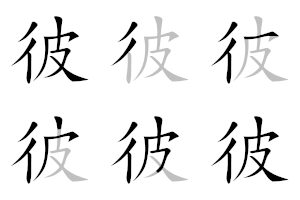 | |||
| Japanese stroke order | |||
|---|---|---|---|
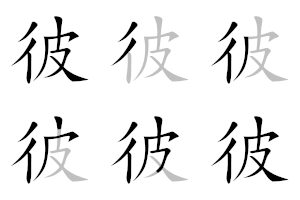 | |||
Han character
彼 (radical 60, 彳+5, 8 strokes, cangjie input 竹人木竹水 (HODHE), four-corner 24247, composition ⿰彳皮)
References
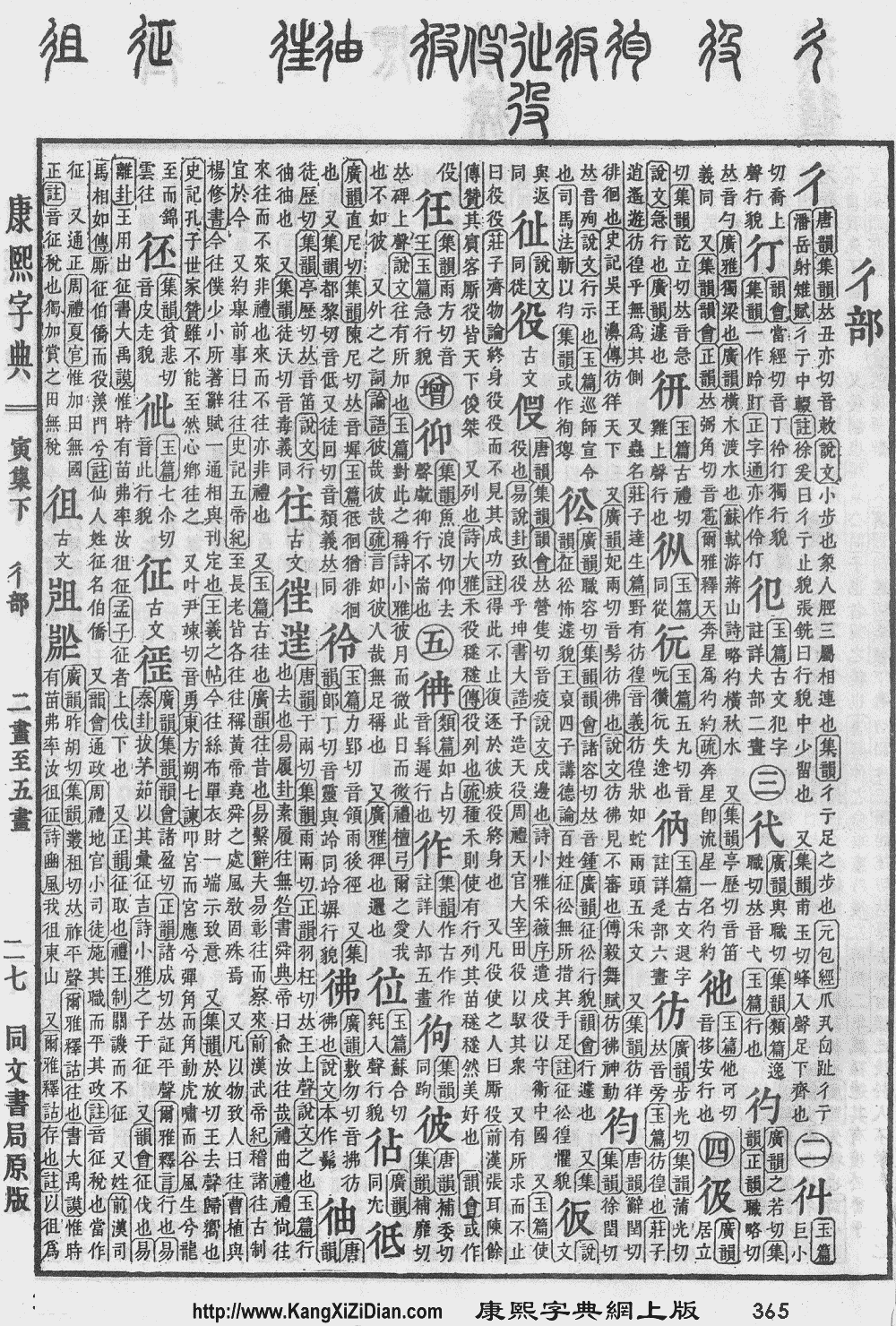
- KangXi: page 365, character 25
- Dai Kanwa Jiten: character 10066
- Dae Jaweon: page 685, character 18
- Hanyu Da Zidian: volume 2, page 817, character 10
- Unihan data for U+5F7C
Chinese
Glyph origin
| Characters in the same phonetic series (皮) (Zhengzhang, 2003) | |
|---|---|
| Old Chinese | |
| 陂 | *pral, *prals |
| 詖 | *pral, *prals |
| 彼 | *pralʔ |
| 柀 | *pralʔ |
| 佊 | *pralʔ, *prals |
| 貱 | *prals |
| 跛 | *prals, *paːlʔ |
| 披 | *pʰral, *pʰralʔ |
| 鈹 | *pʰral |
| 帔 | *pʰral, *pʰrals |
| 鮍 | *pʰral |
| 耚 | *pʰral |
| 狓 | *pʰral |
| 翍 | *pʰral |
| 旇 | *pʰral, *brals |
| 秛 | *pʰral, *pʰrals |
| 紴 | *pʰralʔ, *paːl |
| 皮 | *bral |
| 疲 | *bral |
| 被 | *bralʔ, *brals |
| 髲 | *brals |
| 鞁 | *brals |
| 骳 | *mbralʔ |
| 波 | *paːl |
| 碆 | *paːl, *baːl |
| 菠 | *paːl |
| 簸 | *paːlʔ, *paːls |
| 駊 | *paːlʔ, *pʰaːlʔ |
| 頗 | *pʰaːl, *pʰaːlʔ, *pʰaːls |
| 坡 | *pʰaːl |
| 玻 | *pʰaːl |
| 破 | *pʰaːls |
| 婆 | *baːl |
| 蔢 | *baːl |
Phono-semantic compound (形聲, OC *pralʔ) : semantic 彳 + phonetic 皮 (OC *bral).
Etymology 1
| simp. and trad. |
彼 | |
|---|---|---|
Related to 夫 (OC *pa, *ba, “that”) (Schuessler, 2007).
This etymology is incomplete. You can help Wiktionary by elaborating on the origins of this term.
Pronunciation
Definitions
彼
Compounds
Etymology 2
Related to 許/许 (hí, hír, “that”); see there for more.
Pronunciation 2 is a fusion word of 許/许 (hí, hír, “that”) + 一 (it, “one”); compare Mandarin 那 (nèi), from 那 (nà, “that”) + 一 (yī, “one”) (Mei and Yang, 1995).
Pronunciation 1
| simp. and trad. |
彼 | |
|---|---|---|
| alt. forms | 許/许 赫 | |
Definitions
彼
- (Zhangzhou, Taiwanese Min Nan) that (demonstrative pronoun)
Pronunciation 2
| simp. and trad. |
彼 | |
|---|---|---|
| alt. forms | 許/许 迄 | |
Definitions
彼
Japanese
Kanji
Readings
Compounds
Etymology 1
| Kanji in this term |
|---|
| 彼 |
| か Grade: S |
| kun’yomi |
From Old Japanese.
Pronunciation
Pronoun
- distal demonstrative, something far off removed from both speaker and listener: that, yon
Derived terms
- 彼 (kano), 彼の (kano, “his; that”)
- 彼 (kare, “he”)
Etymology 2
| Kanji in this term |
|---|
| 彼 |
| かれ Grade: S |
| kun’yomi |
From Old Japanese. Compound of 彼 (ka, “that, yon”) + れ (re, nominalizing suffix for demonstratives). Found in the Man'yōshū compiled around 759.
Pronunciation
Pronoun
- distal demonstrative, something far off removed from both speaker and listener: that, yon
- c. 759, Man'yōshū (book 18, poem 4045)
- 於伎敝欲里 美知久流之保能 伊也麻之尓 安我毛布支見我 弥不根可母加礼
- c. 759, Man'yōshū (book 18, poem 4045)
- third person pronoun: he, she
Synonyms
- (boyfriend): 彼氏 (kareshi)
Derived terms
- 彼氏 (kareshi, “boyfriend”)
Etymology 3
| Kanji in this term |
|---|
| 彼 |
| か(の) Grade: S |
| kun’yomi |
Compound of 彼 (ka, “that, yon”) + の (no, possessive particle).[2][1]
Pronunciation
Alternative forms
- 彼の (much more common)
Pronoun
彼 (hiragana かの, rōmaji kano)
- distal demonstrative, something far off removed from both speaker and listener: that, yon
- third person pronoun: he, she, it
Usage notes
The term kano has been mostly replaced by あの (ano) in modern Japanese. Kano is still in use, but is viewed as more formal and archaic.[2]
Derived terms
- 彼女 (kanojo, “she; girlfriend”)
Etymology 4
| Kanji in this term |
|---|
| 彼 |
| あ Grade: S |
| kun’yomi |
/ka/ → /a/
Shift in pronunciation from ka above. Appears from the Heian period.[2]
Pronunciation
Pronoun
- distal demonstrative, something far off removed from both speaker and listener: that, yon
Derived terms
- 彼の (ano, “that [one] (as a modifier)”)
- 彼 (are, “that [one] (as a noun)”)
See also
Etymology 5
| Kanji in this term |
|---|
| 彼 |
| あれ Grade: S |
| kun’yomi |
Compound of 彼 (a, “that, yon”) + れ (re, nominalizing suffix for demonstratives).
Pronunciation
Pronoun
- distal demonstrative, something far off removed from both speaker and listener: that, yon
- third person pronoun: he, she, it
- second person pronoun: you
- a euphemism for sex: it
See also
Usage notes
More often spelled in hiragana, as あれ.
References
Korean
Hanja
彼 • (pi)
- This term needs a translation to English. Please help out and add a translation, then remove the text
{{rfdef}}.
Vietnamese
Han character
- This term needs a translation to English. Please help out and add a translation, then remove the text
{{rfdef}}.