誰
| ||||||||
Translingual
| Japanese stroke order | |||
|---|---|---|---|
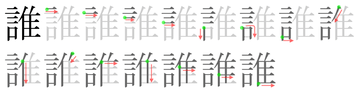 | |||
Han character
誰 (radical 149, 言+8, 15 strokes, cangjie input 卜口人土 (YROG), four-corner 00614, composition ⿰言隹)
Derived characters
- 𩽀, 𧀣, 䜃, 𪇻
References
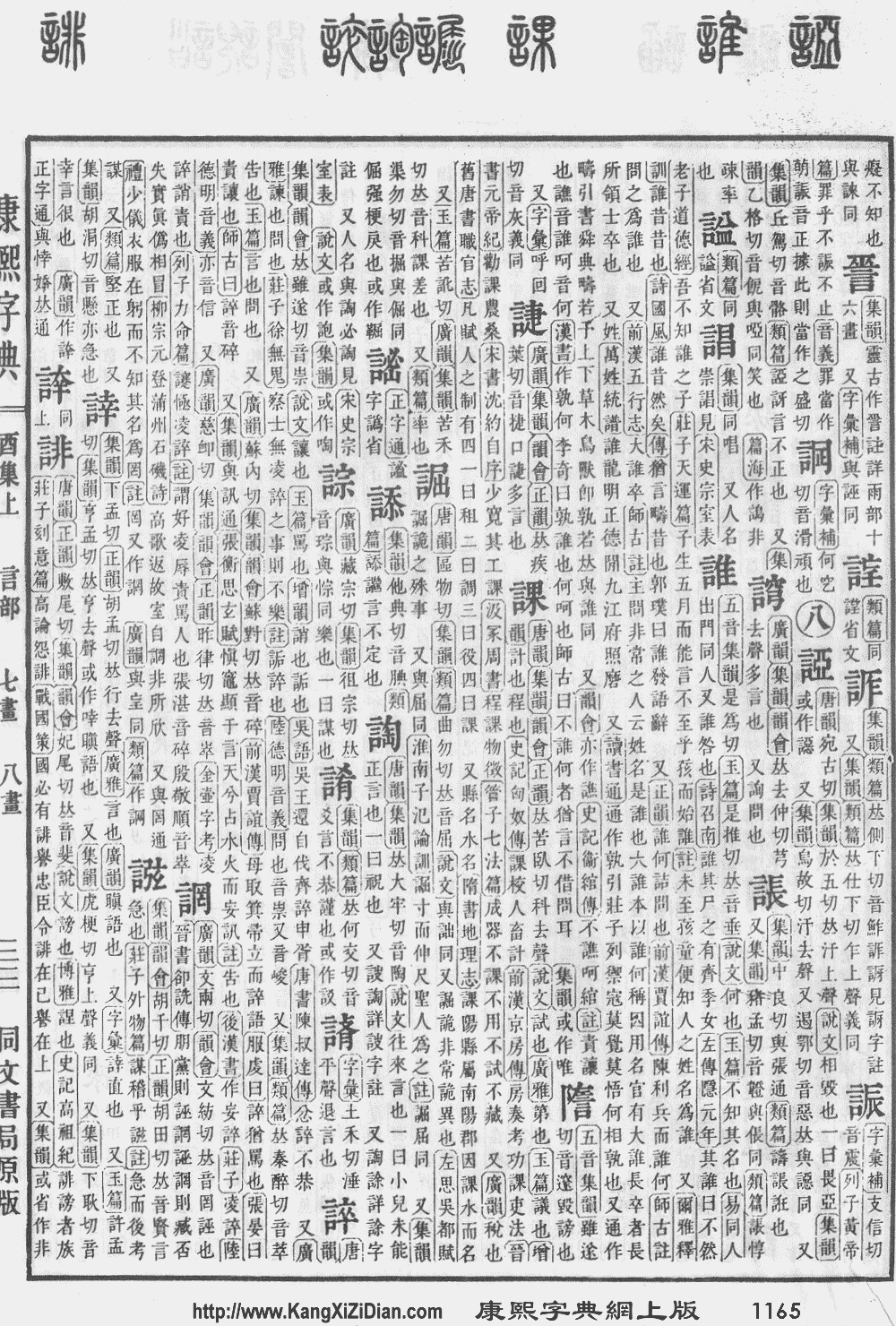
- KangXi: page 1165, character 11
- Dai Kanwa Jiten: character 35686
- Dae Jaweon: page 1630, character 27
- Hanyu Da Zidian: volume 6, page 3987, character 10
- Unihan data for U+8AB0
Chinese
Glyph origin
| Characters in the same phonetic series (隹) (Zhengzhang, 2003) | |
|---|---|
| Old Chinese | |
| 蜼 | *lus, *rulʔ, *luls |
| 堆 | *tuːl |
| 嵟 | *tuːl |
| 碓 | *tuːls |
| 推 | *tʰuːl, *tʰjul |
| 蓷 | *tʰuːl, *tʰjul |
| 陮 | *duːlʔ |
| 魋 | *duːl |
| 嶊 | *stuːlʔ |
| 崔 | *zluːl, *sʰluːl |
| 猚 | *ŋreːl, *rulʔ |
| 椎 | *dul |
| 顀 | *dul |
| 隹 | *tjul |
| 錐 | *tjul |
| 萑 | *kljul |
| 騅 | *tjul |
| 鵻 | *sɢʷinʔ, *tjul |
| 誰 | *djul |
| 脽 | *djul |
Phono-semantic compound (形聲, OC *djul) : semantic 言 (“speak”) + phonetic 隹 (OC *tjul).
Etymology 1
| trad. | 誰 | |
|---|---|---|
| simp. | 谁 | |
From *du + *-i (“suffix in independent pronouns”); cognate with 疇 (OC *du, “who”), 孰 (OC *djɯwɢ, “which one; who”) (Schuessler, 2007). In other Sino-Tibetan languages, compare Mizo tû (“who; which”), Chepang दोह् (“what”), Proto-Kuki-Chin *tuu (“who; which (relativizer)”) (Schuessler, 2007; STEDT).
Pronunciation
Definitions
誰
Compounds
Etymology 2
| trad. | 誰 | |
|---|---|---|
| simp. | 谁 | |
| alt. forms | 倽 | |
Contraction of 啥人 (siáⁿ-lâng).
Pronunciation
Definitions
誰
Etymology 3
| trad. | 誰 | |
|---|---|---|
| simp. | 谁 | |
Contraction of 底人 (tī-lâng).
Pronunciation
Definitions
誰
Etymology 4
| trad. | 誰 | |
|---|---|---|
| simp. | 谁 | |
Contraction of 是誰/是谁 (chī-chūi).
Pronunciation
Definitions
誰
Etymology 5
| trad. | 誰 | |
|---|---|---|
| simp. | 谁 | |
| alt. forms | 孰 (chiâ) 咜 (chôa) | |
From shortening of 是誰/是谁 (chī-choa̍h), from 是誰仔/是谁仔 (chī-chūi-á).
Pronunciation
Definitions
誰
Synonyms
See also
Question words
- 嗎/吗 (ma, “yes/no question particle”)
- 什麼/什么 (shénme, “what”)
- 怎麼/怎么 (zěnme, “how”)
- 什麼時候/什么时候 (shénme shíhòu, “when”)
- 哪 (nǎ, “what, which”)
- 哪裡/哪里 (nǎlǐ), 哪兒/哪儿 (nǎr) (where)
- 呢 (ne, “reciprocal questions particle”)
Japanese
Kanji
- interrogative personal pronoun: who
Readings
Etymology 1
| Kanji in this term |
|---|
| 誰 |
| だれ Grade: S |
| kun’yomi |
/tare/ → /dare/
From earlier tare[1][2][3] (see below). The dare form appears from around the Edo period.[2] The voicing of the initial /t-/ to /d-/ is likely by analogy with other interrogative demonstratives 何れ (dore, “which one”), 何処 (doko, “where”).
Now the primary form, replacing earlier tare.
Pronunciation
Pronoun
- interrogative personal pronoun: who
- 誰が誰を作ったのか
- dare ga dare o tsukutta no ka
- Who made who?
- 誰が誰を作ったのか
Synonyms
- 何方 (donata) (honorific)
Etymology 2
| Kanji in this term |
|---|
| 誰 |
| たれ Grade: S |
| kun’yomi |
From Old Japanese. Found in the Nihon shoki, completed in 720 CE.[1] Derived from older ta (see below) plus demonstrative nominalizer ending れ (re, “thing”). Compare the formation of これ (kore, “this”) from こ (ko) + れ (re), 彼 (kare, “that one, that person”) from 彼 (ka, “that”) + れ (re), etc.
Superseded by dare above starting from around the Edo period.[2] The tare form does not appear to be used anymore outside of poetry or intentionally archaic text.
Pronunciation
Pronoun
- (archaic) interrogative personal pronoun: who
- 1603–1604, Nippo Jisho (page 614)
- Tare. タレ (誰) 誰. 例, Tarega maittaca. l, tareca maitta. (誰が参つたか. まはは, 誰か参つた) 誰が来たか. Tare naritomo. (誰なりとも) 誰であろうとも.
- 1603–1604, Nippo Jisho (page 614)
Etymology 3
| Kanji in this term |
|---|
| 誰 |
| た Grade: S |
| kun’yomi |
From Old Japanese. Found in the Kojiki, completed roughly 712 CE.[1] Appears to be the oldest form.
Pronunciation
Pronoun
- (obsolete, persists in some fossilized expressions) interrogative personal pronoun: who
References
- Doi, Tadao (1603–1604) Hōyaku Nippo Jisho (in Japanese), Tōkyō: Iwanami Shoten, published 1980, →ISBN.
Korean
Hanja
誰 • (su) (hangeul 수)
- This term needs a translation to English. Please help out and add a translation, then remove the text
{{rfdef}}.
Vietnamese
Han character
誰 (thùy)
- This term needs a translation to English. Please help out and add a translation, then remove the text
{{rfdef}}.