爾
| ||||||||
Translingual
Han character
爾 (radical 89 爻+10, 14 strokes, cangjie input 一火月大 (MFBK), four-corner 10227)
Descendants
References
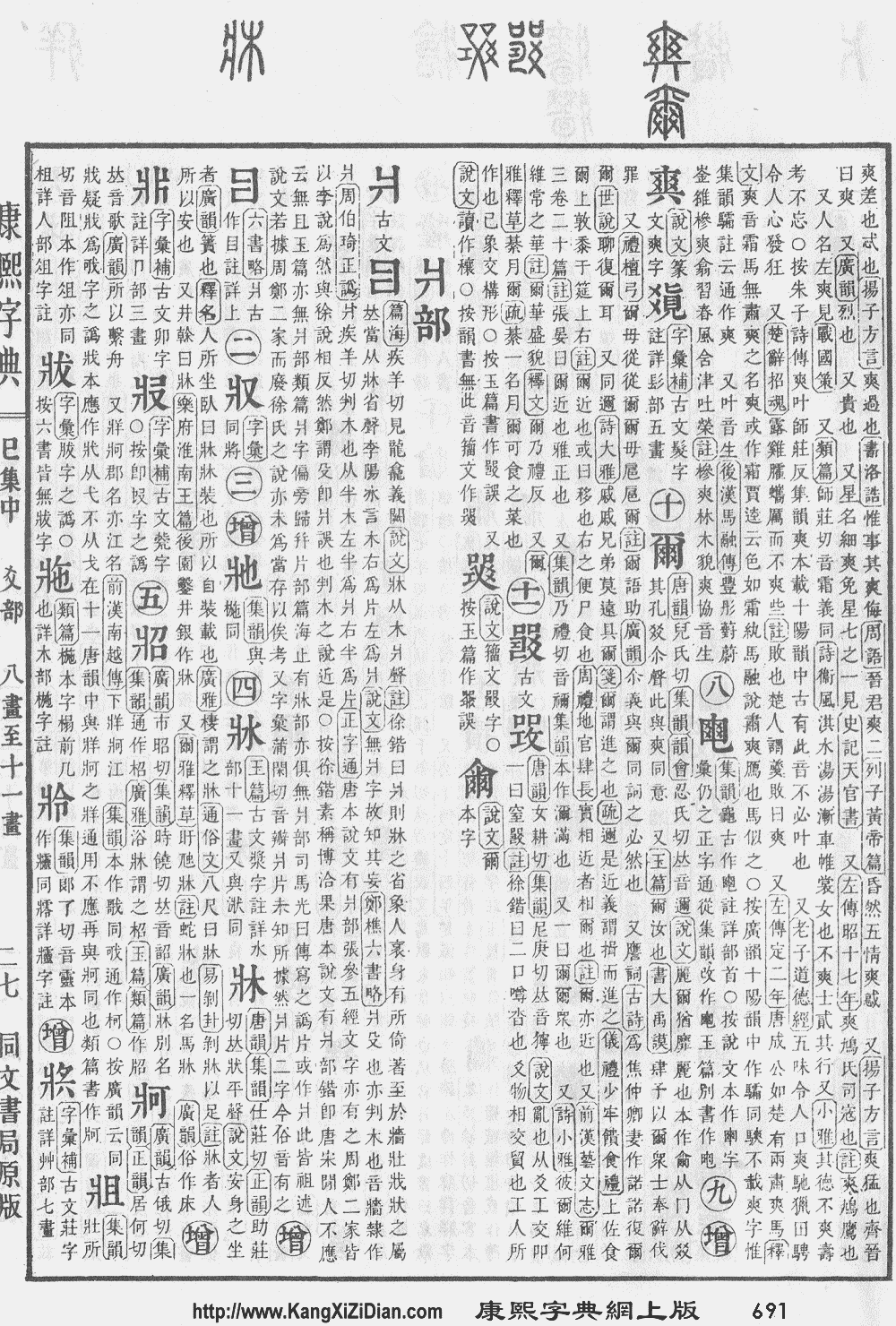
- KangXi: page 691, character 4
- Dai Kanwa Jiten: character 19750
- Dae Jaweon: page 1104, character 3
- Hanyu Da Zidian: volume 1, page 27, character 1
- Unihan data for U+723E
Chinese
Glyph origin
| Historical forms of the character 爾 | |||
|---|---|---|---|
| Shang | Western Zhou | Warring States | Shuowen Jiezi (compiled in Han) |
| Oracle bone script | Bronze inscriptions | Chu Slip and silk script | Small seal script |
 |
 |
 |
 |
| Characters in the same phonetic series (爾) (Zhengzhang, 2003) | |
|---|---|
| Old Chinese | |
| 嬭 | *rneːlʔ, *niːlʔ |
| 禰 | *niːlʔ |
| 镾 | *niːlʔ, *mnel |
| 薾 | *niːlʔ |
| 檷 | *niːlʔ |
| 鑈 | *niːlʔ, *neːb |
| 瀰 | *niːlʔ, *mnel, *mnelʔ |
| 獼 | *mnel |
| 瓕 | *mnel |
| 彌 | *mnel |
| 鸍 | *mnel, *hnjel |
| 擟 | *mnel |
| 濔 | *mnelʔ |
| 壐 | *smlelʔ |
| 璽 | *smlelʔ |
| 爾 | *njelʔ |
| 邇 | *njelʔ |
| 獮 | *smlenʔ |
| 籋 | *neb, *neːb |
Pictogram (象形) – cloth on a loom, with threads crossing. Used phonetically.
Etymology 1
| trad. | 爾 | |
|---|---|---|
| simp. | 尔 | |
| alt. forms | 尒 𡭗 尓 𠇍 尔 | |
- “you; your”
- From Proto-Sino-Tibetan *na-ŋ (“you”).
This etymology is incomplete. You can help Wiktionary by elaborating on the origins of this term.
Pronunciation
Definitions
爾
- (literary or dialectal) you; your
- (literary) so; this way
- (literary) this; that
- † (of flowers) exuberant
-
- 彼爾維何,維常之華。 [Classical Chinese, trad.]
- From: The Classic of Poetry, circa 11th – 7th centuries BCE, translated based on James Legge's version
- Bǐ ěr wéi hé, wéi cháng zhī huā. [Pinyin]
- What is that so gorgeous? It is the flowers of the cherry tree.
彼尔维何,维常之华。 [Classical Chinese, simp.]
-
- final particle
- A surname.
Synonyms
| Dialectal synonyms of 你 (“you (singular)”) [map] | ||
|---|---|---|
| Variety | Location | Words |
| Classical Chinese | 汝、爾 | |
| Formal (Written Standard Chinese) | 你 | |
| Mandarin | Beijing | 你、您 |
| Jinan | 你 | |
| Xi'an | 你 | |
| Wuhan | 你、你家 | |
| Chengdu | 你 | |
| Yangzhou | 你 | |
| Hefei | 你 | |
| Cantonese | Guangzhou | 你 |
| Hong Kong | 你 | |
| Taishan | 你 | |
| Yangjiang | 你 | |
| Gan | Nanchang | 你 |
| Hakka | Meixian | 你 |
| Miaoli (N. Sixian) | 你 | |
| Liudui (S. Sixian) | 你 | |
| Hsinchu (Hailu) | 你 | |
| Dongshi (Dabu) | 你 | |
| Zhuolan (Raoping) | 你 | |
| Yunlin (Zhao'an) | 你 | |
| Jin | Taiyuan | 你 |
| Min Bei | Jian'ou | 你 |
| Min Dong | Fuzhou | 汝 |
| Matsu | 汝 | |
| Min Nan | Xiamen | 汝 |
| Quanzhou | 汝 | |
| Zhangzhou | 汝 | |
| Taipei | 汝 | |
| Kaohsiung | 汝 | |
| Tainan | 汝 | |
| Taichung | 汝 | |
| Hsinchu | 汝 | |
| Lukang | 汝 | |
| Sanxia | 汝 | |
| Yilan | 汝 | |
| Kinmen | 汝 | |
| Magong | 汝 | |
| Penang | 汝 | |
| Singapore | 汝 | |
| Philippines (Manila) | 汝 | |
| Chaozhou | 汝 | |
| Shantou | 汝 | |
| Wu | Shanghai | 儂 |
| Suzhou | 倷 | |
| Wenzhou | 你 | |
| Ningbo | 儂、爾、爾儂、像儂、像爾 | |
| Xiang | Changsha | 你 |
| Shuangfeng | 你 | |
Compounds
|
|
|
Etymology 2
| trad. | 爾 | |
|---|---|---|
| simp. | 尔 | |
| alt. forms | 尼 呢 | |
Pronunciation
Definitions
爾
- This term needs a translation to English. Please help out and add a translation, then remove the text
{{rfdef}}.
Compounds
Etymology 3
| trad. | 爾 | |
|---|---|---|
| simp. | 尔 | |
| alt. forms | 耳 | |
Pronunciation
Definitions
爾
Compounds
Etymology 4
| trad. | 爾 | |
|---|---|---|
| simp. | 尔 | |
Pronunciation
Definitions
爾
Japanese
Kanji
(“Jinmeiyō” kanji used for names)
Readings
Compounds
Etymology 1
| Kanji in this term |
|---|
| 爾 |
| おれ Jinmeiyō |
| kun’yomi |
From Old Japanese. Found in use mostly from ancient times until roughly the Heian period,[1] used to refer in the second person to social inferiors or to insult.[1][2][3]
The second person sense of you appears to be obsolete in modern Japanese.
Not to be confused with the modern term 俺 (ore) with the first person sense of I, me. See 俺 for that sense.
Pronunciation
Alternative forms
Pronoun
- (archaic, vulgar) you
Usage notes
Often used to insult. Compare modern Japanese お前 (omae), English you son of a bitch.
Etymology 2
| Kanji in this term |
|---|
| 爾 |
| なんじ Jinmeiyō |
| kun’yomi |
/namuti/ → */nandi/ → /nand͡ʑi/
From Old Japanese. Originally derived as a compound of 汝 (na, “you”) + 貴 (muchi, honorific suffix).[1][2][3]
Originally used to refer honorifically to the second person. From around the Nara period, the honorific sense lessened, and the term was used to refer to social equals or occasionally social inferiors. By the Muromachi period, this term was the most common second person pronoun for social inferiors.[1]
Pronunciation
Alternative forms
- 汝 (more common)
Pronoun
爾 (hiragana なんじ, rōmaji nanji)
Usage notes
No longer in use in modern Japanese outside of contexts where the speaker is deliberately invoking archaic usage. Compare use of English thou.
Etymology 3
| Kanji in this term |
|---|
| 爾 |
| しか Jinmeiyō |
| kun’yomi |
From Old Japanese.[1][2] Compound of し (shi, “that”, demonstrative, likely related to さ (sa), modern そう (sō)) + か (ka, suffix indicating state).[1][3]
The interjection sense appears to have developed from the adverb sense.
Pronunciation
Alternative forms
- 然 (more common)
Adverb
- (obsolete) like that, as such
- (obsolete) certainly, definitely
Derived terms
- 然し (shikashi, “be that as it may, however”)
Interjection
References
Korean
Hanja
爾 • (i) (hangeul 이, revised i, McCune–Reischauer i, Yale i)
- This term needs a translation to English. Please help out and add a translation, then remove the text
{{rfdef}}.
Vietnamese
Han character
爾 (nhãi, nhĩ)
- This term needs a translation to English. Please help out and add a translation, then remove the text
{{rfdef}}.