漢
| ||||||||
| ||||||||
| ||||||||
Translingual
| Japanese | 漢 |
|---|---|
| Simplified | 汉 |
| Traditional | 漢 |
Alternative forms
Note that in traditional Chinese, the component 

Han character
漢 (radical 85, 水+11 in Chinese, 水+10 in Japanese, 14 strokes in Chinese, 13 strokes in Japanese, cangjie input 水廿中人 (ETLO), four-corner 34134, composition ⿰氵𦰩(GHTKV) or ⿰氵⿱艹⿻口夫(J))
References
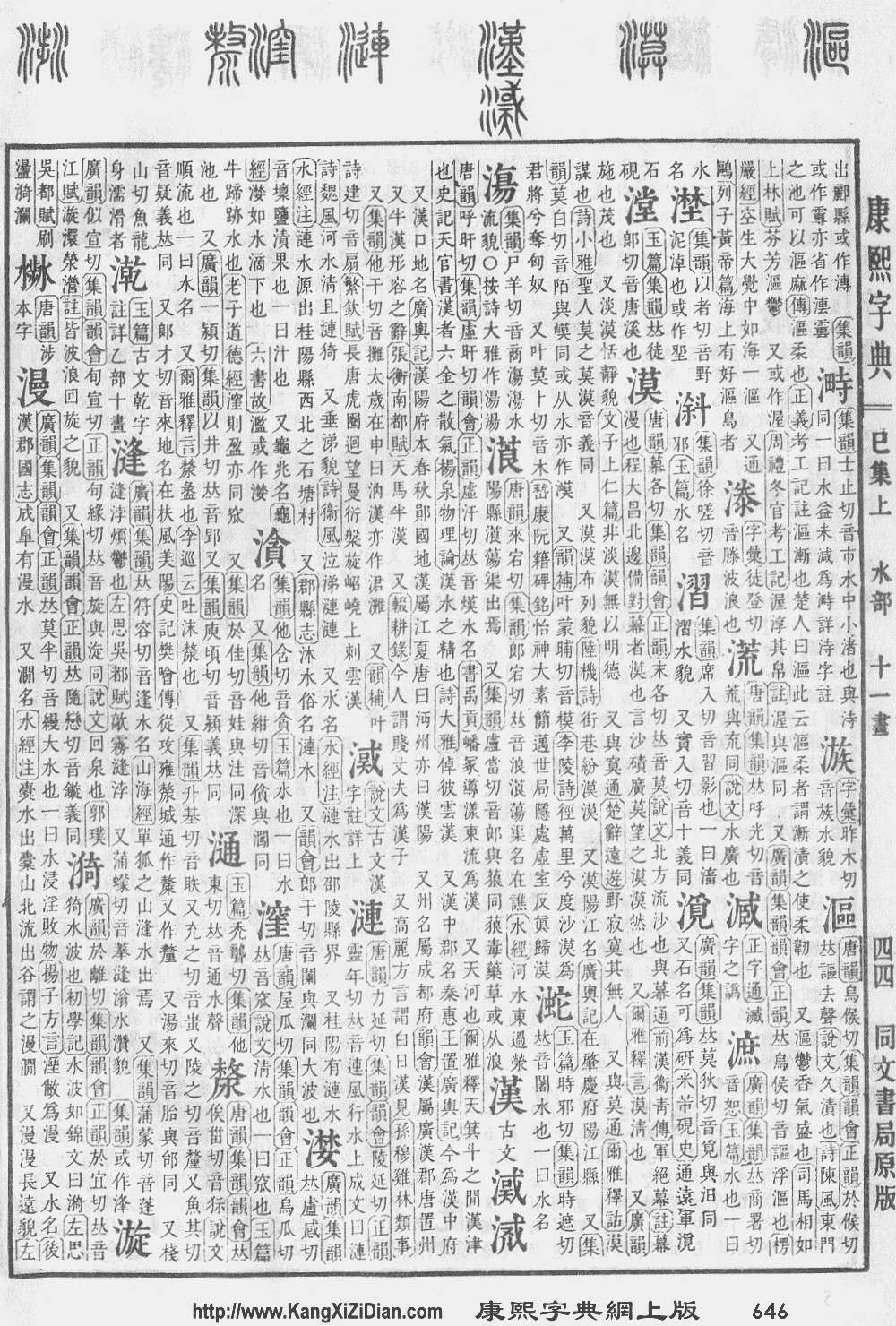
- KangXi: page 646, character 17
- Dai Kanwa Jiten: character 18068
- Dae Jaweon: page 1055, character 15
- Hanyu Da Zidian: volume 3, page 1713, character 9
- Unihan data for U+6F22
Chinese
| trad. | 漢 | |
|---|---|---|
| simp. | 汉 | |
Glyph origin
| Historical forms of the character 漢 | ||
|---|---|---|
| Warring States | Shuowen Jiezi (compiled in Han) | Liushutong (compiled in Ming) |
| Bronze inscriptions | Small seal script | Transcribed ancient scripts |
 |
 |
 |
| Characters in the same phonetic series (暵) (Zhengzhang, 2003) | |
|---|---|
| Old Chinese | |
| 儺 | *naːl |
| 臡 | *naːl, *neːl, *njeːl |
| 嘆 | *n̥ʰaːn, *n̥ʰaːns |
| 灘 | *n̥ʰaːn, *naːns, *hnaːnʔ, *hnaːns |
| 擹 | *n̥ʰaːn |
| 攤 | *n̥ʰaːn, *naːnʔ, *naːns |
| 癱 | *n̥ʰaːn |
| 歎 | *n̥ʰaːns |
| 難 | *n̥ʰaːn, *naːns |
| 暵 | *hnaːnʔ, *hnaːns |
| 熯 | *hnaːnʔ, *hnaːns, *njanʔ |
| 漢 | *hnaːns |
| 戁 | *rnaːnʔ, *njanʔ |
Phono-semantic compound (形聲, OC *hnaːns) : semantic 氵 (“water”) + phonetic 𦰩 – name of a river.
Pronunciation
Definitions
漢
- (~水) Han River, a tributary of the Yangtze
- (Classical Chinese) the Milky Way
- (~江) Han River, the fourth-longest river on the Korean peninsula
- (~朝) Han Dynasty
- Chinese; Chinese people
- Chinese language
- man; guy; bloke
- A surname.
See also
Compounds
|
|
|
Japanese
| 漢 | |
| 漢 |
Kanji
Readings
Compounds
- 漢音 (kan'on)
- 漢学 (kangaku)
- 漢奸 (kankan)
- 漢語 (kango)
- 漢才 (kansai), 漢才 (kanzai)
- 漢詩 (kanshi)
- 漢字 (kanji, “Chinese character”)
- 漢籍 (kanseki)
- 漢朝 (Kanchō)
- 漢文 (kanbun, “Chinese classical literature”)
- 漢方 (kanpō, “Chinese medicine”)
- 漢名 (kanmei)
- 阿羅漢 (arakan), 羅漢 (rakan, “arhat”)
- 銀漢 (Ginkan), 天漢 (Tenkan, “the Milky Way”)
- 国漢 (kokkan)
- 霄漢 (shōkan)
- 珍紛漢, 珍糞漢 (chinpunkan)
- 頓珍漢 (donchinkan)
Etymology 1
| Kanji in this term |
|---|
| 漢 |
| かん Grade: 3 |
| on’yomi |
From Middle Chinese 漢 (MC hɑnH), in reference to the Han Chinese ethnic group.
The sense of man arose from usage in Chinese to differentiate between the “civilized” people of the Han Chinese ethnicity versus other ethnic groups.
Noun
- man
- さらに悟上に得悟する漢あり、迷中又迷の漢あり。
- Sara ni gojō ni tokugo suru kan ari, meichū umei no kan ari.
- Moreover, some men achieve enlightenment and further enlightenment, and some men achieve confusion and further confusion.
- さらに悟上に得悟する漢あり、迷中又迷の漢あり。
Derived terms
- 悪漢 (akkan), 凶漢, 兇漢 (kyōkan, “villain”)
- 快漢 (kaikan), 好漢 (kōkan, “fine man”)
- 怪漢 (kaikan, “suspicious person”)
- 巨漢 (kyokan, “giant”)
- 硬骨漢 (kōkotsu-kan, “man of principle”)
- 酔漢 (suikan, “drunkard”)
- 大食漢 (daishoku-kan, “glutton”)
- 痴漢 (chikan, “molester”)
- 熱血漢 (nekketsu-kan, “hot-blooded person”)
- 暴漢 (bōkan, “hoodlum, ruffian”)
- 木石漢 (bokuseki-kan, “unfeeling or callous person”)
- 没分暁漢 (botsubungyō-kan, “blockhead, obstinate person”)
- 門外漢 (mongai-kan, “outsider”)
- 冷血漢 (reiketsu-kan, “cold-blooded person”)
Proper noun
- the name of China during the Han dynasty (206 BCE – 220 CE)
- name of various Chinese dynasties
- the 西漢 (Saikan, “Western Han”) or 前漢 (Zenkan, “Former Han”) (206 BCE – 9 CE)
- the 東漢 (Tōkan, “Eastern Han”) or 後漢 (Gokan, “Later Han”) (25–220 CE)
- the 蜀漢 (Shokkan, “Shu Han”) (221-263)
- the 前趙 (Zenchō, “Former Zhao”) (304–329)
- the 成漢 (Seikan, “Cheng Han”) (304–347)
- the 南漢 (Nankan, “Southern Han”) (917–971)
- the 後漢 (Kōkan, “Later Han”) (947–951)
- the 北漢 (Hokukan, “Northern Han”) (951–979)
- the Han Chinese people
- the Han River, a tributary of the Yangtze
- (by extension from the "river" sense) the Milky Way
- alternative name for 漢中 (Kanchū, “Hanzhong”)
- a surname
Derived terms
- 漢民 (Kan-zoku), 漢民族 (Kan-minzoku, “the Han Chinese people”)
- 漢和 (Kan-Wa, “Chinese-Japanese”)
- 和漢 (Wa-Kan, “Japanese-Chinese”)
Etymology 2
| Kanji in this term |
|---|
| 漢 |
| から Grade: 3 |
| kun’yomi |
From Old Japanese.
Originally referred to the Gaya confederacy, an independent state in the south of the Korean peninsula in the years 42-562 CE. Over time, the meaning extended to refer in general to the Korean peninsula and China, expanding further just before and during the Edo period to refer to foreign lands in general.[1][2]
Pronunciation
Alternative forms
- (usually China in the Tang dynasty, and foreign lands in general): 唐
- (usually Korea): 韓
- (specifically the Gaya confederacy): 加羅, 伽羅, 迦羅
Prefix
漢 (hiragana から, rōmaji kara-)
- element in compounds, referring to things imported from China or Korea, or from other foreign lands
Derived terms
- 漢詩 (karauta)
- 漢声 (karagoe)
- 漢才 (karazae)
- 漢竹 (karatake)
- 漢書 (karabumi)
Noun
- (historical) shortly before and during the Edo period, foreign lands in general
Proper noun
- the Gaya confederacy
- (archaic) the Korean peninsula
- (archaic) China, especially during the Han dynasty
Derived terms
Etymology 3
| Kanji in this term |
|---|
| 漢 |
| あや Grade: 3 |
| kun’yomi |
From Old Japanese, in reference to clans purportedly originating from China.[1][3][2] Appears to be cognate with 文 / 紋 / 綾 / 絢 (aya, “a pattern or design; a pattern of diagonally interweaving lines; twill; how something fits together, the reason or background of a thing; skillful expression in color or words; melody, tune”), possibly in distant reference to technologies and cultural practices brought to Japan by the original Chinese immigrants.
Pronunciation
Proper noun
- short for 漢氏 (Aya uji): name of one of two ancient clans, purportedly descendants from Han Chinese, and notable historically for major achievements in fields including literature, diplomacy, and finance, among others
Derived terms
Etymology 4
| Kanji in this term |
|---|
| 漢 |
| おとこ Grade: 3 |
| kun’yomi |
Rare alternative spelling for 男 (otoko, “man”), from usage in Chinese to differentiate between the “civilized” people of the Han Chinese ethnicity versus other ethnic groups.
See the 男 entry for the derivation of the reading.
Pronunciation
Noun
漢 (hiragana おとこ, rōmaji otoko, historical hiragana をとこ)
- (manga slang) Rare spelling of 男 (“man”).
- 2004 July 7, Watsuki, Nobuhiro, “第26話 トレーニング・デイ [Chapter 26: Training Day]”, in 武装錬金 [Armed Alchemy], volume 3 (in Japanese), Tokyo: Shueisha, →ISBN, page 161:
- 漢は背中で人生を語る!キミのベストポーズでスーパーアピール‼
- Otoko wa senaka de jinsei o kataru! Kimi no besuto pōzu de sūpā apīru‼
- Men show what life is with their backs! Strike your best pose to drive home your point‼
- 漢は背中で人生を語る!キミのベストポーズでスーパーアピール‼
-
References
- 1 2 1988, 国語大辞典(新装版) (Kokugo Dai Jiten, Revised Edition) (in Japanese), Tōkyō: Shogakukan
- 1 2 1995, 大辞泉 (Daijisen) (in Japanese), Tōkyō: Shogakukan, →ISBN
- 1 2 3 2006, 大辞林 (Daijirin), Third Edition (in Japanese), Tōkyō: Sanseidō, →ISBN
- 1 2 1997, 新明解国語辞典 (Shin Meikai Kokugo Jiten), Fifth Edition (in Japanese), Tōkyō: Sanseidō, →ISBN
- ↑ 1998, NHK日本語発音アクセント辞典 (NHK Japanese Pronunciation Accent Dictionary) (in Japanese), Tōkyō: NHK, →ISBN
Korean
Hanja
漢 • (han) (hangeul 한, McCune–Reischauer han, Yale han)
Vietnamese
Han character
漢 (Hán,hớn)
- This term needs a translation to English. Please help out and add a translation, then remove the text
{{rfdef}}.