新
| ||||||||
Translingual
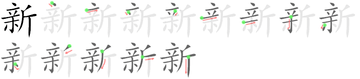
| Stroke order | |||
|---|---|---|---|
 | |||
Alternative forms
Han character
新 (radical 69, 斤+9, 13 strokes, cangjie input 卜木竹一中 (YDHML), four-corner 02921, composition ⿰亲斤)
Derived characters
References
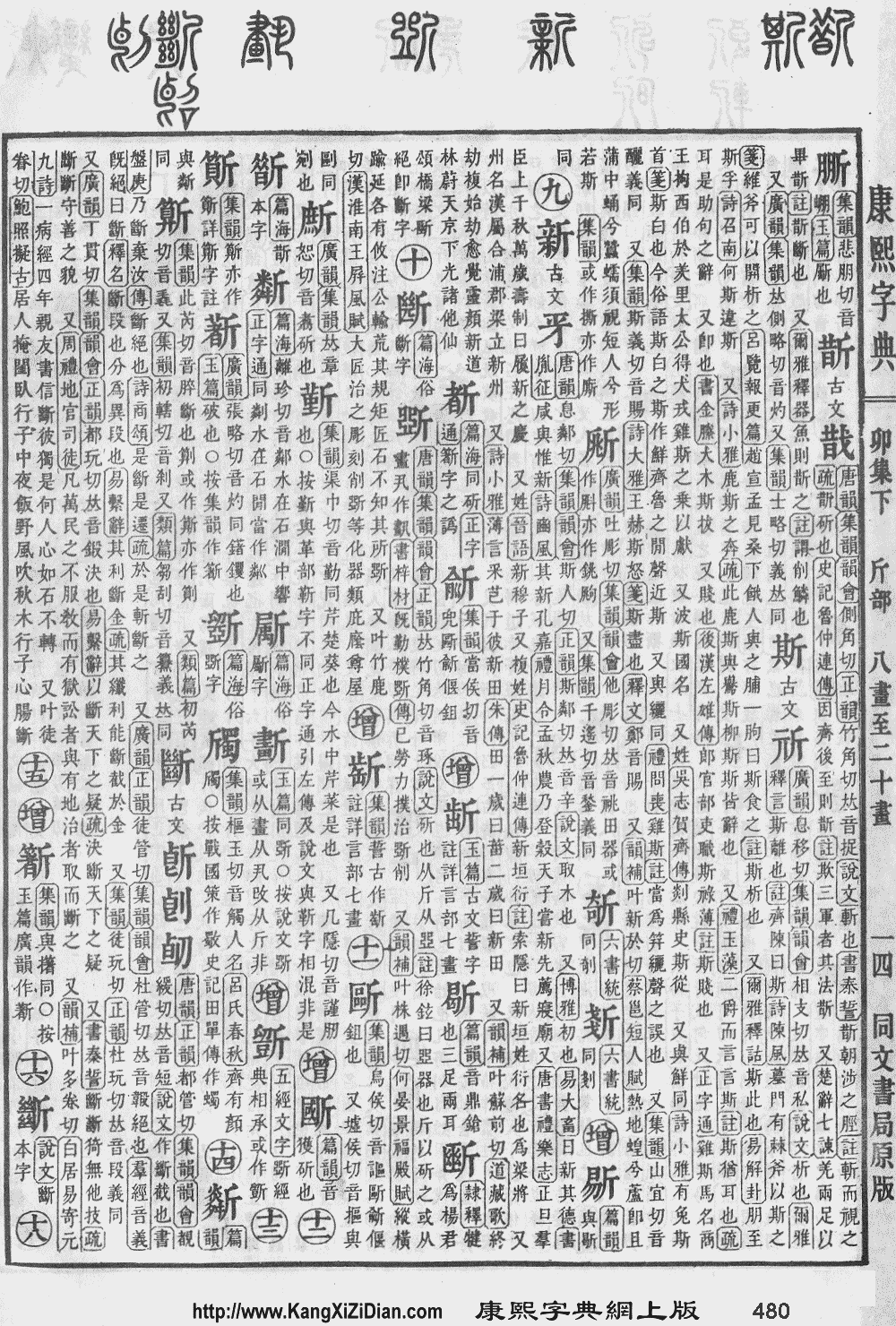
- KangXi: page 480, character 10
- Dai Kanwa Jiten: character 13572
- Dae Jaweon: page 839, character 10
- Hanyu Da Zidian: volume 3, page 2026, character 21
- Unihan data for U+65B0
Chinese
| simp. and trad. |
新 | |
|---|---|---|
Glyph origin
| Historical forms of the character 新 | |||
|---|---|---|---|
| Shang | Western Zhou | Warring States | Shuowen Jiezi (compiled in Han) |
| Oracle bone script | Bronze inscriptions | Chu Slip and silk script | Small seal script |
 |
 |
 |
 |
| Characters in the same phonetic series (辛) (Zhengzhang, 2003) | |
|---|---|
| Old Chinese | |
| 親 | *sʰin, *sʰins |
| 寴 | *sʰin, *sʰins |
| 儭 | *sʰins, *sʰrins |
| 瀙 | *sʰins, *ʔsrin, *sʰrins |
| 辛 | *siŋ |
| 新 | *siŋ |
| 薪 | *siŋ |
| 襯 | *sʰrins |
| 櫬 | *sʰrins |
| 嚫 | *t͡sʰrinh |
| 莘 | *sriŋ |
| 騂 | *seŋ |
| 垶 | *seŋ |
| 觪 | *seŋ |
Phono-semantic compound (形聲, OC *siŋ) : phonetic 亲 (OC *siŋ, “hazelnut tree”) + semantic 斤 (“axe”) – to cut down a tree with an axe (hence starting something new).
Also ideogrammic compound (會意) . Original form of 薪 (OC *siŋ, “firewood”).
Etymology
Sino-Tibetan; cognate with Burmese သစ် (sac, “new”). Compare the cognacy between 薪 (OC *siŋ, “firewood”) and Burmese သစ် (sac, “wood; timber”).
This word may belong to the Sino-Tibetan stem Proto-Sino-Tibetan *siŋ (“alive, fresh, green”) and may hence be related to 青 (OC *sʰleːŋ, “green”) as well as 薪 (OC *siŋ, “firewood”) (Schuessler, 2007).
Pronunciation
Definitions
新
- new; fresh
- newly; freshly; recently
- neo- (prefix)
- (chemistry) meso-
- A surname. Xin
- (~朝) Xin dynasty
- Short for 新疆 (Xīnjiāng).
- Short for 新加坡 (Xīnjiāpō).
- Short for 新西蘭/新西兰 (Xīn Xīlán).
- 澳新银行 ― àoxīnyínxíng ― Australia and New Zealand Banking Corporation (ANZ Bank)
See also
Compounds
Derived terms from 新
|
|
|
Japanese
Kanji
新
Readings
Compounds
Compounds
Prefix
| Kanji in this term |
|---|
| 新 |
| しん Grade: 2 |
| on’yomi |
- neo-
- Antonym: 旧 (kyū-)
- 新世界
- Shinsekai
- the New World
- 新約聖書
- Shin'yaku Seisho
- the New Testament
- 2004 April 7, Ohba, Tsugumi; Obata, Takeshi, “page.1 退屈 [page.1 Boredom]”, in DEATH NOTE [DEATH NOTE], volume 1 (fiction, in Japanese), Tokyo: Shueisha, →ISBN, pages 48–49:
- そして 僕は新世界の神となる
- Soshite boku wa shinsekai no kami to naru
- And then I will become the god of this new world
- そして 僕は新世界の神となる
- attached to the title of a fiction work to mean “new storyline”, to distinguish it from older works
- 新鉄拳チンミ
- Shin Tekken Chinmi
- New Ironfist Chinmi
- 新鉄拳チンミ
- attached to the title of a fiction adaptation to mean “remake”, to distinguish it from older adaptations
- Lois & Clark 新スーパーマン
- Lois & Clark Shin Sūpāman
- Lois & Clark: New Superman
- Lois & Clark 新スーパーマン
Korean
Hanja
Compounds
Vietnamese
Han character
- This term needs a translation to English. Please help out and add a translation, then remove the text
{{rfdef}}.
This article is issued from
Wiktionary.
The text is licensed under Creative Commons - Attribution - Sharealike.
Additional terms may apply for the media files.