夏
| ||||||||
Translingual
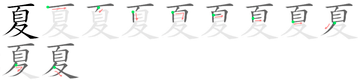
| Stroke order | |||
|---|---|---|---|
 | |||
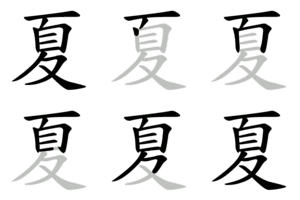
| Stroke order | |||
|---|---|---|---|
 | |||
Han character
夏 (radical 35, 夊+7, 10 strokes, cangjie input 一山竹水 (MUHE), four-corner 10247, composition ⿱𦣻夂(GJK) or ⿱𦣻夊(HT))
References
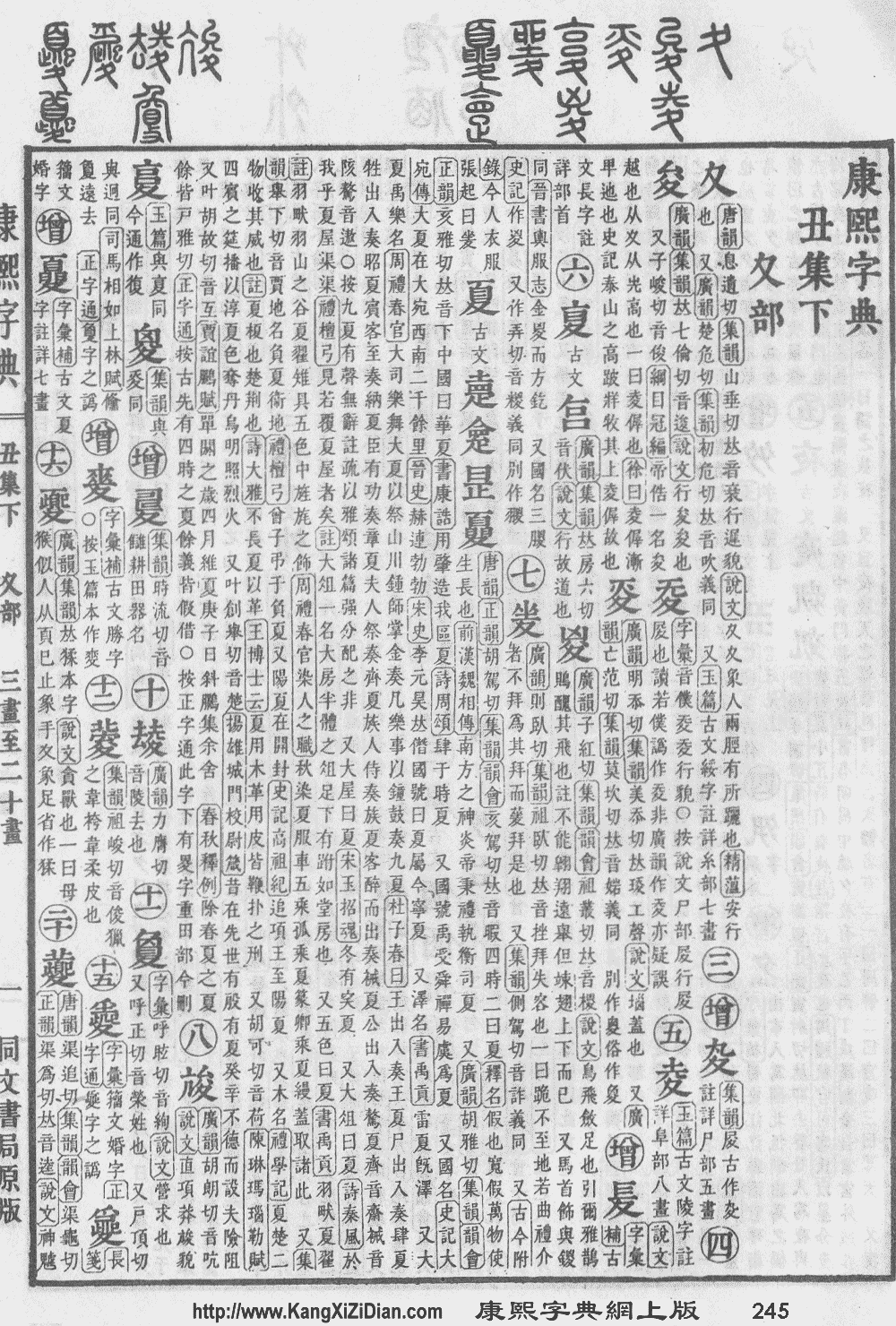
- KangXi: page 245, character 12
- Dai Kanwa Jiten: character 5720
- Dae Jaweon: page 485, character 29
- Hanyu Da Zidian: volume 2, page 869, character 10
- Unihan data for U+590F
Chinese
| simp. and trad. |
夏 | |
|---|---|---|
| alt. forms | ||
Glyph origin
| Historical forms of the character 夏 | ||||
|---|---|---|---|---|
| Shang | Western Zhou | Warring States | Shuowen Jiezi (compiled in Han) | Liushutong (compiled in Ming) |
| Oracle bone script | Bronze inscriptions | Chu Slip and silk script | Small seal script | Transcribed ancient scripts |
 |
 |
 |
 |
 |
| Characters in the same phonetic series (夏) (Zhengzhang, 2003) | |
|---|---|
| Old Chinese | |
| 榎 | *kraːʔ |
| 廈 | *sraːs, *ɡraːʔ |
| 嗄 | *sqʰraːs, *qraːds |
| 夏 | *ɡraːʔ, *ɡraːs |
In the oracle bone script, it was an ideogrammic compound (會意) : 日 (“sun”) + 頁 (“head; man”) – man under the scorching sun; summer.
Various variants were seen in the bronze inscriptions from the Spring and Autumn period. 止 (“foot”) was often added to the bottom of the man. Additionally, in the form shown above, the 日 was removed and 𦥑 (“two hands”) was added. The seal script inherits its form from this form, with 止 replaced with the related 夊.
Various forms were also seen from the Warring States period. The bamboo and silk script above shows a common form: 日 + 止 + 頁. The “ancient script” (古文) from Shuowen (labelled as the large seal script) has deviated significantly, with 止 becoming the related 足. The top part may be a corruption of 頁.
The current form is simplified from the seal script, with the removal of 𦥑 and the legs from 頁.
Etymology 1
- “great; Xia Dynasty; China; Chinese”
- Possibly related to 假 (OC *kraːʔ, *kraːs, “great”), 嘏 (OC *kraːʔ, “great”) and 廈 (OC *sraːs, *ɡraːʔ, “big house”) (Wang, 1980). Shi (2000) and Mair (2013) relate this word to Tibetan རྒྱ (rgya, “great; wide; width; size; expanse; China”).
- “magnificent colours; variegated”
- The sense “variegated” may be of a different origin. Compare Proto-Sino-Tibetan *Krā(H) (“variegated”) (Starostin), whence Tibetan བཀྲ (bkra, “variegated; bright; radiant; splendid”), Tibetan ཁྲ (khra, “many-coloured; variegated; mottled; striped”) and Burmese ကျား (kya:, “variegated; striped; chequered”). Possibly related to 騢 (OC *ɡraː, “horse with mixed red and white colour”).
Pronunciation
Definitions
夏
- (~朝) (historical) Xia Dynasty
- † (by extension) China; Chinese
- † great; grand; magnificent
- † magnificent colours; resplendent colours; variegated
- † Alternative form of 廈/厦 (shà, “big house”).
- A surname.
See also
Compounds
Etymology 2
Pronunciation
Definitions
夏
- summer (season)
See also
| Seasons in Chinese · 四季 (sìjì, “four seasons”) (layout · text) | |||
|---|---|---|---|
| 春 (chūn, “spring”) | 夏 (“summer”) | 秋 (qiū, “fall; autumn”) | 冬 (dōng, “winter”) |
Compounds
Etymology 3
Pronunciation
Definitions
夏
Compounds
|
|
References
Japanese
Kanji
Readings
Compounds
Etymology
Possibly from Proto-Altaic *ni̯ā́ŕà (“young; spring, summer”) (compare Korean 여름 (yeoreum, “summer”), Proto-Turkic *jāŕ (“summer”) (Turkish yaz)).[1].
Pronunciation
| Kanji in this term |
|---|
| 夏 |
| なつ Grade: 2 |
| kun’yomi |
Noun
- summer (season)
Synonyms
See also
| Seasons in Japanese · 四季 (shiki, “four seasons”) (layout · text) | |||
|---|---|---|---|
| 春 (haru, “spring”) | 夏 (natsu, “summer”) | 秋 (aki, “fall; autumn”) | 冬 (fuyu, “winter”) |
References
- ↑ Starostin, Sergei; Dybo, Anna; Mudrak, Oleg (2003) Etymological dictionary of the Altaic languages (Handbuch der Orientalistik; VIII.8), Leiden, New York, Köln: E.J. Brill: “*ni̯ā́ŕà”
Korean
Hanja
夏 • (ha) (hangeul 하, revised ha, McCune–Reischauer ha)