伽羅
Japanese
Etymology 1
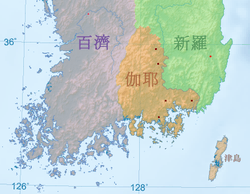
伽羅 (Kara): the Gaya confederacy is shown here in orange.
| Kanji in this term | |
|---|---|
| 伽 | 羅 |
| か Jinmeiyō |
ら Grade: S |
| on’yomi | |
Pronunciation
Proper noun
- the Gaya confederacy, a grouping of smaller states on the southern end of the Korean peninsula, roughly dating to 42-532 CE
- more broadly, ancient Korea and/or China
Usage notes
The Gaya confederacy sense is also found spelled 加羅 and 迦羅
The broader sense is more commonly spelled 唐 (or rarely 漢) when referring to China, and 韓 when referring to the states that became modern Korea.
Synonyms
- (Gaya confederacy): 伽耶 (Kaya), 任那 (Mimana)
Etymology 2
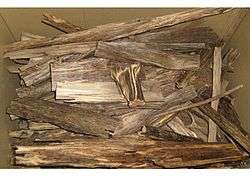
伽羅 (kyara): agarwood.
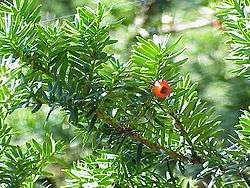
伽羅 (kyara): the Japanese yew.
| Kanji in this term | |
|---|---|
| 伽 | 羅 |
| きゃ Jinmeiyō |
ら Grade: S |
| on’yomi | |
There are two leading theories.
- From Middle Chinese 伽羅 (ghia la), itself a phonetic rendering of the first two syllables of Sanskrit कालागुरु (kālāguru), referring to a kind of fragrant black (kālā) agarwood tree (aguru) used for incense.[2]
- From Middle Chinese 伽羅 (ghia la), itself a phonetic rendering of the last two syllables of Sanskrit तगर (tagara), referring to the Tabernaemontana coronaria (pinwheel flower or crepe jasmine) or a fragrant powder made from the plant.[2][3]
Pronunciation
Noun
伽羅 (hiragana きゃら, rōmaji kyara)
- Taxus cuspidata, the Japanese yew
- an aromatic tree
- incense, especially when made from such aromatic wood
- (by extension) something of high quality, a rarity, a luxury
- (slang, obsolete) during the Edo period, a red-light district slang word for money
- flattery, sycophancy
Derived terms
Derived terms
- 伽羅色 (kyarairo): a dark reddish brown color
- 伽羅柿 (kyaragaki): a variety of persimmon noted for its darker skin and sweeter taste
- 伽羅臭い (kyarakusai): ostentatious, showy, overdone
- 伽羅細工 (kyarazaiku): fine woodwork created using aromatic woods
- 伽羅代 (kyara dai): in the Edo period, a red-light district slang term for money, especially the fee paid to an entertainer or prostitute
- 伽羅の油 (kyara no abura): a kind of pomade or hair oil made from sesame oil, plant resins, and cloves
- 伽羅の御方 (kyara no onkata): one's legal wife
- 伽羅の木 (kyara no ki): Taxus cuspidata, the Japanese yew
- 伽羅の字 (kyara no ji): in the Edo period, a red-light district slang term for money, especially the fee paid to an entertainer or prostitute
- 伽羅の枕 (kyara no makura): a wooden headrest with a drawer for burning incense
- 伽羅冷 (kyara hiyashi): a kind of tin urn or tin-plated box, partially filled with water, over which agarwood incense is placed; used in summer
- 伽羅蕗 (kyarabuki): butterbur stems simmered in soy sauce until dark reddish brown
- 伽羅木 (kyaraboku): Taxus cuspidata, the Japanese yew
- 伽羅枕 (kyara makura): a wooden headrest with a drawer for burning incense
- 伽羅女 (kyara me): (slang) a beautiful woman
- 伽羅者 (kyaramono): a flatterer; an amiable or sociable person who is quick to compliment others
Idioms
Idioms
- 伽羅で作った仏同然 (kyara de tsukutta hotoke dōzen): “just like a Buddha statue made from agarwood” → agarwood only smells nice when burned, so making a statue out of agarwood is pointless: something or someone of high value, but that turns out to be useless
- 伽羅を言う (kyara o iu): “to speak incense” → to flatter, to say nice things to flatter or ingratiate someone
- 伽羅の仏に箔置く (kyara no hotoke ni haku oku): “to put gold foil on an agarwood Buddha” → “to put the icing on the cake”: adding something good on top of something that is already good
- 伽羅も焚かず屁もこかず (kyara mo takazu he mo kokazu): “not even burning incense, not even passing gas” → neither here nor there, neither good nor bad
References
- ↑ Christopher I. Beckwith (2009) Empires of the Silk Road: A History of Central Eurasia from the Bronze Age to the Present, Princeton University Press, →ISBN, page 105: ““The spelling Kaya is the modern Korean reading of the characters used to write the name; the pronunciation /kara/ (transcriptionally *kala) is certain.””
- 1 2 3 1988, 国語大辞典(新装版) (Kokugo Dai Jiten, Revised Edition) (in Japanese), Tōkyō: Shogakukan
- 1 2 3 4 2006, 大辞林 (Daijirin), Third Edition (in Japanese), Tōkyō: Sanseidō, →ISBN
This article is issued from
Wiktionary.
The text is licensed under Creative Commons - Attribution - Sharealike.
Additional terms may apply for the media files.