漢字
See also: 汉字
Chinese
| Chinese; name of a dynasty; man | letter; symbol; character; word | ||
|---|---|---|---|
| trad. (漢字) | 漢 | 字 | |
| simp. (汉字) | 汉 | 字 | |
Pronunciation
Noun
漢字
- Chinese character; Han character; hanzi; kanji (Japanese); hanja (Korean); Hán tự/Han tu (Vietnamese)
Synonyms
Descendants
Others:
See also
Japanese
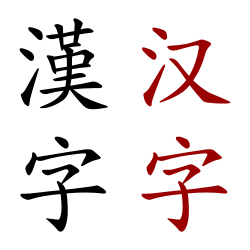
漢字 (kanji): Chinese characters, showing the traditional Chinese script on the left, and simplified on the right.
| Kanji in this term | |
|---|---|
| 漢 | 字 |
| かん Grade: 3 |
じ Grade: 1 |
| on’yomi | |
Etymology
From Middle Chinese compound 漢字 (hɑnH d͡zɨH, literally “Han Chinese + character”). Compare modern Mandarin 漢字/汉字 (hànzì).
Pronunciation
Noun
漢字 (hiragana かんじ, rōmaji kanji)
- kanji
- Literally meaning “Chinese characters”, kanji are ideographic or logographic characters used in Japan, mostly borrowed directly from Chinese. Kanji include some characters created in Japan from originally Chinese elements, and other characters that were modified over time into distinctly Japanese forms. Contrast with 仮名 (kana), uniquely Japanese phonetic characters derived either from cursive forms of kanji (平仮名 (hiragana)) or from specific parts of kanji (片仮名 (katakana)).
Synonyms
See also
References
Korean
| Hanja in this term | |
|---|---|
| 漢 | 字 |
Noun
漢字 • (hanja) (hangeul 한자)
- Hanja form? of 한자 (“Chinese characters, hanja”).
Okinawan
Etymology
Attested in the 沖縄語典 (Okinawa Goten, “Okinawan Dictionary”) as かんじ.[1]
Noun
References
- ↑ 1896: 沖縄語典 (Okinawa Goten, “Okinawan Dictionary”). In Japanese. http://kindai.ndl.go.jp/info:ndljp/pid/992016/28
Vietnamese
| Hán tự in this word | |
|---|---|
| 漢 | 字 |
Noun
漢字
- Hán tự form of Hán tự, “Chinese character”
This article is issued from
Wiktionary.
The text is licensed under Creative Commons - Attribution - Sharealike.
Additional terms may apply for the media files.