夫
| ||||||||
Translingual
Han character
夫 (radical 37, 大+1, 4 strokes, cangjie input 手人 (QO), four-corner 50030, composition ⿻二人)
See also
References
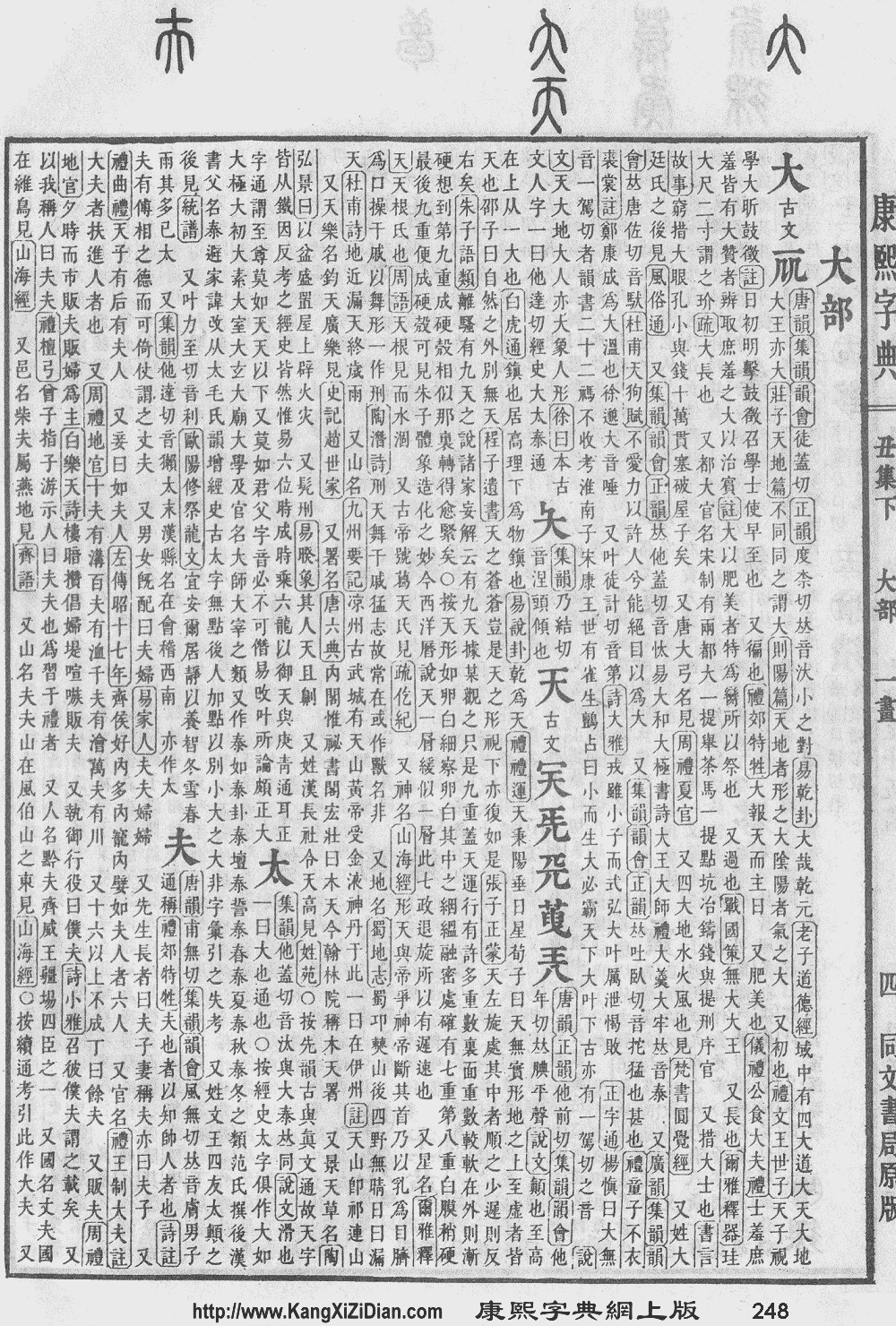
- KangXi: page 248, character 11
- Dai Kanwa Jiten: character 5835
- Dae Jaweon: page 507, character 1
- Hanyu Da Zidian: volume 1, page 521, character 1
- Unihan data for U+592B
Chinese
| simp. and trad. |
夫 | |
|---|---|---|
Glyph origin
| Historical forms of the character 夫 | |||
|---|---|---|---|
| Shang | Western Zhou | Shuowen Jiezi (compiled in Han) | Liushutong (compiled in Ming) |
| Oracle bone script | Bronze inscriptions | Small seal script | Transcribed ancient scripts |
 |
 |
 |
 |
| Characters in the same phonetic series (夫) (Zhengzhang, 2003) | |
|---|---|
| Old Chinese | |
| 趺 | *pa |
| 肤 | *pa |
| 邞 | *pa |
| 鈇 | *pa |
| 衭 | *pa |
| 玞 | *pa |
| 夫 | *pa, *ba |
| 鳺 | *pa |
| 扶 | *pa, *ba |
| 妋 | *pa, *qu |
| 麩 | *pʰa |
| 蚨 | *ba |
| 芙 | *ba |
| 颫 | *ba |
| 枎 | *ba |
Ideogrammic compound (會意) : 大 (“man”) + 一 (“hairpin”) – a man with a hairpin in his hair.
In ancient times, when men reached the age of 20, they bound their hair with a hairpin during the Guan Li ceremony. The hairpin is the sign of “a grownup man”.
Etymology 1
From Proto-Sino-Tibetan *p/ba (“male, father, third-person pronoun”). Cognate with Tibetan པ (pa, “masculine noun suffix”), Burmese ဖ (hpa., “masculine noun suffix”). Possibly related to 父 (OC *paʔ, *baʔ, “father”).
Pronunciation
Definitions
夫
Compounds
|
|
|
Etymology 2
“That”. Schuessler (2007) connects this with Proto-Loloish *m-ba (“on the other side”), Tibetan ཕ (pha, “beyond, farther on, onward”). Maybe related to 彼 (OC *pralʔ, “that”).
Pronunciation
Definitions
夫
Compounds
|
|
Etymology 3
| For pronunciation and definitions of 夫 – see 伕 (“husband; common laborer; etc.”). (This character, 夫, is the second-round simplified form of 伕.) |
Notes:
|
Japanese
Kanji
Readings
Compounds
- 夫妻 (fusai)
- 夫人 (fujin)
- 夫婦 (fūfu)
- 夫れ夫れ (sorezore)
- 煙突掃除夫 (entotsu soujifu)
- 義太夫 (gidayū)
- 水夫
- 寡夫 (kafu)
- 工夫 (kufū, kōfu)
- 丈夫 (jōbu, masurao)
- 前夫 (zenpu)
- 大夫 (taifu, daibu, tayū)
- 大丈夫 (daijōbu)
- 人夫 (ninpu)
- 農夫 (nōfu)
- 匹夫 (hippu)
- 武夫 (bufu)
- 亡夫 (bōfu)
- 老夫婦 (rōfūfu)
- 憲夫 (のりお, Norio)
- 郁夫 (いくお, Ikuo; ふみお, Fumio)
- 多喜夫 (たきお, Takio)
Etymology 1
| Kanji in this term |
|---|
| 夫 |
| おっと Grade: 4 |
| kun’yomi |
Pronunciation
Noun
Etymology 2
| Kanji in this term |
|---|
| 夫 |
| つま Grade: 4 |
| kun’yomi |
Pronunciation
Noun
References
Korean
Hanja
夫 • (bu) (hangeul 부)
- This term needs a translation to English. Please help out and add a translation, then remove the text
{{rfdef}}.
Vietnamese
Han character
夫 (phu)
- This term needs a translation to English. Please help out and add a translation, then remove the text
{{rfdef}}.