像
See also: 象
| ||||||||
| ||||||||
Translingual
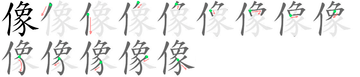
| Stroke order | |||
|---|---|---|---|
 | |||
Han character
像 (radical 9, 人+11 in Chinese, 人+12 in Japanese, 13 strokes in Chinese, 14 strokes in Japanese, cangjie input 人弓日人 (ONAO), four-corner 27232, composition ⿰亻象)
References
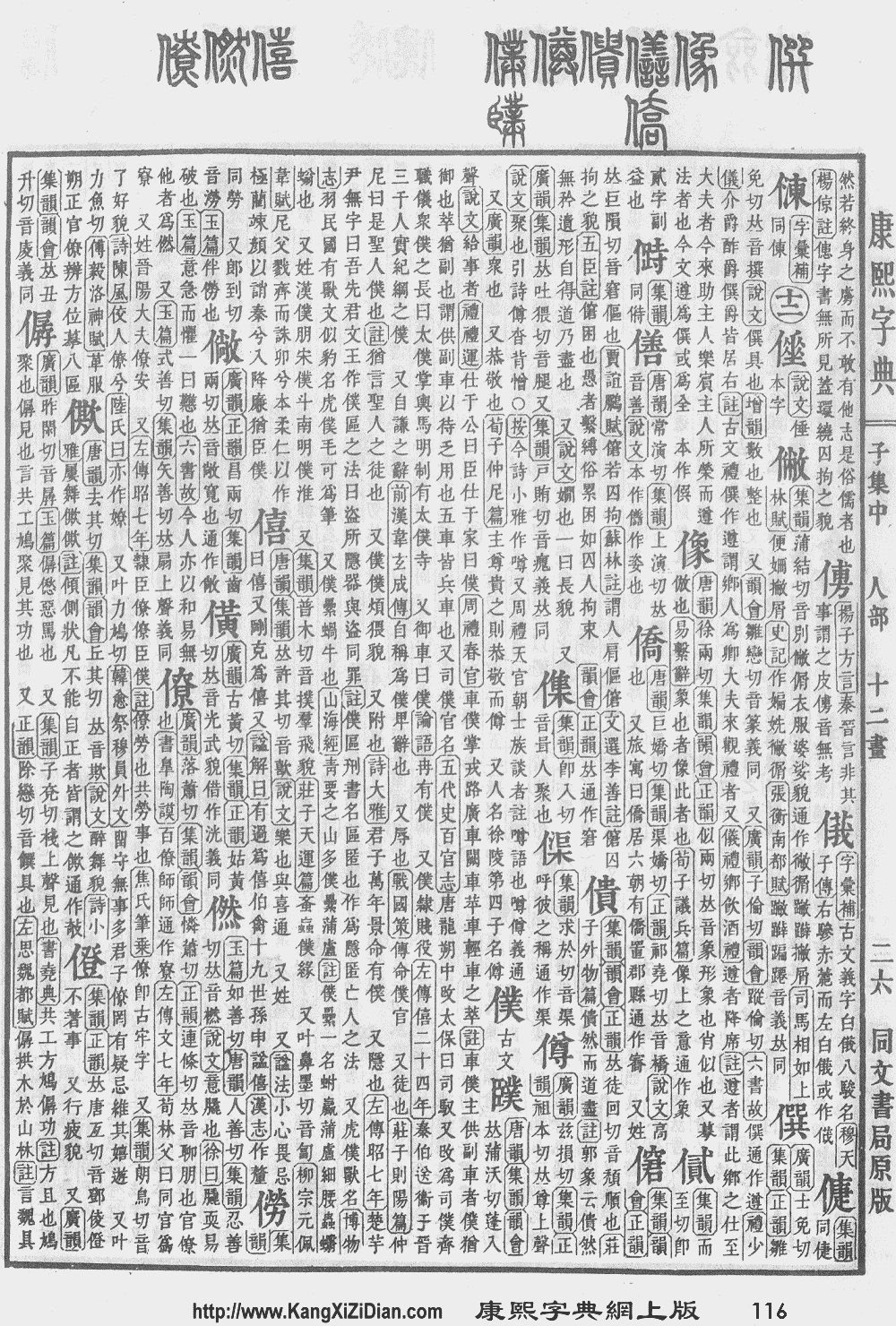
- KangXi: page 116, character 8
- Dai Kanwa Jiten: character 1084
- Dae Jaweon: page 247, character 20
- Hanyu Da Zidian: volume 1, page 213, character 3
- Unihan data for U+50CF
Chinese
| simp. and trad. |
像 | |
|---|---|---|
Glyph origin
| Historical forms of the character 像 | |||
|---|---|---|---|
| |||
|
References: Mostly from Richard Sears' Chinese Etymology site (authorisation),
|


| Characters in the same phonetic series (象) (Zhengzhang, 2003) | |
|---|---|
| Old Chinese | |
| 潒 | *l'aːŋʔ, *ljaŋʔ |
| 像 | *ljaŋʔ |
| 象 | *ljaŋʔ |
| 橡 | *ljaŋʔ |
| 蟓 | *ljaŋʔ, *hljaŋs |
| 襐 | *ljaŋʔ |
| 勨 | *ljaŋʔ, *laŋʔ |
| 鱌 | *ljaŋʔ |
| 嶑 | *ljaŋʔ |
Phono-semantic compound (形聲, OC *ljaŋʔ) : semantic 亻 (“man”) + phonetic 象 (OC *ljaŋʔ, “elephant; image”).
Pronunciation
Definitions
像
Compounds
Derived terms from 像
|
|
|
Japanese
Kanji
像
Readings
- Goon: ぞう (zō, Jōyō)←ざう (zau, historical)
- Kan’on: しょう (shō)←しやう (syau, historical)
- Kun: かたち (katachi, 像); かたどる (katadoru, 像る)
Compounds
Noun
像 (hiragana ぞう, rōmaji zō, historical hiragana ざう)
Korean
Hanja
像 • (sang)
- This term needs a translation to English. Please help out and add a translation, then remove the text
{{rfdef}}.
Compounds
Vietnamese
Han character
像 (tượng)
- This term needs a translation to English. Please help out and add a translation, then remove the text
{{rfdef}}.
This article is issued from
Wiktionary.
The text is licensed under Creative Commons - Attribution - Sharealike.
Additional terms may apply for the media files.