多
See also: 夛
| ||||||||
| ||||||||
Translingual
| Stroke order | |||
|---|---|---|---|
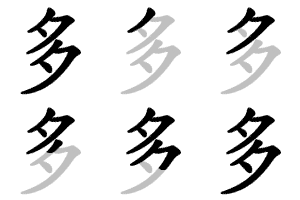 | |||
Han character
多 (radical 36, 夕+3, 6 strokes, cangjie input 弓戈弓戈 (NINI), four-corner 27207, composition ⿱夕夕)
Descendants
References
- KangXi: page 246, character 11
- Dai Kanwa Jiten: character 5756
- Dae Jaweon: page 489, character 6
- Hanyu Da Zidian: volume 2, page 862, character 2
- Unihan data for U+591A

Chinese
| simp. and trad. |
多 | |
|---|---|---|
| alt. forms | 𡖈 | |
Glyph origin
| Historical forms of the character 多 | |||
|---|---|---|---|
| Shang | Western Zhou | Shuowen Jiezi (compiled in Han) | Liushutong (compiled in Ming) |
| Oracle bone script | Bronze inscriptions | Small seal script | Transcribed ancient scripts |
 |
 |
 |
 |
| Characters in the same phonetic series (多) (Zhengzhang, 2003) | |
|---|---|
| Old Chinese | |
| 多 | *ʔl'aːl |
| 哆 | *ʔl'aːlʔ, *ʔl'aːls, *ʔr'aːls, *hr'aːl, *l̥ʰjaːlʔ, *l̥ʰjalʔ, *l̥ʰjɯs |
| 跢 | *ʔl'aːls, *ʔl'aːds |
| 痑 | *ʔl'aːls, *l̥ʰaːl, *l̥ʰaːn |
| 爹 | *daːʔ, *tjaː |
| 陊 | *l'aːlʔ, *l'alʔ |
| 橠 | *naːlʔ |
| 袲 | *naːlʔ, *l̥ʰjalʔ, *lal |
| 奓 | *ʔr'aːl, *ʔr'aːls |
| 栘 | *ɦljeːl, *lal |
| 黟 | *ʔleːl, *ʔlil |
| 趍 | *sʰlo, *l'al |
| 誃 | *l'al, *l̥ʰjalʔ |
| 簃 | *l'al, *lal |
| 眵 | *ʔljjal, *l̥ʰjal |
| 恀 | *ʔljalʔ, *l̥ʰjalʔ, *ɦljalʔ |
| 侈 | *l̥ʰjalʔ |
| 姼 | *l̥ʰjalʔ, *ɦljal, *ɦljalʔ |
| 鉹 | *l̥ʰjalʔ, *lal |
| 垑 | *l̥ʰjalʔ |
| 袳 | *l̥ʰjalʔ |
| 卶 | *l̥ʰjals, *hljals |
| 宜 | *ŋral |
| 誼 | *ŋrals |
| 竩 | *ŋrals |
| 移 | *lal |
| 迻 | *lal |
| 扅 | *lal |
| 拸 | *lal, *lalʔ |
| 熪 | *lal |
| 謻 | *lal |
| 蛥 | *ɢljad |
Pictogram (象形) – two pieces of meat (肉).
The conventional explanation is that this represented the concept of “many” through visual repetition. However, the earliest oracle bones use 多 for both “many” and another word meaning “to separate”, thus suggesting that 多 depicts a piece of meat cut in two. The word “to separate” was later written as 誃 (OC *l'al, *l̥ʰjalʔ).
Etymology
Related to Proto-Tai *ʰlaːjᴬ (“many, much”), whence Thai หลาย (lǎai, “many”).
Pronunciation
Definitions
多
- many; much; a lot of; numerous
- Antonyms: 少 (shǎo)
- (after an amount) over; and more; more than
- (used in comparison structure 得多, 多了) much more; a lot more; far more
- more
- extra; in excess
- (used in question) how; how much; what
- (emphasis in exclamations) so, how, what
- to have a lot
- to have more; to have too much; to have too many
- (Cantonese) Short for 多士 (duōshì, “toast”).
Usage notes
- (over, more than): When the number is smaller or equal to 10, 多 can be put after the measure word. If it is bigger than ten, 多 has to be put before the measure word.
- (more): Placing 多 after the verb is correct but it is less natural than placing it before.
Synonyms
Compounds
Derived terms from 多
|
|
|
Japanese
Kanji
多
Readings
(Can we verify(+) this pronunciation?)
Compounds
- 多分 (tabun)
Derived terms
Prefix
- multi-
- 多言語辞書
- tagengojisho
- multilingual dictionary
- 多言語辞書
Korean
Hanja
多 • (da) (hangeul 다, revised da, McCune–Reischauer ta)
Vietnamese
Han character
- This term needs a translation to English. Please help out and add a translation, then remove the text
{{rfdef}}.
This article is issued from
Wiktionary.
The text is licensed under Creative Commons - Attribution - Sharealike.
Additional terms may apply for the media files.