直
| ||||||||
| ||||||||
| ||||||||
Translingual
| Stroke order | |||
|---|---|---|---|
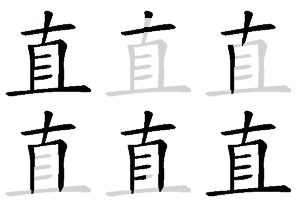 | |||
| Japanese stroke order | |||
|---|---|---|---|
 | |||
Alternative forms
Note the different forms, which differ in two respects: both Simplified and Traditional do not have a left vertical stroke, while the orthodox form has a left vertical stroke; and in simplified form, the top component is connected with the bottom, while in the orthodox they are separated – this last difference is shared with unrelated characters 真 and 具. The older form and stroke order are used in Japan.
Han character
| Japanese | 直 |
|---|---|
| Simplified | 直 |
| Traditional | 直 |
直 (radical 109, 目+3, 8 strokes, cangjie input 十月一一 (JBMM), four-corner 40716, composition ⿱十⿺𠃊目(JK) or ⿱十⿴𠀃三(GT))
Derived characters
See also
References
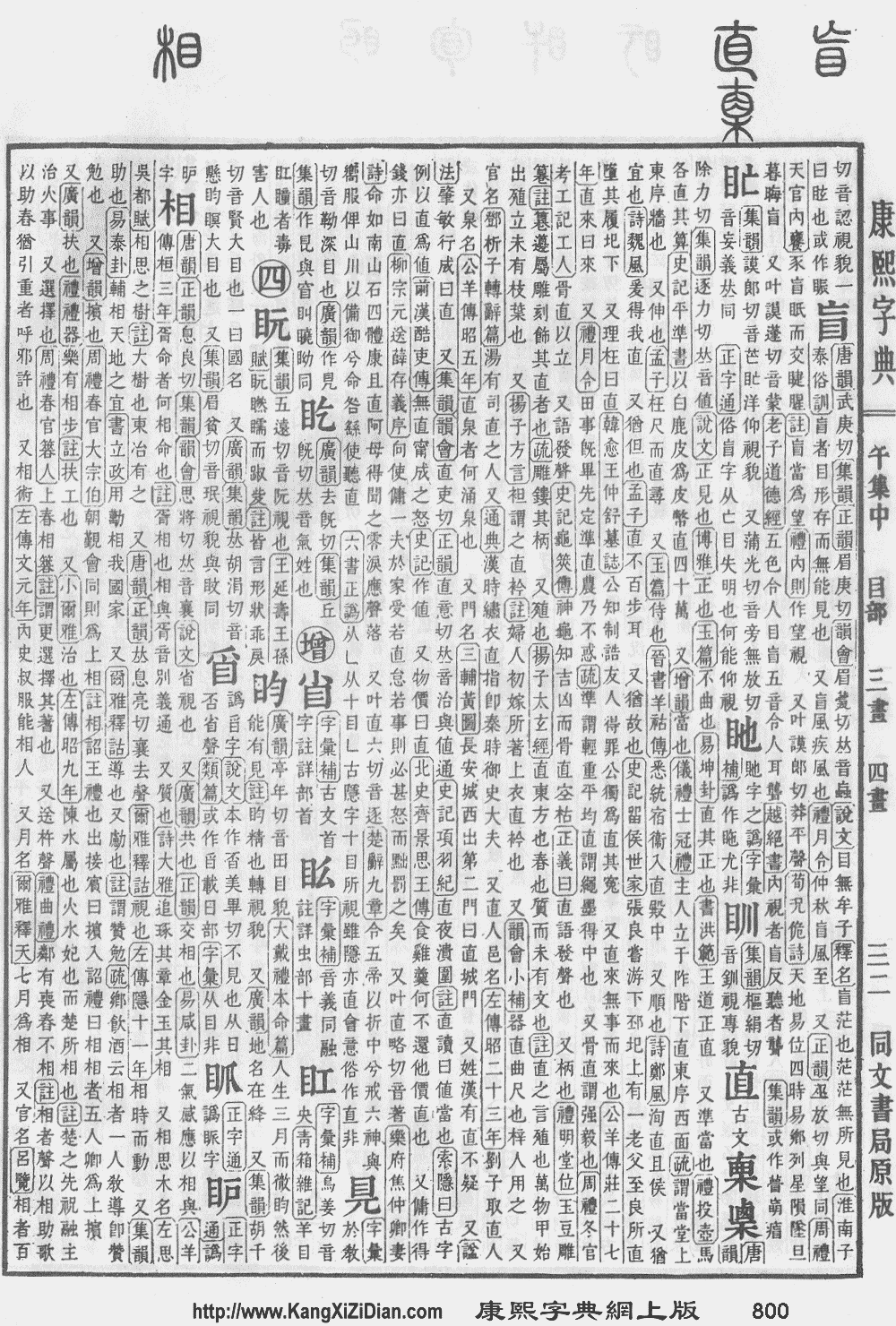
- KangXi: page 800, character 5
- Dai Kanwa Jiten: character 23136
- Dae Jaweon: page 1215, character 1
- Hanyu Da Zidian: volume 1, page 61, character 7
- Unihan data for U+76F4
Chinese
| simp. and trad. |
直 | |
|---|---|---|
Glyph origin
| Historical forms of the character 直 | |||
|---|---|---|---|
| Shang | Western Zhou | Shuowen Jiezi (compiled in Han) | Liushutong (compiled in Ming) |
| Oracle bone script | Bronze inscriptions | Small seal script | Transcribed ancient scripts |
 |
 |
 |
 |
| Characters in the same phonetic series (直) (Zhengzhang, 2003) | |
|---|---|
| Old Chinese | |
| 置 | *tɯɡs |
| 值 | *dɯɡs, *dɯɡ |
| 植 | *dɯɡs, *djɯɡ |
| 埴 | *tʰjɯɡs, *djɯɡ |
| 惪 | *tɯːɡ |
| 德 | *tɯːɡ |
| 稙 | *tɯɡ |
| 淔 | *tʰɯɡ |
| 直 | *dɯɡ |
| 犆 | *dɯɡ |
| 殖 | *djɯɡ |
Oracle bone script: Ideogrammic compound (會意) : 目 (“eye”) + 丨 (“vertical stroke”) – vertical stroke above the eye; looking straight ahead.
The line on the side appears in bronze script and subsequently stretched under the 目 shape, while the traditional form appears in seal script.
Pronunciation
Definitions
直
- straight; linear; undeviating
- to straighten
- vertical; upright; erect
- honest; fair
- straightforward; forthright; frank
- directly; straight
- 直去 ― zhíqù ― to go directly to
- intentionally; deliberately
- † Alternative form of 只 (zhǐ, “only”).
- (Chinese calligraphy) vertical stroke in Chinese characters
- † Alternative form of 值 (zhí, “to be worth”).
- (slang) straight; heterosexual
Compounds
|
|
|
Japanese
Kanji
Readings
- Goon: じき (jiki, Jōyō)←ぢき (diki, historical); じか (jika)←ぢか (dika, historical)
- Kan’on: ちょく (choku, Jōyō)
- Kun: ただちに (tadachini, 直ちに, Jōyō); なおす (naosu, 直す, Jōyō)←なほす (nafosu, historical); なおる (naoru, 直る, Jōyō)←なほる (naforu, historical); あたい (atai, 直)←あたひ (atafi, historical); すぐ (sugu, 直ぐ); なおき (naoki, 直き)←なほき (nafoki, historical)
- Nanori: すぐ (sugu); なおい (naoi); のう (nō); のお (nō)
Compounds
Etymology
| Kanji in this term |
|---|
| 直 |
| じか Grade: 2 |
| kun’yomi |
Sound change from jiki.[1]
This etymology is incomplete. You can help Wiktionary by elaborating on the origins of this term.
Prefix
直 (hiragana じか, rōmaji jika-)
Synonyms
- 直接 (chokusetsu)
Related terms
- 直に (jika ni)
References
- ↑ 1995, 大辞泉 (Daijisen) (in Japanese), Tōkyō: Shogakukan, →ISBN
Korean
Hanja
直 • (jik) (hangeul 직, revised jik, McCune–Reischauer chik, Yale cik)
- This term needs a translation to English. Please help out and add a translation, then remove the text
{{rfdef}}.
Vietnamese
Han character
直 (trực, chực, sực)
- This term needs a translation to English. Please help out and add a translation, then remove the text
{{rfdef}}.