道
| ||||||||
Translingual
| Stroke order | |||
|---|---|---|---|
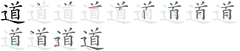 | |||
| Stroke order | |||
|---|---|---|---|
 | |||
Han character
道 (radical 162, 辵+9, 12 strokes, cangjie input 卜廿竹山 (YTHU), four-corner 38306, composition ⿺辶首)
Derived characters
References
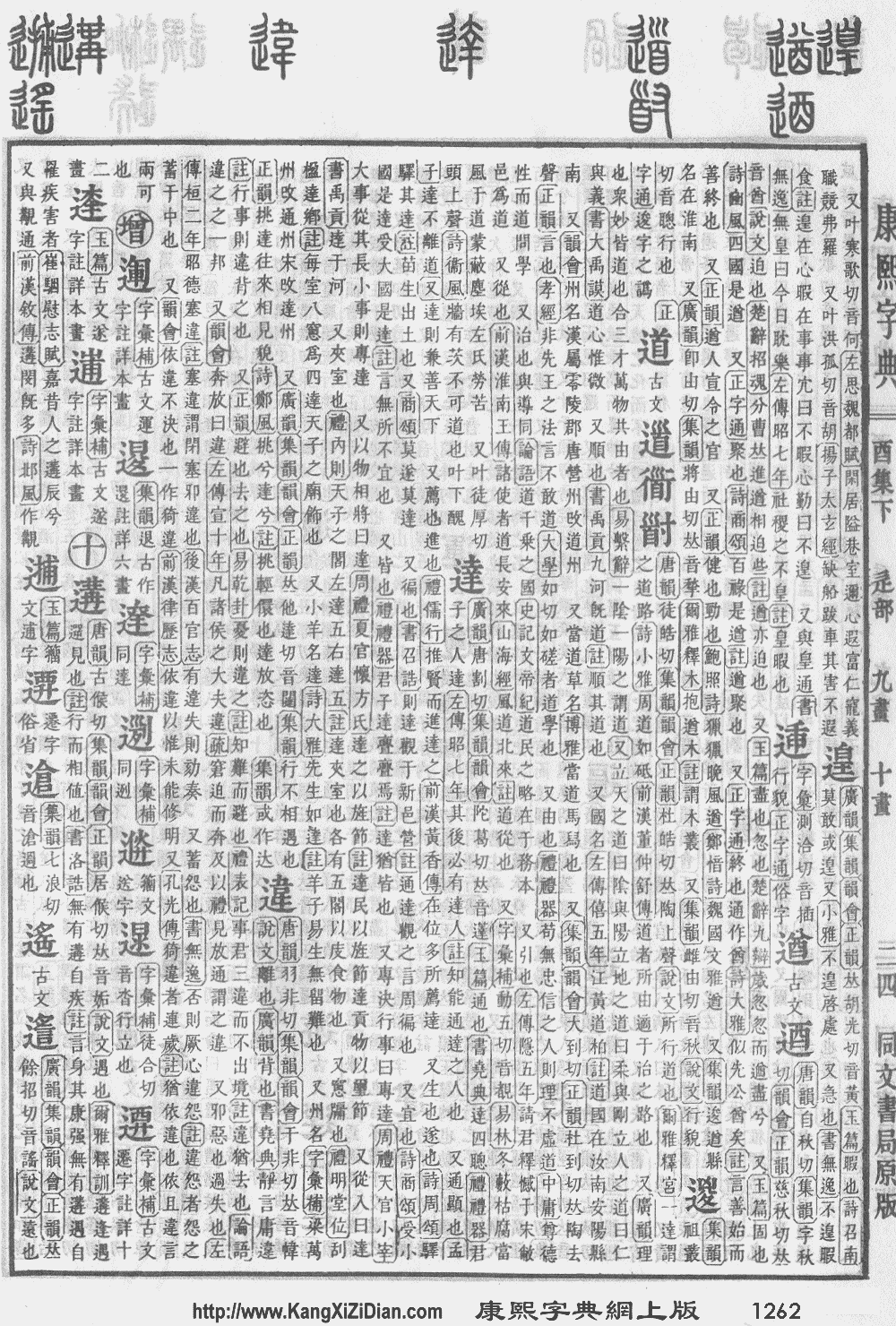
- KangXi: page 1262, character 6
- Dai Kanwa Jiten: character 39010
- Dae Jaweon: page 1754, character 9
- Hanyu Da Zidian: volume 6, page 3864, character 1
- Unihan data for U+9053
Chinese
| simp. and trad. |
道 | |
|---|---|---|
| alt. forms | 辺 second round simplified | |
Glyph origin
| Historical forms of the character 道 | |||
|---|---|---|---|
| Western Zhou | Warring States | Shuowen Jiezi (compiled in Han) | Liushutong (compiled in Ming) |
| Bronze inscriptions | Chu Slip and silk script | Small seal script | Transcribed ancient scripts |
 |
 |
 |
 |
| Characters in the same phonetic series (首) (Zhengzhang, 2003) | |
|---|---|
| Old Chinese | |
| 道 | *l'uːʔ |
| 導 | *duːs |
| 首 | *hljuʔ, *hljus |
Phono-semantic compound (形聲, OC *l'uːʔ) : semantic 辵 (“walking”) + phonetic 首 (OC *hljuʔ, *hljus).
Etymology
Possibly derived from 導 (OC *duːs, “to go along, to bring along, to conduct”):
- > "to explain" > "to talk about", and
- > "road, way".
Cognate with Proto-Hmong-Mien *kləuX (“road, way”) (White Hmong kev (“road”)). See also 首 (OC *hljuʔ, *hljus).
Pronunciation 1
Definitions
道
- way; path; road
- (historical) circuit: an administrative division of late imperial China comprising 2 or more commanderies
- method; principle
- (philosophy) the Way; the Tao; the Dao: the way of nature and/or the ideal way to live one's life
- Short for 道教 (dàojiào, “Taoism”).
- Short for 道士 (dàoshì, “Taoist priest”).
- (religion) doctrine; teachings
- to say; to utter
- Classifier for long things.
- Classifier for barriers.
- Classifier for courses in a meal: dish
- Classifier for questions (in an exam), orders or proclamations.
Compounds
|
|
|
Pronunciation 2
| For pronunciation and definitions of 道 – see 導 (“to direct; to guide; to lead; to conduct”). (This character, 道, is an ancient form of 導.) |
Japanese
Kanji
Readings
Compounds
- 合気道 (aikidō): aikido
- 道具 (dōgu): tool
- 道路 (dōro): road
- 道徳 (dōtoku): ethics
- 報道 (hōdō): broadcast
- 柔道 (jūdō): judo
- 軌道 (kidō): orbit
- 赤道 (sekidō): equator
- 食道 (shokudō): oesophagus
- 水道 (suidō): water supply
- 鉄道 (tetsudō): railway
- 道教 (dōkyō): Taoism
- 道理 (dōri): rational
- 道州制 (dōshūsei): Wide-Area Administration
- 書道 (shodō): calligraphy
- 武道 (budō): budo
- 茶道 (sadō): tea ceremony
- 華道 (kadō): flower arrangement
- 花道 (kadō): flower arrangement
Etymology 1
| Kanji in this term |
|---|
| 道 |
| どう Grade: 2 |
| on’yomi |
/dau/ → /dɔː/ → /doː/
From Middle Chinese 道 (dhɑ̀u, “road; way”). Compare modern Mandarin 道 (dào), Cantonese 道 (dou6).
Pronunciation
Noun
道 (hiragana どう, rōmaji dō, historical hiragana だう)
- The Way: tao, Taoism
- (chiefly historical) A region of Japan consisting of multiple provinces or prefectures. Feudal Japan was divided into several dō; the only remaining dō is Hokkaidō.
Proper noun
道 (hiragana どう, rōmaji Dō, historical hiragana だう)
- A surname.
Etymology 2
| Kanji in this term |
|---|
| 道 |
| ち Grade: 2 |
| kun’yomi |
From Old Japanese.[3] May be cognate with Korean 길 (gil, “road”).
More often written as 路.
Pronunciation
Alternative forms
Suffix
- (obsolete) attaches to place names, indicating a road to that place
- This usage has generally been replaced by -ji below.
Etymology 3
| Kanji in this term |
|---|
| 道 |
| じ Grade: 2 |
| kun’yomi |
Derived as a sound shift from chi above.[3]
More often written as 路.
Pronunciation
Alternative forms
Suffix
Etymology 4
| Kanji in this term |
|---|
| 道 |
| みち Grade: 2 |
| kun’yomi |
Originally a compound of 御 (mi, honorific prefix) + 道 (chi, “road, street, way”).[3] The prefix mi was in reference to the 神 (kami, “god or spirit”) of roads.
Pronunciation
Alternative forms
Noun
- a way, a street, a road, an alley, a path, a pass for local traffic
- 道を歩く
- michi o aruku
- to walk down a road
- 道を歩く
- (figuratively) a road, a path
- 勝利への道
- shōri e no michi
- the path to victory
- 勝利への道
- a way of doing something
- 使い道がわからないもの
- tsukaimichi ga wakaranai mono
- something whose method of usage is not known
- 使い道がわからないもの
Usage notes
This is the most common term for “road”, “street”, or “way” in modern Japanese.
Derived terms
Proper noun
- A female given name
- A surname.
Etymology 5
| Kanji in this term |
|---|
| 道 |
| Grade: 2 |
| Irregular |
Used as ateji in various names.
Proper noun
道 (hiragana おさむ, rōmaji Osamu)
- A male given name
Proper noun
道 (hiragana すすむ, rōmaji Susumu)
- A male given name
Proper noun
道 (hiragana たお, rōmaji Tao)
- A female given name
Proper noun
道 (hiragana ただし, rōmaji Tadashi)
- A male given name
Proper noun
道 (hiragana ただす, rōmaji Tadasu)
- A male given name
Proper noun
道 (hiragana どうざき, rōmaji Dōzaki)
- A surname.
Proper noun
- A female given name
Proper noun
道 (hiragana なおし, rōmaji Naoshi)
- A male given name
Proper noun
道 (hiragana ふみ, rōmaji Fumi)
- A female given name
Proper noun
道 (hiragana まこと, rōmaji Makoto)
- A male given name
Proper noun
道 (hiragana みちざき, rōmaji Michizaki)
- A surname.
Proper noun
道 (hiragana みちひろ, rōmaji Michihiro)
- A male given name
Proper noun
道 (hiragana もとい, rōmaji Motoi)
- A male given name
Proper noun
道 (hiragana わたる, rōmaji Wataru)
- A male given name
References
Korean
Hanja
道 • (do)
A road
- This term needs a translation to English. Please help out and add a translation, then remove the text
{{rfdef}}.