party
English
Pronunciation
- (UK) IPA(key): /ˈpɑː.ti/
- (US, Canada) IPA(key): /ˈpɑɹ.ti/, [ˈpɑɹɾi]
Audio (US) (file) Audio (Canada) (file)
- (General Australian) IPA(key): /ˈpɑ(ː)ɾi/, [ˈpɑ(ː)ɾi]
- Rhymes: -ɑː(r)ti
- Hyphenation: par‧ty
Etymology 1
From Anglo-Norman partie, Old French partie, from Medieval Latin partita (“a part, party”), from Latin partita, feminine of partitus, past participle of partiri (“to divide”); see part.
Noun
party (plural parties)
- (law) A person or group of people constituting a particular side in a contract or legal action.
- The contract requires that the party of the first part pay the fee.
- Sir John Davies (c.1569-1626)
- If the jury found that the party slain was of English race, it had been adjudged felony.
- A person.
- (now rare in general sense) A group of people forming one side in a given dispute, contest etc.
- 1912, Edgar Rice Burroughs, Tarzan of the Apes, Ch.6:
- A mile back in the forest the tribe had heard the fierce challenge of the gorilla, and, as was his custom when any danger threatened, Kerchak called his people together, partly for mutual protection against a common enemy, since this gorilla might be but one of a party of several, and also to see that all members of the tribe were accounted for.
- (role-playing games, online gaming) Active player characters organized into a single group.
- (video games) A group of characters controlled by the player.
- 1912, Edgar Rice Burroughs, Tarzan of the Apes, Ch.6:
- A political group considered as a formal whole, united under one specific political platform of issues and campaigning to take part in government.
- The green party took 12% of the vote.
- 1915, Emerson Hough, The Purchase Price, chapterI:
- "A fine man, that Dunwody, yonder," commented the young captain, as they parted, and as he turned to his prisoner. "We'll see him on in Washington some day. […] A strong man—a strong one; and a heedless." ¶ "Of what party is he?" she inquired, as though casually.
- (military) A discrete detachment of troops, especially for a particular purpose.
- The settlers were attacked early next morning by a scouting party.
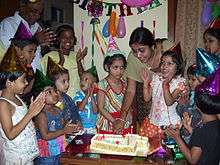
- A social gathering.
- A gathering of usually invited guests for entertainment, fun and socializing.
- I'm throwing a huge party for my 21st birthday.
- 2016 April 3, John Oliver, “Congressional Fundraising”, in Last Week Tonight with John Oliver, season 3, episode 7, HBO:
- So-So, tonight, tonight, let’s look at where that time actually goes, and let’s begin with the most obvious form of fundraising: fundraisers. These are usually shitty parties in D.C. bars, restaurants, or townhouses, and there are a lot of them! The Sunlight Foundation estimates that, in the last election cycle, members of Congress held over 28 hundred fundraisers! Washington is like Rod Stewart’s haircut: party in the front, party in the back, frankly too much party and no business anywhere to be found!
- A group of people traveling or attending an event together, or participating in the same activity.
- We're expecting a large party from the London office.
- 1898, Winston Churchill, chapter 5, in The Celebrity:
- We made an odd party before the arrival of the Ten, particularly when the Celebrity dropped in for lunch or dinner.
- A gathering of acquaintances so that one of them may offer items for sale to the rest of them.
- Tupperware party
- lingerie party
- A gathering of usually invited guests for entertainment, fun and socializing.
- (obsolete) A part or division.
- 1485 July 31, Thomas Malory, “(please specify the chapter)”, in [Le Morte Darthur], (please specify the book number), [London: William Caxton], OCLC 71490786; republished as H[einrich] Oskar Sommer, editor, Le Morte Darthur, London: Published by David Nutt, in the Strand, 1889, OCLC 890162034:, Bk.II, Ch.xv:
- And so the moost party of the castel that was falle doune thorugh that dolorous stroke laye vpon Pellam and balyn thre dayes.
-
Synonyms
Hyponyms
|
Derived terms
|
Related terms
|
|
|
Translations
|
|
|
|
|
|
Verb
party (third-person singular simple present parties, present participle partying, simple past and past participle partied)
- (intransitive) To celebrate at a party, to have fun, to enjoy oneself.
- We partied until the early hours.
- (intransitive, slang, euphemistic) To take recreational drugs.
- 2004, Daniel Nicholas Shields, Firewoman
- “Miss, do you party?” the boy asked. “What?” Jennifer asked back. “Do you smoke? I'll get you some cheap. One American dollar equals forty Jamaican dollars. I'll get you as much of the stuff as you need.”
- 2004, Daniel Nicholas Shields, Firewoman
- (intransitive) To engage in flings, to have one-night stands, to sow one's wild oats.
- (online gaming, intransitive) To form a party (with).
- If you want to beat that monster, you should party with a healer.
Derived terms
- party down
- party on
Translations
References

Etymology 2
From Middle English, from Old French parti (“parted”), from Latin partītus (“parted”), past participle of partiri (“to divide”). More at part.
Adjective
party (not comparable)
- (obsolete, except in compounds) Divided; in part.
- (heraldry) Parted or divided, as in the direction or form of one of the ordinaries.
- an escutcheon party per pale
Derived terms
|
|
|
Adverb
party (not comparable)
- (obsolete) Partly.
- (Can we find and add a quotation of Chaucer to this entry?)
Further reading
Anagrams
Afrikaans
Etymology
Noun
party (plural partye)
- party (group, especially a political one)
Czech
Alternative forms
Noun
party f
- party (gathering of usually invited guests for entertainment, fun and socializing)
Synonyms
- See večírek
Related terms
- See part
Further reading
- party in Kartotéka Novočeského lexikálního archivu
- party in Slovník spisovného jazyka českého, 1960–1971, 1989
Dutch
Etymology
Pronunciation
Audio (file)
Noun
party f, m (plural party's, diminutive party'tje n)
Synonyms
Derived terms
French
Etymology
Pronunciation
- IPA(key): /paʁ.ti/
Audio (CAN) (file)
Noun
party m, f (plural parties or partys)
Usage notes
party has two genders in French: In Canada, it is a masculine noun, and in France it is a feminine noun.
Derived terms
- garden-party
- party hot-dog
- suicide-party
Further reading
- “party” in le Trésor de la langue française informatisé (The Digitized Treasury of the French Language).
Italian
Etymology
Noun
party m (invariable)
- party (social gathering)
Norwegian Bokmål
Etymology
Noun
party n (definite singular partyet, indefinite plural party or partyer, definite plural partya or partyene)
- a party (social event)
Synonyms
References
- “party” in The Bokmål Dictionary.
Norwegian Nynorsk
Etymology
Noun
party n (definite singular partyet, indefinite plural party, definite plural partya)
- a party (social event)
Synonyms
References
- “party” in The Nynorsk Dictionary.
Portuguese
Verb
party
- Obsolete spelling of parti
Spanish
Etymology
Noun
party m (plural partys or parties)
Swedish
Etymology
Pronunciation
(file)
Noun
party n
- party; social gathering
Declension
| Declension of party | ||||
|---|---|---|---|---|
| Singular | Plural | |||
| Indefinite | Definite | Indefinite | Definite | |
| Nominative | party | partyt | partyn | partyna |
| Genitive | partys | partyts | partyns | partynas |