万
| ||||||||
Translingual
| Stroke order | |||
|---|---|---|---|
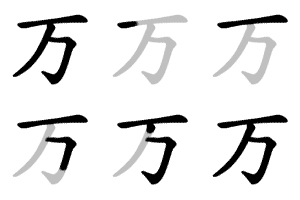 | |||
| Stroke order | |||
|---|---|---|---|
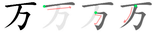 | |||
Han character
万 (radical 1, 一+2, 3 strokes, cangjie input 一尸 (MS), four-corner 10227, composition ⿱一⿰丿𠃌)
References
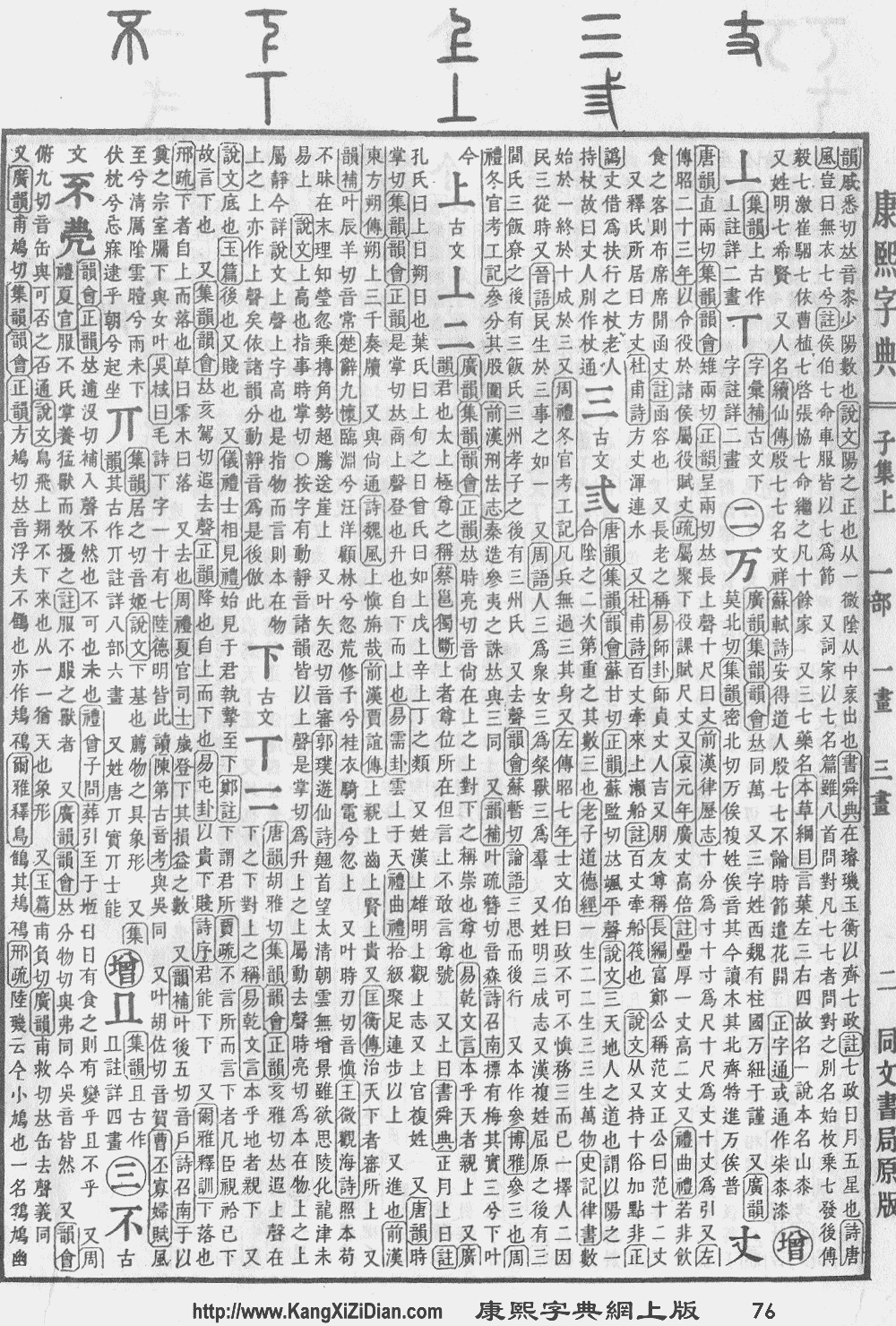
- KangXi: page 76, character 3
- Dai Kanwa Jiten: character 10
- Dae Jaweon: page 137, character 7
- Hanyu Da Zidian: volume 1, page 9, character 3
- Unihan data for U+4E07
Chinese
Glyph origin
| Historical forms of the character 万 | |
|---|---|
| Shang | Western Zhou |
| Oracle bone script | Bronze inscriptions |
 |
 |
Unknown. Used as a tribal name in oracle inscriptions. Used as a number since the Spring and Autumn and Warring States periods.
Various theories have been proposed for its original meaning:
- Qu Wanli, Qiu Xigui and others propose that it originally refers to a type of dancer-musicians. This usage is attested in the oracle inscriptions. This may be supported by ancient literature, e.g. Shijing, which mentions a type of dance called 萬舞/万舞.
- Lin Yiguang proposes that it is an ancient form of 丏 (OC *meːnʔ), acting as a phonetic component in 賓 (OC *mpin).
- Some propose that it is a differentiated form of 亥.
Etymology 1
| For pronunciation and definitions of 万 – see 萬 (“scorpion; etc.”). (This character, 万, is the simplified and variant form of 萬.) |
Notes:
|
Usage notes
Also used in a trisyllabic surname.
Etymology 2
| simp. and trad. |
万 | |
|---|---|---|
Pronunciation
Definitions
万
- Only used in 万俟 (Mòqí).
Japanese
| 万 | |
| 萬 |
Kanji
(grade 2 “Kyōiku” kanji, shinjitai kanji, kyūjitai form 萬)
- myriad, ten thousand
- very many
Readings
As a simplification and variant of 萬:
- Goon: もん (mon)
- Kan’on: ばん (ban, Jōyō)
- Kan’yōon: まん (man, Jōyō)
- Kun: よろず (yorozu, 万)←よろづ (yorodu, historical)
- Nanori: かず (kazu); かつ (katsu); すすむ (susumu); たか (taka); つむ (tsumu); つもる (tsumoru); ま (ma); ゆる (yuru); よし (yoshi)
As part of the surname 万俟:
Compounds
- 万一 (man'ichi): perhaps
- 万引 (manbiki): shoplifting
- 万屋 (yorozuya): general merchant
- 万華鏡 (mangekyō): kaleidoscope
- 万感 (bankan): flood of emotions
- 万機 (manki): state affairs
- 万芸 (bangei): versatility
- 万古 (banko): old time, all this time, eternity
- 万劫 (bangō): an extremely long period of time
- 万才 (mansai): ten thousand years old
- 万作 (mansaku): witch hazel
- 万死 (banshi): critical state of the life
- 万寿 (banju), 万寿 (manju): longevity
- 万丈 (banjō): hurrah
- 万乗 (banjō): sovereignty
- 万状 (banjō): diversification
- 万善 (manzen): ten thousand virtues, 万全 (manzen): perfect
- 万灯 (mandō): ten thousand lights
- 万博 (banpaku): international exposition
- 万歩計 (manpokei): pedometer
- 万万 (banban): very much
- 万民 (banmin): all the people, the entire nation
- 万有 (ban'yū)
- 万葉仮名 (man'yōgana)
- 万葉集 (man'yōshū)
- 万力 (manriki)
- 万斛 (bankoku)
- 万軍 (bangun)
Etymology 1
| Kanji in this term |
|---|
| 万 |
| まん Grade: 2 |
| on’yomi |
From Middle Chinese 万 (MC mʉɐnH, mək̚).
Pronunciation
Noun
万 (shinjitai kanji, kyūjitai kanji 萬, hiragana まん, rōmaji man)
- ten thousand, 10,000
Derived terms
- 万が一 (mangaichi)
Etymology 2
| Kanji in this term |
|---|
| 万 |
| ばん Grade: 2 |
| on’yomi |
From Middle Chinese 万 (MC mʉɐnH, mək̚).
Pronunciation
Adverb
万 (shinjitai kanji, kyūjitai kanji 萬, hiragana ばん, rōmaji ban)
- (followed by a negative) even if, never
- (followed by a negative) no matter what
Prefix
万 (shinjitai kanji, kyūjitai kanji 萬, hiragana ばん, rōmaji ban-)
Etymology 3
| Kanji in this term |
|---|
| 万 |
| よろず Grade: 2 |
| kun’yomi |
⟨yo2ro2du⟩ → /yorodu/ → /yorod͡zu/ → /yorozu/
From Old Japanese.[4] Found in the oldest sources, such as the Man'yōshū (c. 759 CE).[5]
Appears to be a compound or inflection, but the derivation is unclear.
Pronunciation
Noun
万 (shinjitai kanji, kyūjitai kanji 萬, hiragana よろず, rōmaji yorozu, historical hiragana よろづ)
- ten thousand
- a large number
- all, everything
References
- 1 2 3 4 2006, 大辞林 (Daijirin), Third Edition (in Japanese), Tōkyō: Sanseidō, →ISBN
- 1 2 3 4 1998, NHK日本語発音アクセント辞典 (NHK Japanese Pronunciation Accent Dictionary) (in Japanese), Tōkyō: NHK, →ISBN
- 1 2 3 4 1997, 新明解国語辞典 (Shin Meikai Kokugo Jiten), Fifth Edition (in Japanese), Tōkyō: Sanseidō, →ISBN
- ↑ 1988, 国語大辞典(新装版) (Kokugo Dai Jiten, Revised Edition) (in Japanese), Tōkyō: Shogakukan
- ↑ c. 759, Man'yōshū (book 20, poem 4408), text here