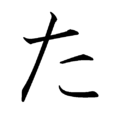
た
See also: だ and Appendix:Variations of "da"
 | ||||||||
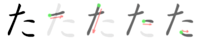
| Stroke order | |||
|---|---|---|---|
 | |||
Japanese
Pronunciation
- IPA(key): [ta̠]
Etymology 1
Derived in the Heian period from writing the man'yōgana kanji 太 in the cursive sōsho style.
Syllable
た (romaji ta)
- The hiragana syllable た (ta). Its equivalent in katakana is タ (ta). It is the sixteenth syllable in the gojūon order; its position is た行あ段 (ta-gyō a-dan, “row ta, section a”).
Derived terms
- だ (da)
See also
Etymology 2
Short form of たれ (tare).
Pronoun
た (rōmaji ta)
- interrogative personal pronoun; who
- c. late 9th – mid-10th century, Taketori Monogatari
- あの書をきし文を讀み聞かせけれど、「なにせむにか命もおしからむ。たが為にか。何事も用もなし」とて[...]
- c. late 9th – mid-10th century, Taketori Monogatari
Etymology 3
From たる (taru), the 連体形 (rentaikei, “adnominal form”) of the classical auxiliary たり (tari).
Alternative forms
- だ (da) (when following -b, -g, -m, and -n base verbs)
Suffix
た (rōmaji -ta)
(auxiliary)
- Indicates a past or completed action.
- Indicates the realization of a situation that has not realized.
- (modifying a noun) Indicates the resulting state of an action.
- Synonyms: てある (-te aru), ている (-te iru)
- (at the end of a sentence)
- Indicates speaker's declaration, confirmation, or sudden realization.
- Makes a light command.
Usage notes
- This suffix follows the 音便 (onbin, “euphonic changes”) forms of certain verb classes, some of which cause the suffix た (-ta) to be voiced as だ (-da).
Conjugation
- Verbs
- godan ending in -k: kaku → kaita, * iku (行く) → itta
- godan ending in -g: oyogu → oyoida
- godan ending in -s: hanasu → hanashita
- godan ending in -t: matsu → matta
- godan ending in -n: shinu → shinda
- godan ending in -b: asobu → asonda
- godan ending in -m: yasumu → yasunda
- godan ending in -r: kaeru → kaetta
- godan ending in -w: iu → itta, * tou (問う) → touta, kou (請う) → kouta
- ichidan: miru → mita
- ichidan: deru → deta
- k-irregular: kuru → kita
- s-irregular: suru → shita, ronzuru → ronjita
- i-adjectives: takai → takakatta, * ii (良い) → yokatta
- na-adjectives: shizukada → shizukadatta
- Auxiliaries
- copula: da → datta
- polite copula: desu → deshita
- polite verb suffix: masu → mashita
- In traditional Japanese grammar, this is a 助動詞 (jodōshi, “auxiliary verb”) with the defective paradigm たろ (taro), --, た (ta), た (ta), たら (tara), --. The 未然形 (mizenkei, “irrealis or incomplete form”) たろ (taro) is used to derive the past conjectural suffix たろう (-tarō), which is now old-fashioned and taken over by だろう (darō) following the past form. The 仮定形 (kateikei, “hypothetical stem”) たら (-tara-) used to further take the conditional particle ば (-ba), but now usually stands on its own to form the conditional.
References
- Sakakura, Atsuyoshi; Yūichi Ōtsu; Hiroshi Tsukishima; Toshiko Abe; Imai Gen'e (1957) Nihon Koten Bungaku Taikei 9: Taketori Monogatari, Ise Monogatari, Yamato Monogatari (in Japanese), Tōkyō: Iwanami Shoten, →ISBN.
- 2006, 大辞林 (Daijirin), Third Edition (in Japanese), Tōkyō: Sanseidō, →ISBN
This article is issued from
Wiktionary.
The text is licensed under Creative Commons - Attribution - Sharealike.
Additional terms may apply for the media files.