夢
| ||||||||
| ||||||||
Translingual
| Japanese | 夢 |
|---|---|
| Simplified | 梦 |
| Traditional | 夢 |
Alternative forms
Note that in Taiwan and Hong Kong, the character is written with 卝 on top instead of 艹, as found in the Kangxi dictionary. Traditionally, the character is listed under the radical 夕 (sunset). However, in simplified Chinese and Japanese dictionaries, the character may be listed under the radical 艹 (grass) as the 卝 (crown/hairstyle) component has been simplified to 艹.
Han character
夢 (radical 36, 夕+10, 13 strokes, cangjie input 廿田中弓 (TWLN), four-corner 44207, composition ⿳𦭝冖夕(GJKV) or ⿱⿳卝罒冖夕(HT))
References
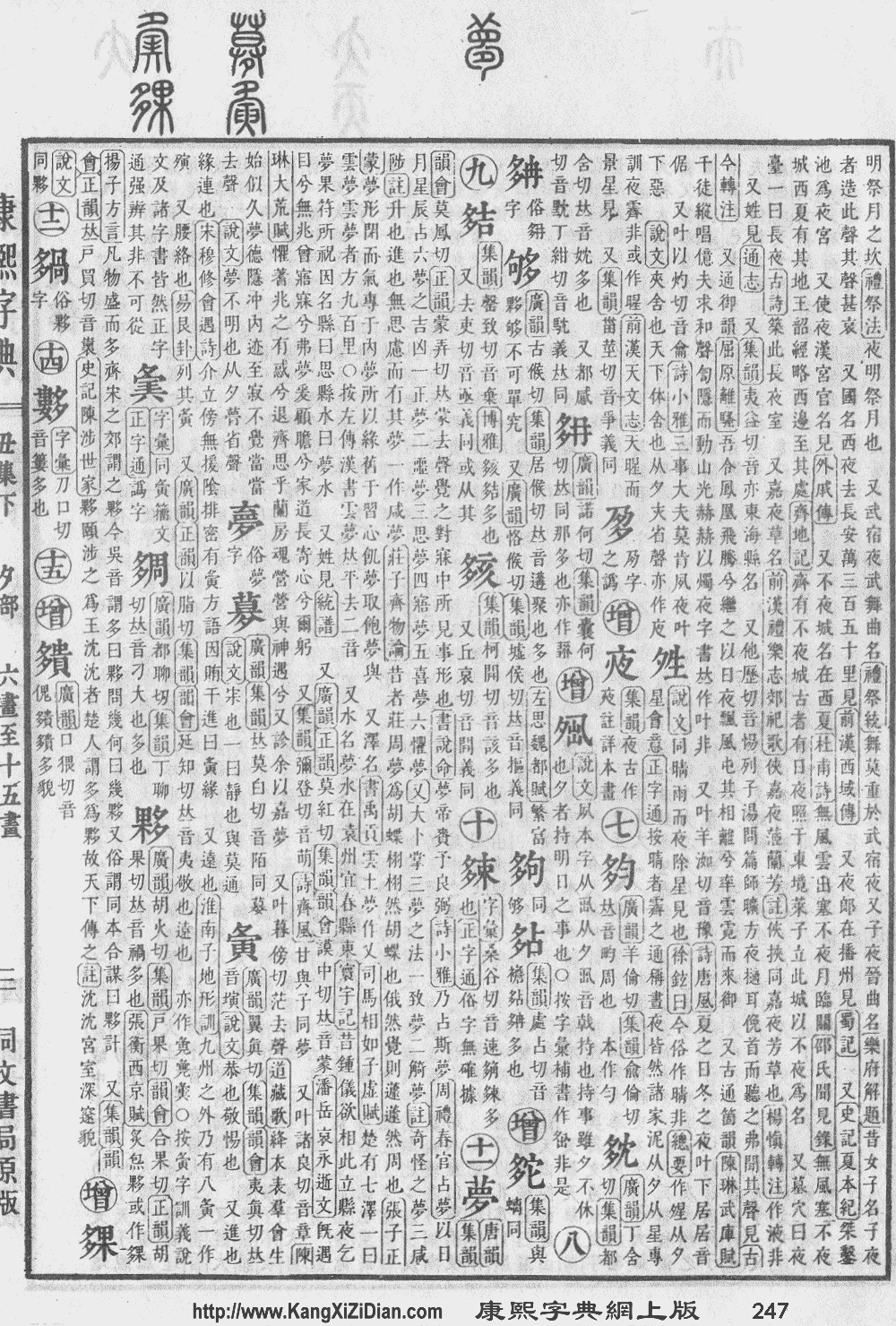
- KangXi: page 247, character 16
- Dai Kanwa Jiten: character 5801
- Dae Jaweon: page 492, character 6
- Hanyu Da Zidian: volume 2, page 864, character 19
- Unihan data for U+5922
Chinese
| trad. | 夢 | |
|---|---|---|
| simp. | 梦 | |
Glyph origin
| Characters in the same phonetic series (夢) (Zhengzhang, 2003) | |
|---|---|
| Old Chinese | |
| 蘉 | *maːŋ |
| 瞢 | *mɯːŋ, *mɯŋ, *mɯŋs |
| 懜 | *mɯːŋs, *mɯːŋ, *mɯŋ |
| 懵 | *mɯːŋs, *mɯːŋʔ |
| 甍 | *mrɯːŋ |
| 薨 | *hmɯːŋ |
| 夢 | *mɯŋ, *mɯŋs |
| 鄸 | *mɯŋs |
Oracle bone script: Pictogram (象形) – a person lying on a bed, with restless hands.
Shuowen: Phono-semantic compound (形聲, OC *mɯŋ, *mɯŋs) : phonetic 瞢 (OC *mɯːŋ, *mɯŋ, *mɯŋs) + semantic 夕.
Pronunciation
Definitions
夢
- dream
- 我尋晚發咗個夢,係關於你嘅。喺夢裡面我見到你同我一齊健身。 [Cantonese, trad.]
- Ngo5 cam4 maan5 faat3 zo2 go3 mung6, hai6 gwaan1 jyu1 nei5 ge3. Hai2 mung6 leoi5 min6 ngo5 gin3 dou3-2 nei5 tung4 ngo5 jat1 cai4 gin6 san1. [Jyutping]
- This morning I had a dream about you. In the dream, I saw you working out with me.
我寻晚发咗个梦,系关于你嘅。喺梦里面我见到你同我一齐健身。 [Cantonese, simp.]
- to dream; to have dreams
- (figuratively) dream; aspiration; ambition; goal
- visionary; imaginary; wishful
- A surname.
Compounds
|
|
|
Japanese
Kanji
Readings
Compounds
Etymology 1
| Kanji in this term |
|---|
| 夢 |
| ゆめ Grade: 5 |
| kun’yomi |
/ime/ → /yume/
Shift from Old Japanese ime (see below).[1][2]
The /i/ → /yu/ shift is common in Middle Japanese, seen in 言う (iu → yuu, “to speak”) and 行く (iku → yuku, “to go”).
Pronunciation
Noun
Derived terms
Proverbs
- 夢に夢見る (yume ni yumemiru)
- 夢の夢 (yume no yume), 夢のまた夢 (yume no mata yume)
- 夢は逆夢 (yume wa sakayume)
- 南柯の夢 (nanka no yume)
Etymology 2
| Kanji in this term |
|---|
| 夢 |
| いめ Grade: 5 |
| kun’yomi |
⟨i me2⟩ → */iməj/ → /ime/
From Old Japanese, first attested in the Kojiki (712 CE).
Originally a compound of 寝 (i, “sleep, sleeping”) + 目 (me, “eye”).
Noun
- (archaic) a dream
References
Korean
Alternative forms
Hanja
夢 • (mong) (hangeul 몽)
- This term needs a translation to English. Please help out and add a translation, then remove the text
{{rfdef}}.
Vietnamese
Han character
夢 (mộng, mọng, mống, mồng, mòng, muống)
- This term needs a translation to English. Please help out and add a translation, then remove the text
{{rfdef}}.