鹿
| ||||||||
Translingual
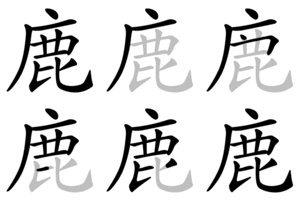
| Stroke order | |||
|---|---|---|---|
 | |||
Han character
鹿 (radical 198 鹿+0, 11 strokes, cangjie input 戈X心 (IXP), four-corner 00211)
- Kangxi radical #198, ⿅.
Derived characters
- Index:Chinese radical/鹿
- 塵
References
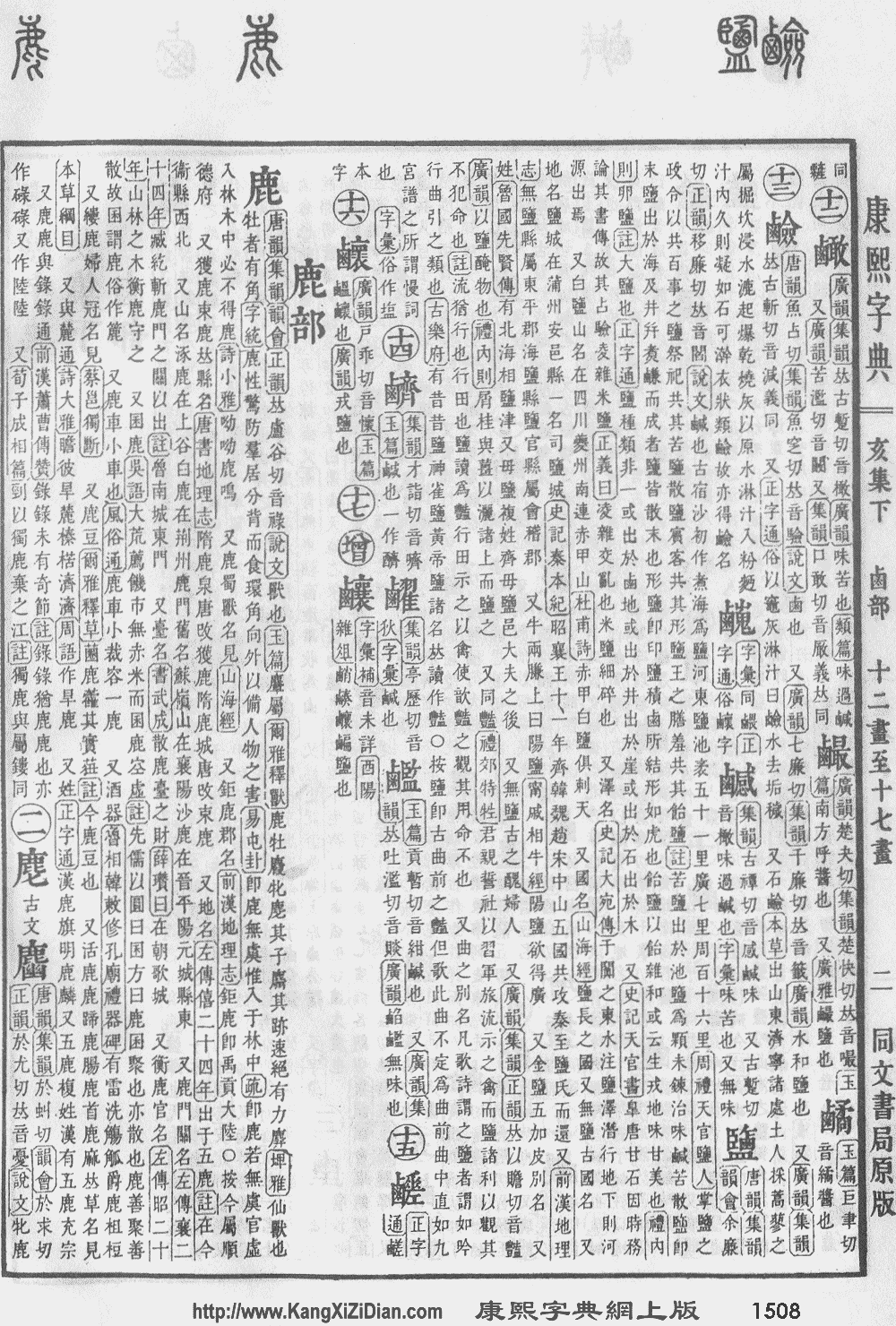
- KangXi: page 1508, character 14
- Dai Kanwa Jiten: character 47586
- Dae Jaweon: page 2036, character 14
- Hanyu Da Zidian: volume 7, page 4727, character 1
- Unihan data for U+9E7F
Chinese
| simp. and trad. |
鹿 | |
|---|---|---|
Glyph origin
| Historical forms of the character 鹿 | |||
|---|---|---|---|
| Shang | Western Zhou | Shuowen Jiezi (compiled in Han) | Liushutong (compiled in Ming) |
| Oracle bone script | Bronze inscriptions | Small seal script | Transcribed ancient scripts |
 |
 |
 |
 |
| Characters in the same phonetic series (鹿) (Zhengzhang, 2003) | |
|---|---|
| Old Chinese | |
| 鄜 | *pʰlo, *roːɡ |
| 鹿 | *b·roːɡ |
| 漉 | *roːɡ |
| 轆 | *roːɡ |
| 簏 | *roːɡ |
| 螰 | *roːɡ |
| 麓 | *roːɡ |
| 騼 | *roːɡ |
| 摝 | *roːɡ |
| 廘 | *roːɡ |
| 蔍 | *roːɡ |
| 鏕 | *roːɡ |
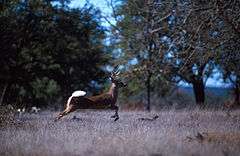
Pictogram (象形) – a deer. Current form is highly abstracted – legs have transformed to 比 – note grouping of front and rear legs, which are bent – head has transformed to middle component (similar to 凸/曲), while antlers on top and extended lip/mouth on left transformed into 广. This transformation occurred during seal characters.
Contrast the very different development of 馬 (“horse”), and the transformation in 𢊁 (as in 薦), which has the head of 鹿 but the legs of 馬 (灬).
Pronunciation
Definitions
鹿
Synonyms
- 鹿仔
Compounds
Japanese
Kanji
Readings
Compounds
Etymology 1
| Kanji in this term |
|---|
| 鹿 |
| か Grade: S |
| kun’yomi |
From Old Japanese.[1]
Pronunciation
Noun
- (archaic) deer
Derived terms
- 鹿沼 (Kanuma): Kanuma, Tochigi
Etymology 2
| Kanji in this term |
|---|
| 鹿 |
| しか Grade: S |
| kun’yomi |
/seka/ → /sika/
Originally a compound of 夫 (se, “male”) + 鹿 (ka, “deer”), in contrast to 女鹿 (meka, “female deer”, archaic).[1][2]
Pronunciation
Noun
- deer
- 奈良公園には鹿しかいない。
- Nara kōen ni wa shika shika inai.
- There is nothing but deer in Nara Park.
- 奈良公園には鹿しかいない。
Idioms
- 鹿を逐う者は山を見ず (shika o ou mono wa yama o mizu): “someone chasing a deer doesn't see the mountain” → a metaphor for how someone who is fixed on a target can be oblivious to the challenges in the way
Descendants
- → English: sika deer
Etymology 3
| Kanji in this term |
|---|
| 鹿 |
| かせぎ Grade: S |
| kun’yomi |
From the resemblance to a 桛木 (kasegi, “cross-shaped spindle; a branching point in a tree”)
Pronunciation
Noun
鹿 (hiragana かせぎ, rōmaji kasegi)
- (archaic) deer
- 1212: Hōjōki
- 山鳥のほろと鳴くを聞きても、父か母かと疑ひ、峰のかせぎの近くなれたるにつけても、世に遠ざかるほどを知る。
- Yamadori no horo to naku o kikite mo, chichi ka haha ka to utagahi, mine no kasegi no chikaku naretaru ni tsukete mo, yo ni tōzakaru hodo oshiru.
- Hearing the horo call of the mountain pheasant, wondering if it were my father or mother [calling from beyond the grave], and seeing how the deer on the ridge are so tame that they come close by, all of it shows me how far away I am from the world.
- 山鳥のほろと鳴くを聞きても、父か母かと疑ひ、峰のかせぎの近くなれたるにつけても、世に遠ざかるほどを知る。
- 1212: Hōjōki
Etymology 4
| Kanji in this term |
|---|
| 鹿 |
| かのしし Grade: S |
| kun’yomi |
Originally a compound of 鹿 (ka, “deer”) + の (no, possessive particle) + 肉 (しし, “meat, flesh”).[1][2]
Pronunciation
Alternative forms
- 鹿の肉
Noun
鹿 (hiragana かのしし, rōmaji kanoshishi)
Etymology 5
| Kanji in this term |
|---|
| 鹿 |
| しし Grade: S |
| kun’yomi |
From 肉 (shishi, “meat, flesh”).[1][2]
Pronunciation
Alternative forms
Noun
鹿 (hiragana しし, rōmaji shishi)
- (archaic) a beast (used for its meat, such as a boar or a deer)
- short for 猪武者 (inoshishi musha): a reckless warrior
- short for 鹿狩り (shishi-gari): a deer hunter
- (slang) a female attendant at a bathhouse or hot spring
- (slang, archaic) a female prostitute at a bathhouse or hot spring
Usage notes
The beast sense is more commonly spelled 獣.
Etymology 6
| Kanji in this term |
|---|
| 鹿 |
| ろく Grade: S |
| on’yomi |
From Middle Chinese 鹿 (luwk, “deer”). Compare modern Min Nan reading lo̍k.
Pronunciation
Noun
References
- Ichiko, Teiji (1212) Hōjōki (Shintei), Iwanami Shoten, published 1989, →ISBN
- Nishio, Minoru (1957) Nihon Koten Bungaku Taikei: Hōjōki, Tsurezuregusa, Iwanami Shoten, →ISBN
Korean
Hanja
鹿 • (rok, nok) (hangeul 록, 녹, revised rok, nok, McCune–Reischauer rok, nok, Yale lok, nok)
- This term needs a translation to English. Please help out and add a translation, then remove the text
{{rfdef}}.
Vietnamese
Han character
- This term needs a translation to English. Please help out and add a translation, then remove the text
{{rfdef}}.