家
| ||||||||
Translingual
| Stroke order | |||
|---|---|---|---|
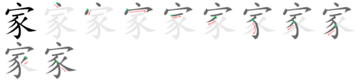 | |||
| Stroke order | |||
|---|---|---|---|
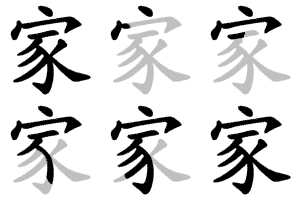 | |||
Han character
家 (radical 40, 宀+7, 10 strokes, cangjie input 十一尸人 (JMSO), four-corner 30232, composition ⿱宀豕)
Derived characters
References
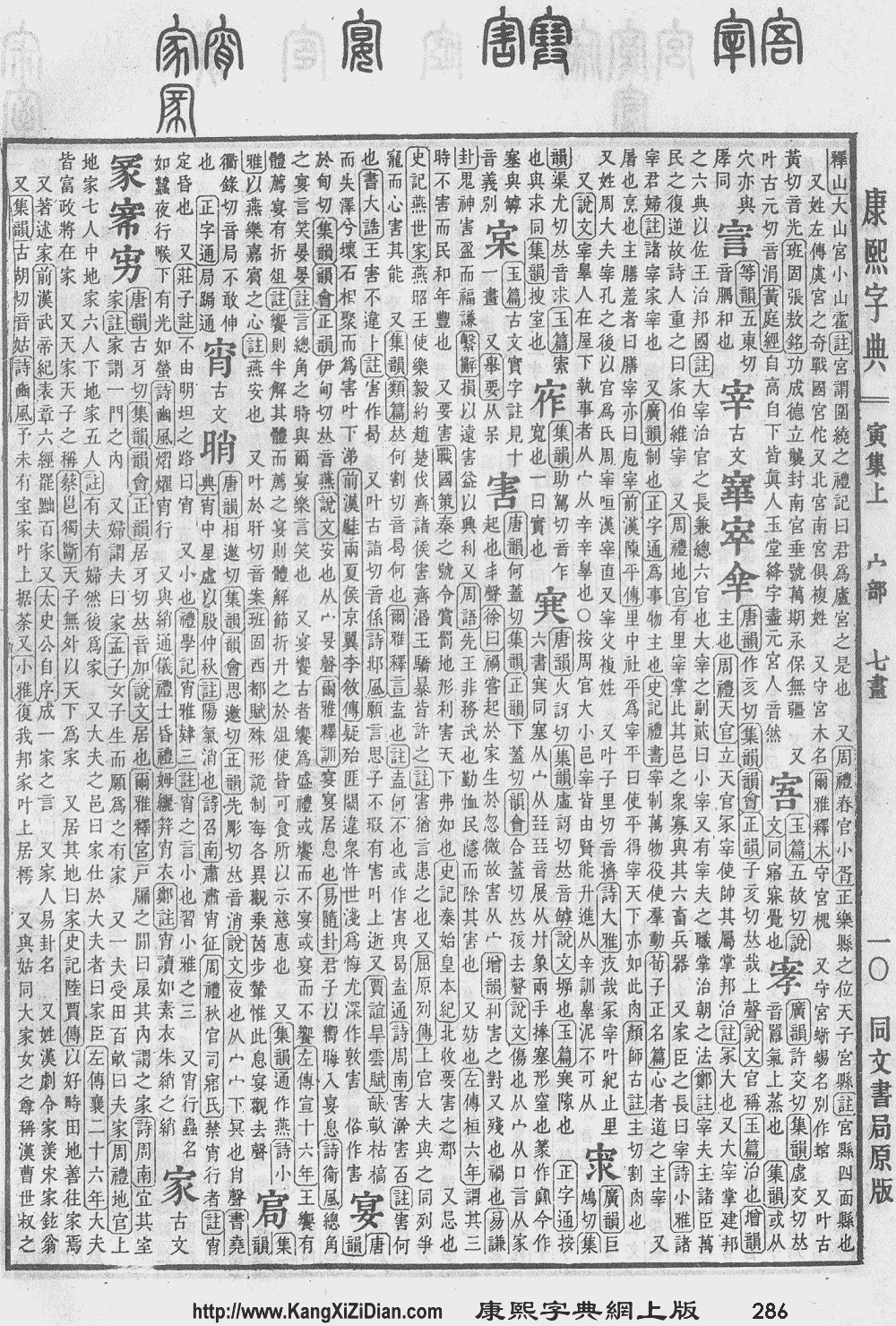
- KangXi: page 286, character 17
- Dai Kanwa Jiten: character 7169
- Dae Jaweon: page 566, character 3
- Hanyu Da Zidian: volume 2, page 930, character 15
- Unihan data for U+5BB6
Chinese
| simp. and trad. |
家 | |
|---|---|---|
Glyph origin
| Historical forms of the character 家 | |||
|---|---|---|---|
| Shang | Western Zhou | Shuowen Jiezi (compiled in Han) | Liushutong (compiled in Ming) |
| Oracle bone script | Bronze inscriptions | Small seal script | Transcribed ancient scripts |
 |
 |
 |
 |
| Characters in the same phonetic series (家) (Zhengzhang, 2003) | |
|---|---|
| Old Chinese | |
| 家 | *kraː |
| 傢 | *kraː |
| 幏 | *kraː, *kraːs |
| 稼 | *kraːs |
| 嫁 | *kraːs |
Phono-semantic compound (形聲, OC *kraː) : semantic 宀 (“roof”) + phonetic 豕 (“pig”).
豕 is an abbreviation of 豭 (OC *kraː, “male pig, boar”) (Shuowen Jiezi), a homophone of 家 in Old Chinese. See 豭 for more on the glyph composition.
Pronunciation
Definitions
家
- home
- house
- family; household
- (polite, for family member) my
- domesticated; domestic
- Classifier for families, businesses and companies.
- school of thought; philosophical school
- Suffix denoting a person with a certain occupation or social standing. -er
- Suffix denoting specialist in a certain activity or field. -ist; -er
- A surname.
Synonyms
| Dialectal synonyms of 家 (“home”) [map] | ||
|---|---|---|
| Variety | Location | Words |
| Classical Chinese | 家 | |
| Formal (Written Standard Chinese) | 家 | |
| Mandarin | Beijing | 家 |
| Taiwan | 家 | |
| Tianjin | 家 | |
| Jinan | 家 | |
| Xi'an | 家、屋 | |
| Wuhan | 屋裡、家 | |
| Chengdu | 屋頭、家 | |
| Yangzhou | 家、家頭 | |
| Hefei | 家 | |
| Cantonese | Guangzhou | 屋企 |
| Hong Kong | 屋企 | |
| Taishan | 企 | |
| Gan | Nanchang | 屋裡 |
| Hakka | Meixian | 屋下 |
| Miaoli (N. Sixian) | 屋下 | |
| Liudui (S. Sixian) | 屋下 | |
| Hsinchu (Hailu) | 屋下 | |
| Dongshi (Dabu) | 屋家 | |
| Zhuolan (Raoping) | 屋下 | |
| Yunlin (Zhao'an) | 屋下 | |
| Jin | Taiyuan | 家 |
| Min Bei | Jian'ou | 厝 |
| Min Dong | Fuzhou | 厝 |
| Min Nan | Xiamen | 厝、兜 |
| Quanzhou | 厝、兜 | |
| Zhangzhou | 厝、兜 | |
| Chaozhou | 裡 | |
| Wu | Suzhou | 屋裡 |
| Wenzhou | 屋裡、屋底、底转 | |
| Xiang | Changsha | 屋裡 |
| Shuangfeng | 屋裡 | |
| Dialectal synonyms of 房子 (“house”) [map] | ||
|---|---|---|
| Variety | Location | Words |
| Classical Chinese | 屋、房 | |
| Formal (Written Standard Chinese) | 房子 | |
| Mandarin | Beijing | 房子 |
| Taiwan | 房子 | |
| Tianjin | 房子 | |
| Jinan | 房子、屋 | |
| Xi'an | 房 | |
| Wuhan | 屋、房子 | |
| Chengdu | 房子 | |
| Yangzhou | 房子 | |
| Hefei | 屋、房子 | |
| Cantonese | Guangzhou | 屋 |
| Hong Kong | 屋 | |
| Taishan | 屋 | |
| Gan | Nanchang | 房子、屋 |
| Hakka | Miaoli (N. Sixian) | 屋仔 |
| Liudui (S. Sixian) | 屋仔 | |
| Hsinchu (Hailu) | 屋仔、屋 | |
| Dongshi (Dabu) | 屋 | |
| Zhuolan (Raoping) | 屋 | |
| Yunlin (Zhao'an) | 屋 | |
| Jin | Taiyuan | 房子 |
| Min Bei | Jian'ou | 厝 |
| Min Dong | Fuzhou | 厝 |
| Min Nan | Xiamen | 厝 |
| Quanzhou | 厝 | |
| Zhangzhou | 厝 | |
| Taipei | 厝 | |
| Penang | 厝 | |
| Philippines (Manila) | 厝 | |
| Chaozhou | 厝 | |
| Wu | Shanghai | 房子 |
| Suzhou | 房子 | |
| Wenzhou | 屋宕 | |
| Xiang | Changsha | 屋 |
| Shuangfeng | 屋 | |
Compounds
Derived terms from 家
|
|
|
Japanese
Kanji
家
Readings
Compounds
Etymology 1
| Kanji in this term |
|---|
| 家 |
| いえ Grade: 2 |
| kun’yomi |
/ihe1/: [ie] ← [iwe] ← [iɸe] ← [ipe], possibly from Proto-Altaic *ibe (compare Proto-Turkic *eb (“house”) (Turkish ev)).
Possibly related to 廬 (io, “temporary hut”).
Pronunciation
Noun
家 (hiragana いえ, rōmaji ie, historical hiragana いへ)
- a house
- one's own home
- a home; a household
- Yamazaki, Kore, “第1篇 April showers bring May flowers. [Composition 1: April showers bring May flowers.]”, in 魔法使いの嫁 [The Ancient Magus’ Bride], volume 1 (fiction, in Japanese), Tokyo: Mag Garden, page 17:
- ここが僕の家 そして今日から君が暮らす家でもある
- Koko ga boku no ie Soshite kyō kara kimi ga kurasu ie de mo aru
- This is my home. From now on, you will live here, too.
- ここが僕の家 そして今日から君が暮らす家でもある
-
- a family
- 1996 September 15, Adachi, Mitsuru, “5×4P 第1話 お茶をにごす [5×4P Chapter 1: Tea-Bragging]”, in SHORT PROGRAM [SHORT PROGRAM], volume 2 (fiction, in Japanese), Tokyo: Shogakukan, →ISBN, page 104:
- あ———
- A———
- Ah———
- Dōshita no Sachiko?
- What is it, Sachiko?
- Omoidashita. Uchi no otō-san da wa, ano hito——
- I remember now. That guy—— is my father
- A——
- Oh——
- あ———
-
Suffix
- (as suffix) an expert, professional, performer
Etymology 2
| Kanji in this term |
|---|
| 家 |
| うち Grade: 2 |
| kun’yomi |
Cognate with 内 (uchi).
Pronunciation
Noun
- a house
- one's house
Descendants
- English: hooch
Suffix
- a suffix representing relationship to a family
- 平家
- taira-ke
- the Taira family
- 平家
Etymology 3
A contraction of uchi → chi. Often following the genitive case marker no which contracts to n.
Noun
- house
- 俺ん家に来ない?
- Ore n chi ni konai?
- Wanna come to my place?
- 俺ん家に来ない?
| Kanji in this term |
|---|
| 家 |
| や Grade: 2 |
| kun’yomi |
Pronunciation
Noun
- house
Suffix
- house of something, place where some business is conducted
- person who does that thing
See also
References
Korean
Hanja
- home; family; household
Compounds
Okinawan
Kanji
Compounds
Noun
Derived terms
Vietnamese
Han character
- This term needs a translation to English. Please help out and add a translation, then remove the text
{{rfdef}}.
Yonaguni
Kanji
Noun
This article is issued from
Wiktionary.
The text is licensed under Creative Commons - Attribution - Sharealike.
Additional terms may apply for the media files.