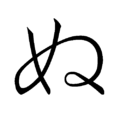
ぬ
 | ||||||||
Japanese
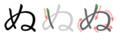
| Stroke order | |||
|---|---|---|---|
 | |||
Pronunciation
- IPA(key): [nɯ̟ᵝ]
Etymology 1
Derived in the Heian period from writing the man'yōgana kanji 奴 in the cursive sōsho style.
Syllable
ぬ (romaji nu)
- The hiragana syllable ぬ (nu). Its equivalent in katakana is ヌ (nu). It is the twenty-third syllable in the gojūon order; its position is な行う段 (na-gyō u-dan, “row na, section u”).
See also
Etymology 2
From Old Japanese.[1][2][3]
Many monolingual Japanese dictionaries[1][2][3] derive this as a contraction of Old Japanese 往ぬ (inu, “to go away; to pass (such as time); to pass away, to die”); however, the meaning does not seem to make sense in the context of the verb ending -nu.
More recent work by Bjarke Frellesvig and others suggests that -nu may have originated from an ancient copular or stative verb.
Suffix
ぬ (rōmaji -nu)
- marks the end of action:
- (after the 未然形 (mizenkei, “incomplete form”) of a verb) the negative: indicates negation of the action, ending without starting or occurring -- not
- 風が立たぬ
- kaze ga tatanu
- the wind does not rise / does not pick up
- 風が立たぬ
- (after the 連用形 (ren'yōkei, “continuative or stem form”) of verb) the perfective: indicates completion of the action, ending after starting or occurring -- has done, has happened
- 風が立ちぬ
- kaze ga tachinu
- the wind has risen / has picked up
- 風が立ちぬ
- (after the 未然形 (mizenkei, “incomplete form”) of a verb) the negative: indicates negation of the action, ending without starting or occurring -- not
Usage notes
In Old Japanese and continuing in classical and later Japanese, the ending -nu and the ending -ta have both been used to mark the completion of an action, with two key differences:
- -ta was not used after the 未然形 (mizenkei, “incomplete form”) of a verb, and thus was not used in negation contexts
- -nu was used mainly for verbs that indicated intransitive, naturally occurring, or unintentional actions, while -ta was used mainly for verbs that indicated transitive or intentional actions.
In modern Japanese, -nu is rarely encountered, and it often imparts a formal or archaic sense.
Synonyms
(negative verb ending):
- (very casual, also archaic, also dialectal) ん (n)
- (casual) ない (nai)
- (formal) ません (masen)
- (written formal) ず (zu)
- (Kansai) へん (hen)
(perfective verb ending):
- (casual) た (ta)
- (formal) ました (mashita)
References
Okinawan
Etymology
Cognate with mainland Japanese の (no).
Particle
ぬ (romaji nu)
- possessive particle